Honda Amaze 1.2 Comfort CVT (2026) Review

A comfortable and sensibly engineered small sedan whose reliability and resale prospects justify its premium, despite modest performance and several irritating equipment omissions.
Introduction
Buy the Honda Amaze if proven mechanicals and Honda’s long local history matter more than scoring the lowest sticker price. That’s the central question in this Honda Amaze review: do reliability and resale justify spending more than you would on a Suzuki Dzire? Honda has quietly sold this nameplate on our shores since 2013, giving it an established used-market record. As of 2026, small sedans are finding fresh favour with e-hailing operators and cost-conscious families. The Amaze wants a slice. To be honest, it deserves consideration.
Key takeaway: The Amaze costs more than a Dzire, but counters with proven mechanicals, stronger outputs and the ownership confidence attached to the Honda badge.
Design & Exterior
Nobody buys an Amaze for pavement theatre. Honda knows this. The current Amaze II facelift remains a neat three-box sedan at 3,995 mm long, riding on a 2,470 mm wheelbase. It’s compact enough for tight Braamfontein parking bays, yet avoids looking like a hatchback with a boot hastily attached.
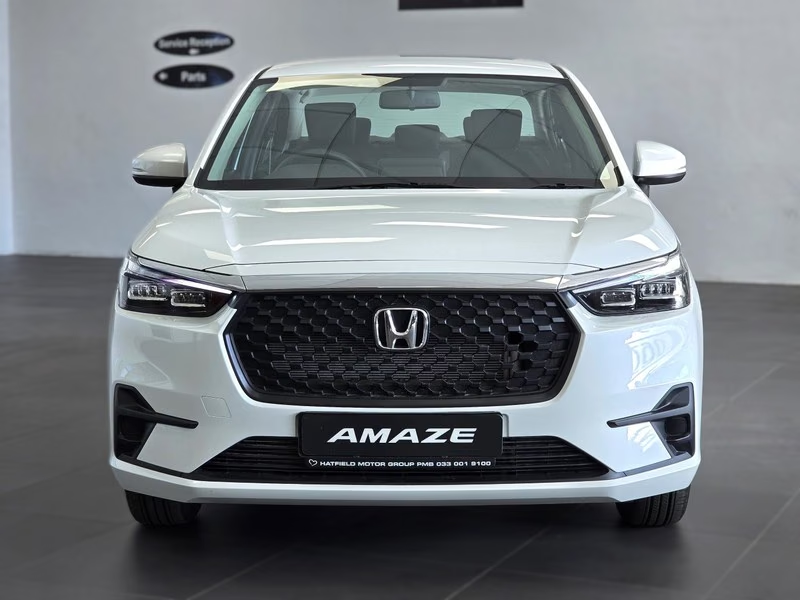
Up front, the styling is cleaner and the chrome hasn’t been applied with a garden hose. It looks entirely at home on the school run, which is probably more relevant than impressing anyone outside a design studio. The 15-inch alloys wear 185/60 R15 rubber, a sensible combination that copes well with pothole-scarred Joburg roads and rougher suburban tarmac.
Compared with the Dzire’s brighter, more chrome-heavy face, the Amaze keeps things restrained. Five years from now, that conservative shape should still look composed on a dealer’s used-car floor.
Cabin & Practicality
Cabin execution is where the Honda Amaze interior rises above its budget billing. Honda has borrowed a few cues from the Civic, particularly in the orderly layout and reassuring action of the switchgear.
Materials and layout
Dark cloth trim makes sense in a family or e-hailing car destined to collect biscuit crumbs, school bags and gravel dust. Build quality feels better than the price suggests. An 8-inch touchscreen provides wireless Apple CarPlay and Android Auto, while the top Comfort trim gains wireless charging, push-button start and a six-speaker system.
Space and boot
Rear legroom is properly competitive, even with taller adults up front, and the boot is usefully shaped rather than merely impressive on paper.
- Boot capacity: 416 litres, enough for two people’s weekend luggage, with room for a few soft bags.
- Kerb weight: roughly 950 kg, which helps the modest engine feel willing.
- Six airbags on the Comfort trim, versus two on the entry Trend.
Now for the grumbles. No local variant gets cruise control, and driver-assistance equipment remains absent even from the range-topper. Overseas Amazes offer more. South African buyers simply go without, which is difficult to excuse at this price.
On the Road
Underneath the bonnet is a 1.2-litre naturally aspirated i-VTEC four, producing 66 kW and driving through a CVT with seven simulated steps and paddle shifters. No turbo. No dual-clutch gearbox. Very little mechanical complication, which is precisely the attraction.
Around town
Stop-start traffic suits the CVT. It delivers power smoothly, keeps the engine settled and removes much of the irritation from a slow urban commute. Performance is unhurried, but the Amaze seldom feels troubled by the task.
On the open road
It is in these conditions that a vehicle’s true character is exposed. Once clear of the traffic on the N1, the Amaze settled into an easy cruise and held its line without needing constant steering corrections. Ask for more speed to get past slower traffic and the CVT sends the revs climbing, with quite a bit of noise to go with it. Wind and tyre noise also become noticeable at speed.
Still, the car feels solid and the suspension handles broken tarmac with more composure than many budget rivals. A short stretch of gravel also failed to unsettle it, with the body remaining controlled and the ride pleasantly pliant.
I completed one 400 km loop expecting the Amaze to bore me rigid. Instead, it did not disappoint on comfort, although the engine never encouraged me to chase the upper reaches of the rev counter.
Data & Comparison
Right, so let’s discuss money. The Honda Amaze price will decide whether its ownership argument lands or falls flat.
Pricing across the range
- Trend MT: from around R254,900.
- Comfort MT: around R274,900.
- Comfort CVT (as tested): around R294,900, the range-topper.
Running costs and economy
Honda claims 5.5 L/100 km. Independent testing returned roughly 6.4 to 6.7 L/100 km across mixed local driving, including congestion and open-road running. Budget according to the higher figure, especially if your routine involves a full car, highway climbs and regular overtaking.
- Claimed economy: 5.5 L/100 km.
- Real-world: about 6.5 L/100 km.
- Estimated 5-year cost of ownership: around R230,000.
Aftersales
Aftersales support is a strong part of the pitch. The Amaze includes a 5-year/200,000 km warranty, a 4-year/60,000 km service plan (doubled from the old two-year plan) and 3 years of roadside assistance. For a challenger in a price-sensitive class, that cover carries real weight.
How it compares on power
Placed alongside larger cars available for similar money, the Amaze’s output looks modest. Its 66 kW sits below both examples here, although this is not a like-for-like comparison of new rivals.
| Model | Power (kW) | Avg price (R) | Fuel |
|---|---|---|---|
| Honda Amaze 1.2 i-VTEC CVT | 66 | ~294,900 | Petrol |
| Mazda 3 1.5 Skyactiv-G | 88 | 279,613 | Petrol |
| BMW 318i Steptronic (used) | 100 | 273,466 | Petrol |
Your more realistic comparison is the Suzuki Dzire, which undercuts the Amaze and speaks to the same practical, value-driven buyer.
Editorial Focus
Here’s the real contest: Amaze reliability and resale against the cheaper Dzire. My view isn’t quite as simple as the price lists suggest.
Suzuki’s Dzire starts from roughly R229,900, claims about 4.4 L/100 km and provides a 378-litre boot. For buyers led entirely by the calculator, it is cheaper and more frugal on paper. Clear win.
Both cars now offer identical headline aftersales cover: a 5-year/200,000 km warranty and a 4-year/60,000 km service plan. That removes what might previously have been a Suzuki advantage. Honda therefore needs to earn its premium elsewhere, and it mostly succeeds in three areas.
First up is the engine. The 1.2 i-VTEC is a proven, low-complexity, naturally aspirated unit with stronger outputs than most direct rivals and no turbocharger to fret about at 180,000 km. Then there’s the cabin, which feels a class above and should remain appealing to the next owner. Most persuasive, though, is Honda’s footprint. It has sold the Amaze locally for over a decade, and used-car buyers recognise the badge and nameplate. That established history offers some reassurance, even if it cannot guarantee what the car will fetch when you sell it.
My verdict is straightforward. The Dzire remains the cheaper buy, while the Amaze makes a persuasive case for long-term ownership. Pay extra if you keep cars for years and value its cabin, proven mechanicals and established local history.
Verdict
Unflashy by design, the Amaze quietly performs above its budget-car reputation. It rides with maturity over poor surfaces, feels surprisingly polished inside and brings proven mechanicals backed by a long local history. The modest powertrain remains its obvious weakness, while the absence of cruise control hurts on long highway journeys. Drive the CVT before committing.
Buy it: Long-term owners and families who place cabin quality, proven mechanicals and ownership confidence above the cheapest sticker price.
Shortlist it: E-hailing operators seeking Honda durability and generous cover, provided the running-cost sums still work against the cheaper Dzire.
Wait: Regular highway commuters who consider cruise control essential may want to hold off and see what a future South African specification brings.
Walk away: Bargain hunters focused solely on the lowest price and strongest claimed economy will probably be happier with a Dzire.
Summary
Here’s the Honda Amaze 1.2 i-VTEC CVT as South African buyers will experience it: sensible, comfortable and reassuringly familiar. We cover the drive, ownership costs, cabin and its reliability and resale prospects against the Suzuki Dzire.
Ratings
Pros
- ✓Long-term owners and families who place cabin quality, proven reliability and resale confidence above the cheapest sticker price.