Toyota Etios sedan 1.5 Xi (2016) Review

– Honest, tough, cheap to keep, and unbeatable for spares—loses marks for ergonomic oddities, missing safety gear and a cabin that feels every cent of its sticker price.
Introduction
Right, so you want the least stressful way into Toyota ownership. Parts stacked from Durban to Upington, and almost any Midas or Goldwagen in Joburg ready to help if something gives. The Etios 1.5 Xi 5Dr still makes sense as a used buy in 2024. Forget thrills. It was never about that. Between 2012 and 2020, the Etios replaced the Tazz for Toyota SA, chasing rental fleets and first-time buyers who made that badge a household name. This review locks onto the entry Xi hatch, because that’s the one most South Africans actually drive - whether it’s yours, a friend’s, or the keys you get at OR Tambo’s Avis counter for the umpteenth time.
Key takeaway: If Toyota parts access and simple mechanics matter more than features or style, the Etios 1.5 Xi is still the safest, simplest used buy under R130k right now.
Design & Exterior
Form follows fleet
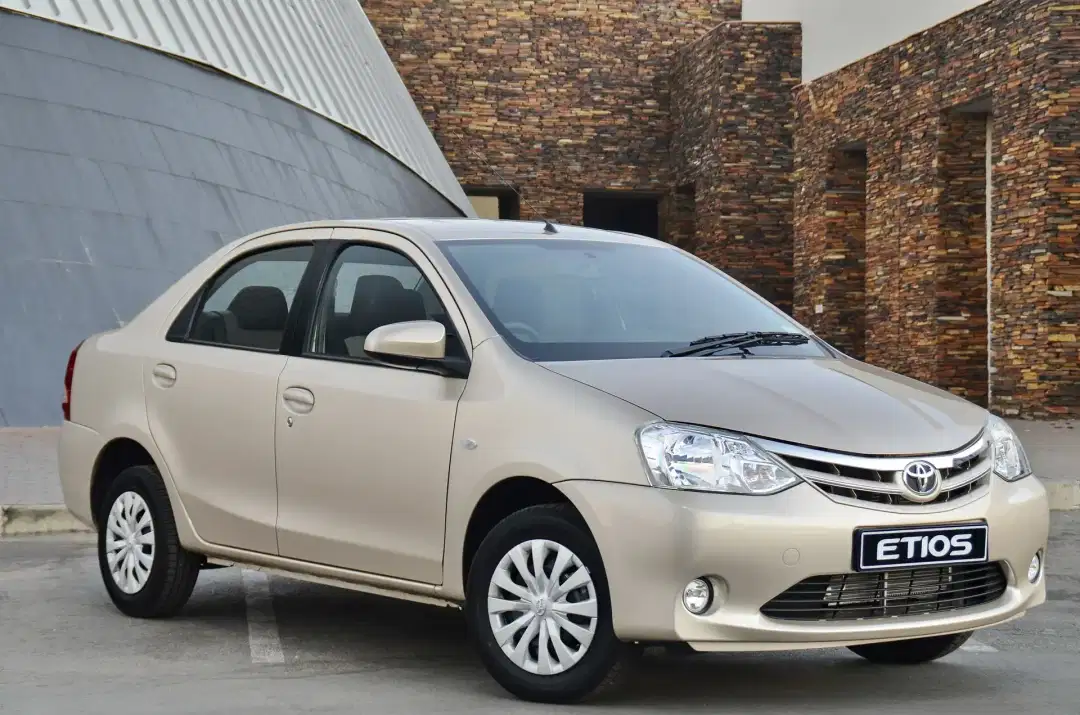
No one’s confusing the Etios hatch for something aspirational. It’s 3,775 mm long, 1,695 mm wide, 1,510 mm tall - pure function in every panel. Tall glass, upright pillars, a narrow track that makes the wheels look bashful. Steelies with plastic covers, basic halogen headlamps, body-coloured bumpers. No fogs, no chrome, zero pretense. It’s honest about what it is.
Stance and proportions
Rides tall, and that’s not for show. The Etios clears 154 mm off the tar, and that’s a lifesaver for South African roads and urban kerbs. More than most B-segment hatches, so you don’t need to crawl over speed bumps on the R21 near Kempton Park like you might in a Polo Vivo. The wheels look lost, granted, but after a weekend on chewed-up gravel near Mokopane, I was grateful for every extra millimetre. One big pothole outside Klerksdorp and you’ll appreciate it too.
Cabin & Practicality
Layout and ergonomics
Let’s talk about the cabin, because it’s weird. Toyota chucked the instrument cluster in the middle of the dash. Might sound funky, but in practice, it’s just awkward - every speed check sends your eyes off the road. Steering only adjusts for height, no audio buttons, and you get two keys: one for ignition, one for the remote. Not dealbreakers at R110k, but you want to live with these before buying. The first time I drove one at night on the N1, that centre cluster glow took some getting used to.
Materials and kit on Xi
Xi spec means basic. Here’s what you get:
- Manual air-con
- Electric windows, all doors
- Bluetooth, USB, aux audio
- Twin front airbags, ABS with EBD, ISOFIX points
- Three-point belts for all seats, including rear centre
- Remote central locking (but on a separate fob)
No alloys, no fogs, no multi-function wheel, no rear sensors, no stability control, no cruise. Hard plastics everywhere, barely textured, but tough. After 80,000 km, most still look fine - better than some German rivals at twice the price. That’s the rental DNA showing its value.
Space and the boot question
Rear legroom? Genuinely good. Two adults fit behind two adults - rare in this league. For Toyota Etios boot space, the hatch manages groceries and weekend bags, but the sedan’s 595 litres (including a full-size spare) is on another level. Fold the rear bench in the 5Dr Xi (post-2017 facelift cars got split folding; pre-facelift sedans did not - so check) and a Makro run is easy, if you pack smart.
On the Road
The 1.5 petrol in real conditions
Under the bonnet: 2NR-FE 1.5L petrol, 66 kW and 132 Nm, 5-speed manual. On paper at least, those numbers are forgettable, but because the car is light, they work. Independent figures clocked a 0-100 km/h sprint at 10.57 seconds at sea level. That’s actually quicker than Toyota’s own claim, and more than most buyers will ever need. At altitude - think N3 up past Villiers - you’ll lose about 15 percent off the line, so overtakes need a downshift and patience.
Ride and steering
Ride comfort is the Etios’s secret weapon. Soft springs, budget dampers, and a compliance that just shrugs off battered tar between Bloem and Kimberley. Cars costing twice as much sometimes can’t match it. Steering? Light and vague, but with a tight 9.6 m turning circle - parking at Sandton City becomes a non-issue. Long-throw but positive gear shifts, forgiving clutch. Even a learner won’t stall in M1 morning traffic.
Fuel and range
Toyota claims 6.0 L/100 km. In my mixed Highveld week, I averaged 6.8 L/100 km - still good for about 650 km before the reserve light appears from the 45-litre tank. If you’re clocking 4,000 km a month as a courier or Uber driver, that’s gold. Most of your spend is on petrol, and the Etios keeps more of it in your pocket than you’d think.
Data & Comparison
The numbers that count
| Spec | Toyota Etios 1.5 Xi 5Dr | VW Polo Vivo 1.4 Trendline | Renault Sandero 900T Expression |
|---|---|---|---|
| Power (kW) | 66 | 55 | 66 |
| Torque (Nm) | 132 | 130 | 135 |
| Claimed fuel (L/100 km) | 6.0 | 5.7 | 5.2 |
| Gearbox | 5MT | 5MT | 5MT |
| Stability control | No | No | No |
Ownership and TCO
Five-year total cost of ownership for the Etios sits at around R377,000 for fuel, servicing, tyres, and insurance - noticeably lower than most B-segment competition. The original warranty was 3 years/100,000 km, and the Toyota Etios service plan South Africa ran for 2 or 3 years/30,000 km with 10,000 km intervals. Most are now out of plan, so budget R1,800–R2,400 for a minor service at a Toyota dealer, or less if you use a trusted indie workshop.
Parts, problems and used prices
Here’s the clincher: parts. The Toyota Etios parts catalogue South Africa is legendary. Toyota SA supported the car for eight years, and the 2NR-FE engine shares hardware with other models. Walk into any Goldwagen or Midas and you’ll usually find what you need. A replacement Toyota Etios battery price South Africa? R1,200–R1,800. That’s average for this class and a fraction of what newer tech costs.
Common Toyota Etios problems are minor, mostly cosmetic or wear-and-tear:
- Door handle and lock cylinder wear, especially on ex-fleet units
- Rear shocks fading after 120,000 km
- Aircon condenser stone damage (the grille is very open)
- Dashboard rattles, mainly around the centre cluster
- Clutch master cylinder weeping after 150,000 km
Toyota Etios Cross problems are a different story - mostly for the Indian market. The local hatch and sedan share all the important bits. The Toyota Etios sedan 1.5 Xi review South Africa? Same power, bigger boot, a touch more stability at highway speeds. Otherwise, identical buying advice. Any Toyota Etios review, really, covers the hatch and sedan together.
Used pricing landscape
Toyota Etios price South Africa (used) in 2024 runs from R75,000 for high-mileage 2014–2016 ex-fleet units, up to R140,000 for late-2019 or 2020 cars with full service history. New, the Xi stickered at R197,000 when it left showrooms. Resale value is strong, and that’s the point: buyers and the market haven’t lost faith.
Verdict
The Etios 1.5 Xi 5Dr is a tool, not a toy. It moves people and cargo through a South Africa where potholes, fuel prices, and surprise repair bills keep you honest. On those terms, it absolutely nails the brief. The cabin looks cheap, the ergonomics are odd, and you’ll never love its shape. But after three years of ownership, you’ll probably have spent less than your mate with a Golf hands over just for front tyres.
Buy this if you’re a first-time driver, small business owner, student, or anyone who wants the cheapest path to Toyota reliability. If style, plush interiors, or driving feel are high on your list, look elsewhere. Here’s the scenario: stretch R30,000–R50,000 more and a used Starlet (the Etios’s Suzuki-bred successor) brings you fresher kit, better safety, and similar costs. It’s what the Etios should have been from the start…
Summary
Here’s a used-buyer guide to the Toyota Etios 1.5 Xi 5-door, written for South Africans working with a sub-R150k budget. We’re talking real-world practicality, ownership costs, local issues, and how the no-nonsense 1.5L petrol holds up on our roads in 2024—warts and all.