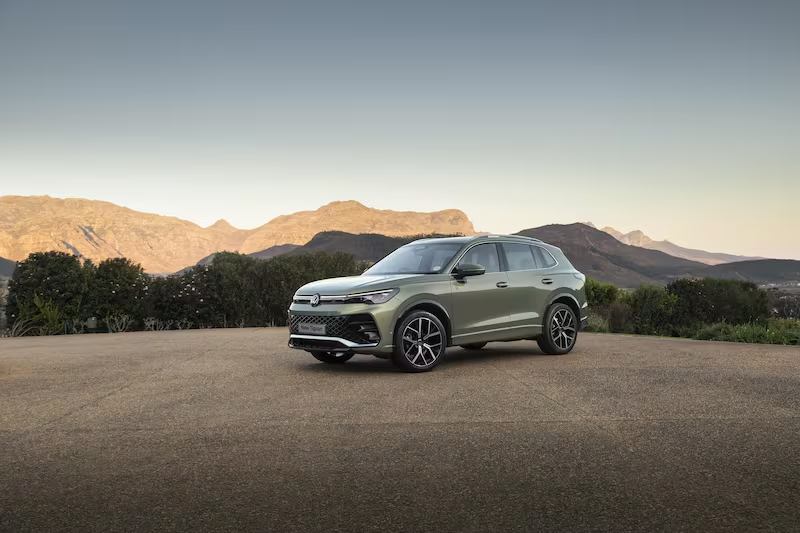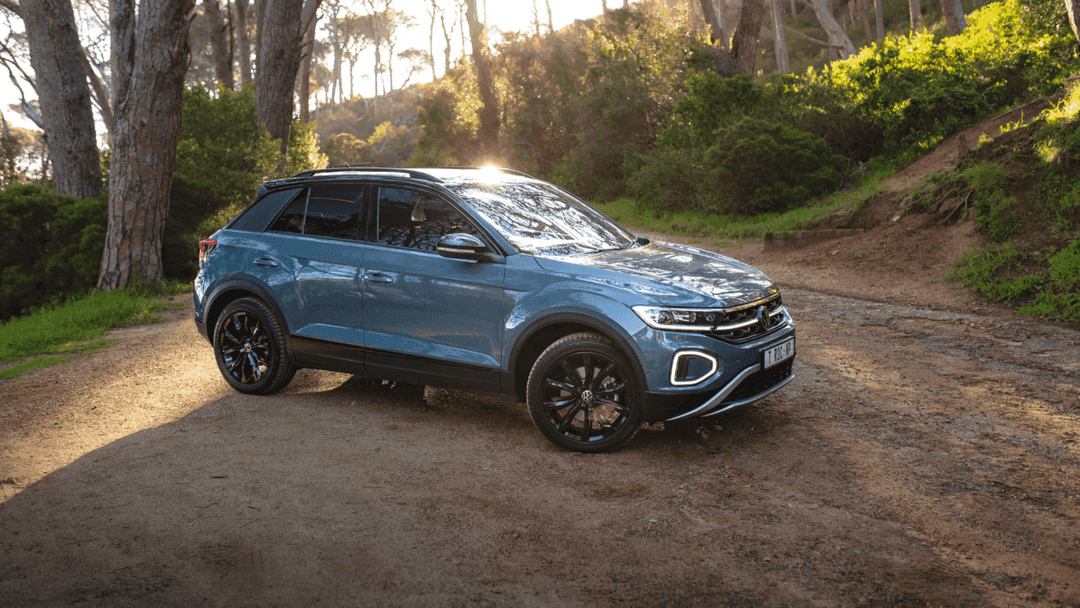
Toyota HiAce vs Volkswagen Transporter (2025)
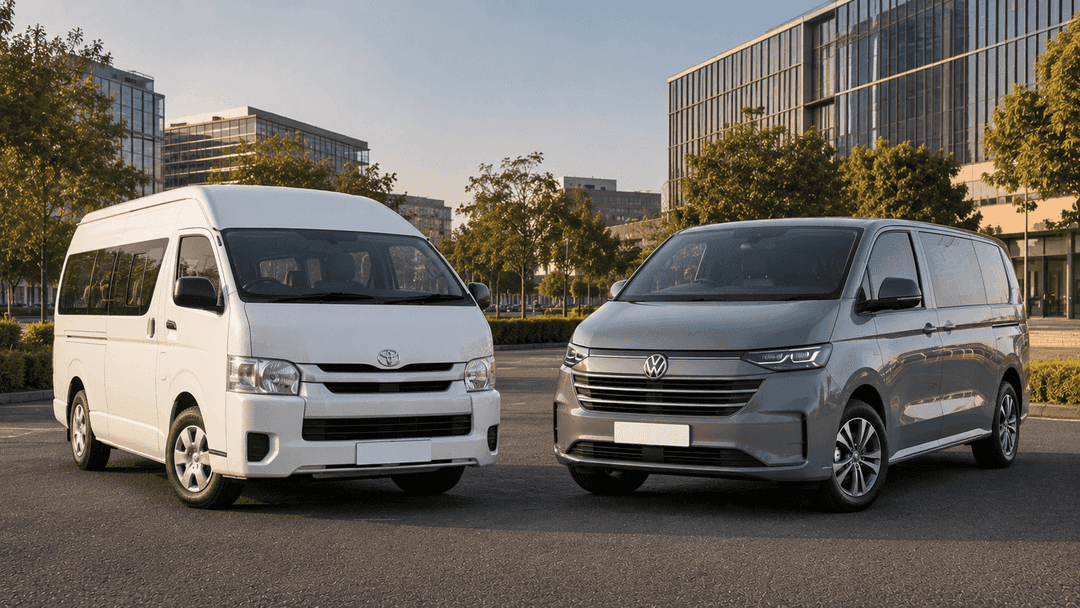
After a week in both, I’d hand the HiAce keys to any first-time operator with a set route. For anything involving long days behind the wheel, I’d take the Transporter myself.
Introduction
Key takeaway: The HiAce is built for operators who sweat every cent per kilometre. The Transporter T7? That’s your choice if pace, climate comfort, and four-driven wheels matter - but you’ll pay for the privilege.
If you’re running parcels out of Isando and the bottom line drives every call, you can’t ignore the HiAce. But if you’re in the Cape, shuttling tech crews or ferrying tourists between Stellenbosch and the airport in a hurry, the Transporter T7 makes a better case. This isn’t just spec-sheet theatre; the HiAce and Transporter solve very different headaches. And that’s the point.
Design & Exterior
Stance and proportions
Toyota’s HiAce keeps its upright, unpretentious shape. With dimensions at 4 695 mm long and 1 695 mm wide, it slips through tight alleyways and loading docks off Bree Street without breaking a sweat. The Volkswagen, though, stretches to 5 050 mm in length and 2 032 mm wide on a 3 100 mm wheelbase. It looks like a people-mover, not just a box on wheels - and that’s intentional.
SA-specific observations
Potholes in Gauteng? Both handle them, but the Transporter sits a bit taller at 1 992 mm. HiAce buyers get white or silver - easy to shift as fleet units in Durban. Volkswagen’s colours are bolder, great for branding if you’re running a courier business. That’s the sort of detail that matters when you’re fighting for visibility on congested city roads.
Cabin & Practicality
Materials and controls
This HiAce isn’t pretending: everything inside is hard-wearing, easy to hose down, and looks like it’ll outlast the tax code. VW’s Transporter nicks its digital cluster and proper controls from the passenger range. There’s a touchscreen, rotary climate knobs (thank goodness), and a generally smarter feel. If you’ve ever cursed finger-smudged sliders in a Golf, you’ll appreciate the step back to real buttons here.
Seats, doors and access
- Toyota HiAce: 5 doors, three across up front, and a sliding door for the load bay.
- Volkswagen Transporter: 4 doors, two seats, and a serious bulkhead for the cab.
- Kerb weight: HiAce at 1 830 kg, Transporter at 1 934 kg - so the HiAce starts 104 kg lighter before you even load a crate.
Infotainment and everyday usability
VW walks this. Apple CarPlay, Android Auto, a customisable driver display, and seats that won’t break your back. The HiAce? Basic radio, maybe Bluetooth, and a wheel that feels unchanged since the Zuma era. But in a van, that’s almost a bonus: less to break, less to distract. Simplicity sometimes wins.
On the Road
Toyota HiAce: honest and unhurried
There’s a 2.5-litre engine under the HiAce’s nose, good for 75 kW and 260 Nm, and it turns the rear wheels via a four-speed auto. Not headline numbers, on paper at least. Yet on the R21 north with half a load, it’ll cruise at 110 km/h, no issue. Passing slower traffic? You have to plan - overtaking near Cullinan means you need a calendar, not just a stopwatch. Last winter, I drove from Edenvale to Bronkhorstspruit in a HiAce and saw 6.4 L/100km, which is better than its own 5.8 L/100km claim. Not bad for a boxy van on local diesel.
Volkswagen Transporter: the new benchmark
VW’s 2.0 TDI in the T7 makes 127 kW and 390 Nm, paired with an 8-speed auto and 4MOTION all-wheel drive. Different league. It’ll hit 100 km/h in 14.0 seconds - not quick, but still out of reach for the HiAce. Cruising through the Huguenot Tunnel on the N1, the Transporter feels barely awake at the limit. That 4MOTION is gold when you’re crawling up a muddy gravel service road near the Cederberg. The steering’s light, gearbox slick - after a long Friday shift, you want this, not a basic bakkie cab.
Specs & Ownership
| Spec | Toyota HiAce (2025) | Volkswagen Transporter (2024) |
|---|---|---|
| Engine | 2.5L 75 kW ECT | 2.0 TDI 127 kW 4MOTION Automatic L1H1 |
| Torque | 260 Nm | 390 Nm |
| 0-100 km/h | N/A | 14.0 s |
| Combined fuel consumption | 5.8 L/100km | 8.3 L/100km |
| Gearbox | 4-speed automatic | 8-speed automatic |
| Drive | Rear Wheel Drive | All Wheel Drive (4x4) |
| Kerb weight | 1 830 kg | 1 934 kg |
| Length / Width / Height | 4 695 / 1 695 / 1 980 mm | 5 050 / 2 032 / 1 992 mm |
| 5-year TCO estimate | R372 100 | R420 900 |
Total cost of ownership
HiAce takes this one, saving roughly R48 800 over five years. That’s mostly down to thriftier fuel use and easier, cheaper servicing. With a 2.5 L/100km advantage, if you’re clocking 60 000 km a year, the maths writes itself. And here’s the kicker: Toyota’s dealer reach is absurd. A HiAce stuck in Polokwane is usually back on the road before lunch. For smaller operators, uptime matters more than any digital dashboard. The Transporter? It’s posher, more capable, and will likely hold value in the right circles, but you’ll pay for parts and service at your nearest VW commercial dealer - think Sandton or Umhlanga rates.
Verdict
Comfort-seeker? Go Transporter: car-like cabin, digital display, less fatigue. Value hunter? HiAce, every time. That R48 800 five-year gap isn’t just a stat. Rough-road regular? Transporter’s 4MOTION shines, especially where gravel or muddy access is routine.
Waiting for the next thing? Toyota’s H300 HiAce is already out in some markets. If you’re a fleet buyer (and can wait), the next twelve months might be worth it for the updated model. But for now, these two own the Hiace vs Transporter in South Africa discussion.
After a week with both, I’d pass the HiAce keys to a new operator with a fixed route in a heartbeat. But if my day meant long hauls and endless hours behind the wheel, I’d take the Transporter, no question. Both do their jobs - and that’s the real trick: knowing which one actually fits your life.
Summary
Here's the truth: if you need a panel van that earns its stripes on South African roads, the 2025 Toyota HiAce and 2024 Volkswagen Transporter T7 are polar opposites in how they go about it. This comparison covers their road manners, cabin workability, running costs, and which one genuinely pays for