How to Register and Licence a Car in South Africa (First Registration and Imports)

How to Register and Licence a Car in South Africa (First Registration and Imports)
Introduction
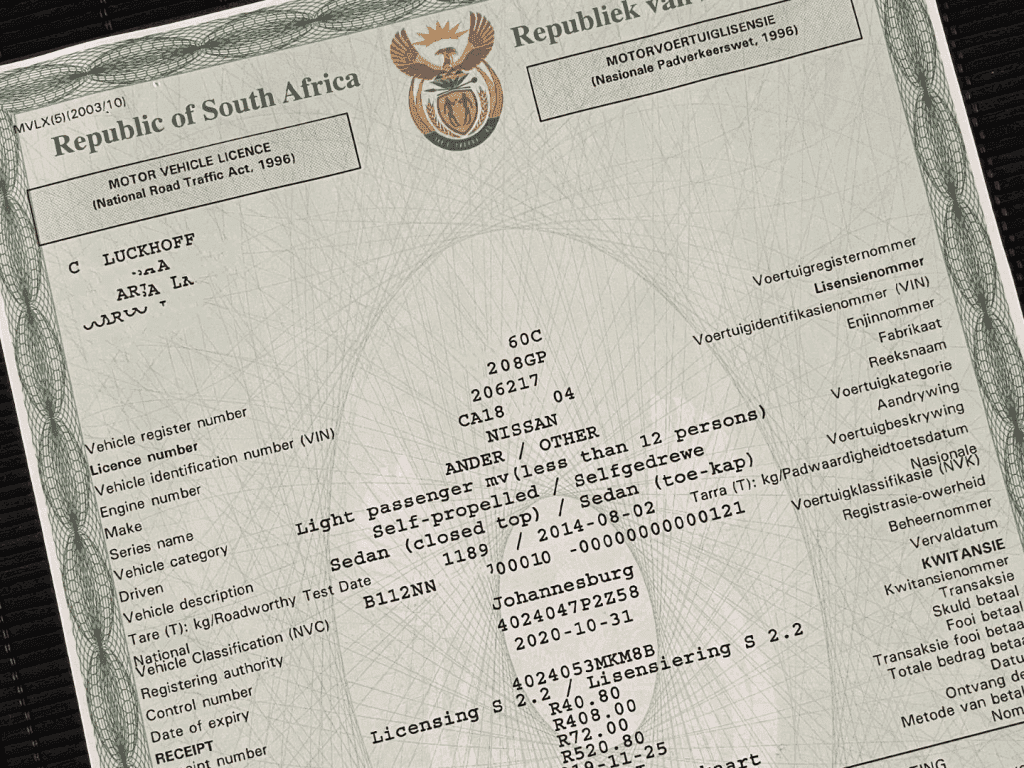
Here is the direct answer on how to register a car in South Africa: registration records the vehicle and its owner and title holder on eNaTIS, while licensing covers the licence disc. Those are different things, although you can usually deal with both in the same application. Confusing them trips up plenty of first-time owners. I have watched buyers assume a shiny new disc means their name is on the record. It does not always. Get the documents right the first time and you save yourself hours in a queue.
Key takeaway: Registration and licensing both need attention. Personally imported vehicles involve additional approvals, customs documents and police clearance.
Last updated September 2026.
What the law requires
The National Road Traffic Act and its regulations govern vehicle registration and licensing, with eNaTIS holding the official record. Two obligations sit side by side, and to be honest, most people only think about one of them.
- Register a car: record the vehicle’s owner and title holder. If it is financed, the finance institution is normally the title holder.
- Licence a car: pay the applicable licence fee and display the valid disc. For an ordinary private car, renewal is annual.
After a change of ownership, you must register and license the vehicle within 21 days. Paying for a disc renewal does not, by itself, transfer the vehicle into your name. Source: Department of Transport
Step-by-step: how to register a car in your name
First registration of a new vehicle
When you buy new, the dealer usually handles this. Still, know what happens so nothing slips.
- The dealer arranges the vehicle’s source documents, including the manufacturer’s certificate.
- You supply your ID and acceptable proof of residential address.
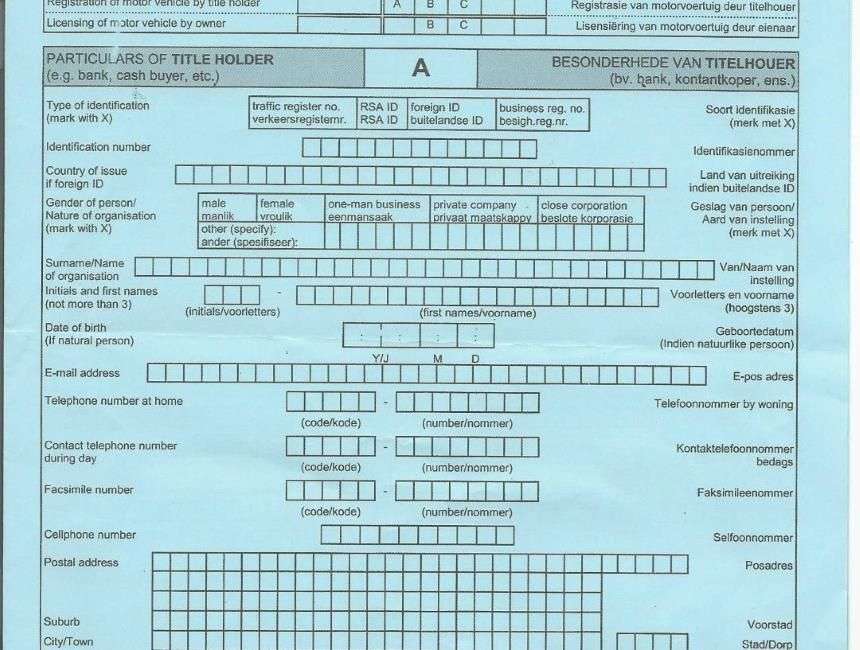
- The Application for Registration and Licensing of Motor Vehicle form, or RLV, is completed and submitted.
- The registering authority processes the application and the required fees are paid.
- Once registration and licensing are complete, check the vehicle details and owner information.
An ordinary new private passenger car does not generally need a separate roadworthy certificate for first registration. Government guidance specifically requires one for new heavy-load or Road Transport Quality System vehicles. Source: Government registration checklist
Check the owner and title-holder fields carefully. Seeing the finance institution listed as title holder is normal on a financed car. Seeing the wrong person listed as owner needs sorting out.
Second-hand transfer into your name
Buying privately means a change of ownership. The seller completes and submits the Notification of Change of Ownership form, or NCO. The buyer then submits the registration application with the supporting documents.
These include identification, proof of address, the seller’s registration certificate, proof of purchase and the required roadworthy documentation. Government guidance calls for a fresh roadworthy certificate if the current one is older than 60 days. Our Change of ownership guide walks through both sides of that handover. Source: Used-vehicle registration requirements
Registering an imported vehicle
This is where people get stuck, so I will slow down. This section concerns vehicles imported personally or outside the normal local dealer process. Buying a new imported model from its authorised South African dealer does not usually leave you handling customs clearance yourself.
Start before the vehicle is shipped. Used-car imports are restricted, and permits are issued only under defined circumstances. Finding a cheap car overseas does not automatically mean you can bring it here and register it. Source: Government used-vehicle import guidance
The paperwork involves different authorities:
- Obtain the NRCS Letter of Authority. The National Regulator for Compulsory Specifications handles this approval. It is not an ITAC document. Source: Letter of Authority requirements
- Obtain the ITAC import permit for a used vehicle. Confirm that you qualify before committing to the purchase or shipping. ITAC says the vehicle must not be shipped before the permit is issued. Source: ITAC application guidance
- Arrange customs clearance. Keep the customs release documents and proof that the applicable requirements have been met. SARS also lists an Interpol clearance certificate among the documents required for a second-hand import. Paying duties alone does not replace the other approvals. Source: SARS import requirements
- Approach the registering authority for the SAPS clearance referral. Government guidance says the local police clearance follows the registering authority’s referral process. Do not assume you can start with a police appointment and sort the rest out afterwards.
- Complete the required inspection and registration steps. Confirm the roadworthy requirements for your vehicle with the authority, then submit the application and outstanding documents.
For imported-vehicle registration, government guidance lists the MVR1A or RLV form, identification, foreign registration and licensing documents, and the NRCS Letter of Authority. SAPS clearance and proof of customs compliance are also required. Ask your registering authority for its complete checklist, including address documents, before your first visit. Source: Imported-vehicle registration
Miss an approval and another trip to the counter will not fix it. Put the documents in order before trying to put the car on the road.
Costs, deadlines and penalties
There is no single registration-and-licensing amount that applies to every car across the country. Get a current quote from your registering authority, using the vehicle’s details.
| Item | What to check |
|---|---|
| Where to register | The motor vehicle registering authority serving your address. Confirm that the office handles vehicle registrations. |
| System of record | eNaTIS, also commonly called NaTIS. |
| Registration fee | Obtain the current local tariff. |
| Licence fee | Confirm the charge for the vehicle’s category and mass. |
| Imported vehicle | Budget separately for approvals, clearance, applicable taxes, inspections and registration. |
| Change-of-ownership deadline | Register and license within 21 days. |
| Annual renewal grace period | 21 days after the existing licence expires. |
For an ordinary car’s annual renewal, the 21-day grace period allows renewal without additional late costs. After that, arrears and penalties apply. It is not a fresh year of licensing starting whenever you eventually pay. Source: RTMC renewal guidance
Renew before expiry wherever possible. For the yearly process and how to avoid arrears stacking up, see our Car licence disc renewal guide.
Common mistakes and what trips people up
- Assuming the disc equals ownership. Paying the licence does not register the car in your name. Check the registration record.
- Confusing owner and title holder. A finance institution appearing as title holder is not the same as the dealer failing to register you as owner.
- Arriving with unsuitable proof of address. Take a recent document and confirm the office’s requirements beforehand. If the account is in someone else’s name, ask about the supporting affidavit.
- Assuming every copy needs the same treatment. Confirm which originals, copies and certified documents your application requires before joining the queue.
- Mixing up NRCS and ITAC. The NRCS issues the Letter of Authority. ITAC issues the used-vehicle import permit. One does not replace the other.
- Shipping first and asking questions later. Establish eligibility and obtain the required approvals before the vehicle leaves the exporting country.
- Assuming any licensing office can help. A driving licence testing centre does not necessarily handle motor vehicle registration. Check the service before travelling.
- Leaving everything to the last day. System downtime, missing documents and clearance appointments can all delay completion.
Next steps
Sort your documents first: identification, acceptable proof of address and the correct vehicle paperwork for a new purchase, used purchase or import.
Buying an import? Establish whether it qualifies, then arrange the NRCS and ITAC approvals before shipping. Follow that with customs clearance and the registering authority’s inspection and police-clearance process.
If you are buying privately, start with our Change of ownership guide, then diarise your Car licence disc renewal. Confirm the testing requirements through our Roadworthy certificate guide.
Still shopping? Browse listings and check the paperwork story before you commit. A good deal becomes rather less attractive when the car cannot be registered.
Summary
This guide explains how to register a vehicle on eNaTIS/NaTIS in South Africa, covering brand-new dealer cars, second-hand transfers and imported vehicles. It is for anyone recording ownership for the first time or bringing a car onto our shores.