Ashok Leyland Phoenix 1.5TD F/C D/S (2025) Review

– A clever workhorse for those who buy on payload-per-rand, let down by a safety spec that really should have been better from the start, and that’s the point.
Introduction
Let’s not pretend. The Ashok Leyland Phoenix isn’t for the family driver or anyone craving airbags, soft plastics, or flashy infotainment. It’s for people running businesses, schlepping bricks, and treating their bakkie like a moving invoice. If the Hilux seems like overkill for your operation, here’s your alternative. This is Ashok Leyland’s most low-key re-entry to South Africa since the old days, and they’ve built the 1.5TD F/C D/S for FMCG, agri-haulage, and last-mile logistics where 1.8 tonnes matter more than badge snobbery. That’s the promise. Let’s see if it’s real.
Key takeaway: The Ashok Leyland Phoenix 1.5TD F/C D/S price South Africa is a big drawcard, and so’s the payload, but you’re trading away ABS, airbags, and a fair bit of peace of mind.
Design & Exterior
Honest, functional, and built for work
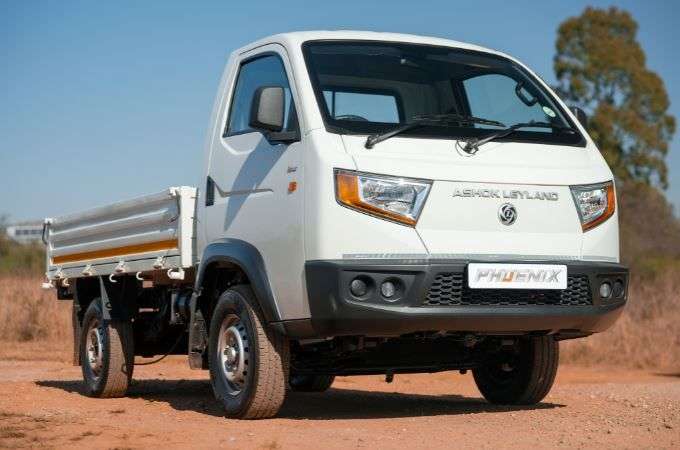
Instagram? Forget it. The Phoenix is all straight lines, right angles, and a slabby cab that looks like it was drawn to spec, not style. At 5,025mm long and 1,842mm wide, it’s not huge for a single-cab, but the load bed is the main event: 2,950 x 1,750 x 415mm. You want to toss 3m pipes or timber flat? No problem. No weird tailgate gymnastics needed.
Where it fits in the Ashok Leyland range
Pitched between the city-friendly Dost and the beefier Partner, the Phoenix sits as Ashok Leyland’s middleweight. Those 215/75 R15 tyres are pothole-proof, and replacements are a phone call away at Midas or Hi-Q. Standing 2,061mm tall, it’ll clear most old-school Joburg loading bays. Official Ashok Leyland Phoenix ground clearance numbers aren’t on the spec sheet – ask your dealer, but I never scraped a thing driving through that cratered patch of the R21 near Pomona. Leaf springs and a high stance keep the diff out of trouble.
Cabin & Practicality
Three seats, all business
Three seats. One for you, two crew on a basic bench, and that’s it. The dash plastics are hard as a farm boot, the switches are chunky, and there’s a tilting steering wheel to nod at comfort. Air-con is standard – and in Durban humidity, that’s not just nice, it’s essential. Power steering comes on every Phoenix. You won’t find a touchscreen, cruise control, or rear PDC. This cab is for working, not loafing.
The deck is where the money is
Let’s talk numbers that matter:
- Load bed: 2,950mm long, 1,750mm wide
- Side wall: 415mm high
- Payload: about 1,810kg
- Dropsides on all three sides for hassle-free loading
That’s more payload than a Mahindra Bolero single cab (on paper at least) and a longer deck than the Hyundai H-100. If you pack smart, two full-size pallets fit side by side. Some rivals can’t manage that.
Missing kit, big consequences
No airbags, no ABS, rear drums. Not sugar-coating it, and neither will the brochure. If you run one on the N3 in a summer thunderstorm, you’ll feel the risk. The Mahindra Pik Up? At least a driver airbag and ABS. Do that comparison if safety is a deal-breaker for you.
On the Road
The 1.5 turbodiesel: simple, honest grunt
Under the Phoenix’s bonnet sits a 1,478cc three-cylinder turbodiesel: 59kW at 3,300rpm, 190Nm from 1,600 to 2,400rpm. Rear-wheel drive, five-speed manual. Modest? Sure. But torque arrives early, the clutch is featherlight, and the cable shift isn’t the vague mess I expected. In Sandton traffic, unloaded, it’ll keep up with bakkies twice the price. Properly quick? No. Honest about its job? Absolutely.
100km/h, and that’s your lot
Flat out, you’ll nudge 100km/h. No PR spin – that’s what the speedo says. On the N1, you’re right at the limit, and the engine is vocal about it. Any proper hill – Van Reenen’s, loaded – means fourth gear, hazards on, and watching Isuzus disappear. For city stuff, from Pinetown to Riverhorse Valley, it’s fine. But a Joburg-to-Polokwane run? Patience required. Fully loaded, 23.2% gradeability covers most tarred uphills, but gravel farm tracks will test your brakes and your bottle.
How it rides and stops
Empty, the rear bounces and skips on rough patches. With 800kg of cement stacked on, it settles down and starts feeling like a proper single-cab. Steering is slow but reassuring. Tight parking bays at Builder’s Warehouse are easy thanks to the Phoenix’s footprint. Front discs do most of the braking; rears are drums. I once loaded it with bricks for a site run – the brakes felt solid, even crawling through heavy late-afternoon N3 traffic. Not cutting-edge, but honest.
Data & Comparison
The numbers that count
| Spec | Ashok Leyland Phoenix 1.5TD F/C D/S |
|---|---|
| Engine | 1.5L 3-cyl turbodiesel |
| Power | 59kW |
| Torque | 190Nm |
| Gearbox | 5-speed manual, RWD |
| Length x Width x Height | 5,025 x 1,842 x 2,061mm |
| Seats / Doors | 3 / 2 |
| Model year | 2025 |
How it compares
| Model | Power | Payload (claimed) | Deck length | ABS/Airbag |
|---|---|---|---|---|
| Ashok Leyland Phoenix 1.5TD | 59kW / 190Nm | ~1,810 kg | 2,950mm | No / No |
| Mahindra Bolero S/C | ~55kW / 195Nm | ~1,100 kg | ~2,520mm | Yes / Driver |
| Mahindra Pik Up S/C | 103kW / 320Nm | ~1,250 kg | ~2,260mm | Yes / Driver |
| Hyundai H-100 | 58kW / 167Nm | ~1,300 kg | ~2,665mm | Yes / Driver |
Phoenix vs Dost: which makes sense?
Phoenix for big, heavy loads – think cement, bricks, or full-size pallets on the East Rand. Dost is better if you’re zipping parcels through Cape Town’s tight streets. Air-con is standard on Phoenix, which matters in Durban, but Dost is the city van if parking and tight alleys are your headache.
Ashok Leyland price in South Africa, warranty and service plan
- Launch price: R269,900 for the Ashok Leyland Phoenix 1.5TD F/C D/S
- Warranty: 5 years / 150,000km, with fleet extensions up to 500,000km
- Roadside assistance: 5 years
- Service interval: 15,000km or 12 months
- Estimated 5-year running cost: about R230,000
Ashok Leyland Phoenix service plan South Africa? Mostly for fleet buyers – single-owner operators will pay for each 15,000km service as you go. Could be cheaper than Mahindra over five years, but check the fine print at your local outlet before signing. I had an owner at a Pretoria dealer swear by cash servicing – said he pocketed real savings over a plan.
Real-world Ashok Leyland Phoenix fuel consumption
Book figures say 15-17 km/L unladen, but we don’t have proper local testing yet. With a 50-litre tank, even a loaded 11 km/L still means about 550km per fill. In my experience, running loaded most days, expect 8.5 to 9.0 L/100km. That’s your biggest monthly variable, so keep the logbook honest and budget carefully.
Ashok Leyland Phoenix reliability in South Africa
Most buyers under 40 have never heard of the badge. After vanishing in the 1980s, Ashok Leyland is back via ETG Logistics, with around 14 dealers in the main metros. Mechanically, it’s old-school: leaf springs, rear drums, simple manual gearbox. That’s good news for farmers and contractors far from the N1. Ashok Leyland Phoenix problems? Too early to tell. Parts support from India is decent, but how does it cope with Free State gravel, SA diesel, and three summers of dust? We’ll only know after two years of real work.
Where single-cab bakkies stand now
Single-cabs hover at 47-50 units on the SA market index while lifestyle double-cabs steal the spotlight. The Phoenix targets SMEs shifting goods, not folks chasing Instagram likes.
Verdict
The Ashok Leyland Phoenix is a one-track workhorse. If you’re an SME boss shifting serious weight around town and you’ve done your sums on Ashok Leyland Phoenix fuel consumption and service costs, that price-to-payload ratio is hard to ignore. Standard air-con, solid warranty, and mechanical basics are on your side – especially if you’re running loads on the Highveld or away from the fancy electronics that hate South African dust. If you need highway speed, family comfort, or can’t live with no ABS and airbags, keep walking. Ashok Leyland’s hinted at an electric LCV and possible local assembly in the next year or two. If that happens, the Phoenix story could change fast – and that matters.
Summary
Here’s the real-world take on the 2025 Ashok Leyland Phoenix 1.5TD single-cab dropside. It’s a payload-first workhorse that’s got SME budgeters in its crosshairs, but the safety spec is thin and you’ll need to do the running cost sums yourself. So, how does it stack up against the usual suspects fro