Chevrolet Utility UTILITY 1.4 A/C P/U S/C (2017) Review

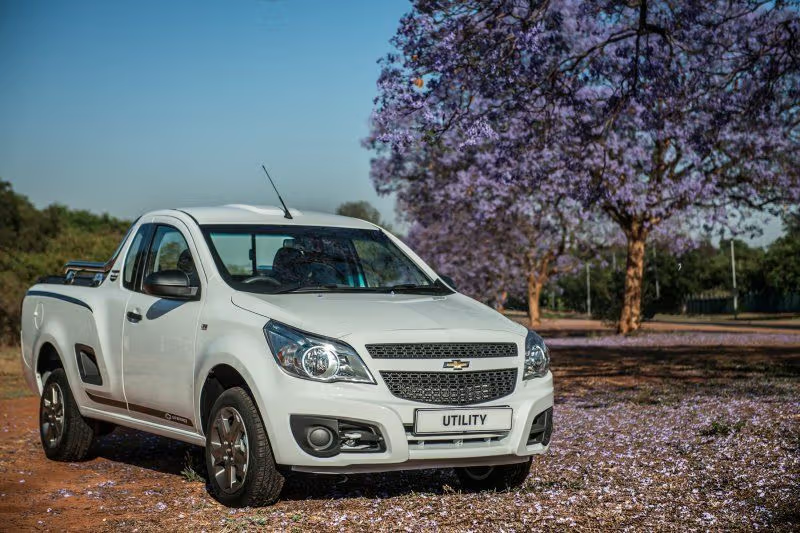
- honest, well-judged half-ton with standout steering, let down by the no-ABS spec and the GM aftersales void since 2017.
Introduction
Right, so the Chevrolet Utility 1.4 A/C makes sense if you’re a cash buyer after a bargain half-ton bakkie, you’re not bothered by the lack of factory backup, and you find a low-mileage one with its service book in order. That’s a narrow lane. For most buyers, the NP200 is simply less hassle. By 2026, you’re looking at a Utility that’s at least nine years old. That matters because the whole ownership story now hangs on body condition, full service history, and whether your local indie can source the right bits. This Chevrolet Utility review targets business owners, tradies, and first-time bakkie shoppers wondering if a 2017 1.4 A/C is a clever buy or a false economy.
Key takeaway: A used Utility 1.4 A/C is a justifiable cheap workhorse in 2026, but only with a stamped book, low mileage, and an independent specialist nearby. No ABS, no GM dealer safety net.
Design & Exterior
Launched in 2011 and run out in 2017, the third-gen Utility took its shape from the Holden line and stripped it back for SA’s half-ton crowd. Even now, it looks neater than the blockier NP200 - which counts for plenty when you’re parked next to a builder’s fleet in an East London alley.
Dimensions and stance
It’s 4 514 mm long, 1 700 mm wide, and 1 578 mm high. Small enough to slip into a CBD loading bay on Bree Street, big enough to swallow a Builder’s Express haul. The A/C rides on plain steelies, gets unpainted bumpers, and skips the Sport’s body kit. That’s a deliberate choice for anyone who sees a bakkie as a tool, not a toy. Smaller wheels mean cheaper rubber every time you swap a set after 60 000 km of pothole punishment on the R21.
Spotting the A/C spec
- Unpainted black door handles and mirror caps
- Steel wheels with clip-on covers
- No nudge bar, no sports bar, no stickers
- Body-colour grille bar (nothing fancier)
- Soft tonneau cover (factory fit for some, usually missing or tatty on survivors)
Cabin & Practicality
No pretence here. Hard plastics, tough cloth, just enough kit for a long slog behind the wheel.
What the A/C trim actually gives you
It’s mid-pack: above Base, below Club. You get aircon (obviously), aux-in audio, electric windows up front, central locking, and dual front airbags. That airbag warning sticker will be peeling or faded on most units now. But - and it’s a big one - no ABS. ABS with EBD was reserved for the Sport. If you’re hauling bricks in the rain, this is the dealbreaker you have to weigh up.
Space and storage
It’s a tight cabin for anyone above 1.9 m. Steering only adjusts for rake, and the seat base sits high. I’m 1.83 m and managed a 240 km trip down the N2 to Mossel. My mate, 1.92 m, was squirming before Knysna. The shelf behind the seats is deep enough for a toolbag, a laptop, and a reflective bib. A sliding rear window makes it easy to feed through a long plank or PVC pipe.
Load bay
- Steel load box, later models get plastic side liners
- Tie-downs in all four corners
- The tailgate drops to the right height for a sack trolley
- Soft tonneau will leak in a Gauteng thunderstorm - if you’re hauling electronics, budget for a hard canopy
On the Road
Here’s where the Utility pulls a surprise, especially if you’re coming from an NP200. Old-school hydraulic steering gives the front end a sense of connection you just don’t get in the Nissan. You actually feel what the tyres are doing when you tip into a wet offramp near Gillooly’s.
The 1.4 engine in SA reality
1.4-litre 8-valve SOHC petrol, 68 kW and 120 Nm. Plenty of empty runs at the coast. Stack 400 kg of cement in the back on the Highveld, and it’s suddenly working for a living. Altitude saps naturally aspirated power - no escaping it. Keep revs under 4,000, and it’s smooth enough. Above that, the engine gets rowdy without real reward. The five-speed manual is light, learner-friendly, but shifts too quickly from second to third, and it’ll grate. It’s a gearbox that prefers you take your time.
Highway experience
At an indicated 120 km/h between Joburg and Bloem on the N1, revs sit just above 4 000. That means noise, vibration, and fuel consumption that creep up. The official figure is 7.2 L/100 km combined, but I saw 8.1 L/100 km on a mixed loop. Still, with a 56-litre tank, you’re good for more than 600 km between stops.
Ride and braking
Front MacPherson struts, torsion beam at the rear, tuned on the soft side for a bakkie. Empty, it rides better than you’d expect over Joburg’s patched tar. With a load, it sits down nicely. Independent tests from when the Utility was new saw the ABS-equipped Sport stop from 100 km/h in 50.4 metres. The A/C, with no ABS, will take longer and is sketchier in the wet. You’ll want to double your following gap in the rain.
Data & Comparison
Here’s how a 2017 1.4 A/C shapes up in 2026.
Specs at a glance
| Item | Figure |
|---|---|
| Engine | 1.4L Petrol, SOHC |
| Power | 68 kW (91 hp) |
| Torque | 120 Nm |
| Gearbox | 5-speed manual |
| Drive | FWD |
| Claimed combined fuel | 7.2 L/100 km |
| Length / Width / Height | 4 514 / 1 700 / 1 578 mm |
| Seats | 2 |
| Production run | 2011 - 2017 |
How it compares
| Model (used, similar vintage) | Power | Claimed fuel | ABS standard | Factory backup in SA |
|---|---|---|---|---|
| Chevrolet Utility 1.4 A/C (2017) | 68 kW | 7.2 L/100 km | No | None since 2017 |
| Nissan NP200 1.6 (still sold new through 2024) | 64 kW | 7.6 L/100 km | Yes, on most trims | Full dealer network |
| Fiat Strada 1.4 (used) | 65 kW | 7.4 L/100 km | Trim-dependent | Limited |
Running costs and TCO
Do your sums: over five years, a 2017 1.4 A/C bought in 2026 works out to about R406 400 with fuel, tyres, insurance, two cambelt services, and the usual bits-and-bobs. The wild card is always parts. No factory Chevrolet Utility service plan for South Africa is left - if you didn’t buy it with one in 2017, there’s nothing now. Chev utility spares in South Africa are still out there, especially through places in Edenvale, Pinetown, and Bellville. Anything Opel-based (Family 0 engine bits especially) is easy. Trim parts? Could be a treasure hunt.
What about reliability?
Mechanically, the Utility is solid. Loads of 180 000 km+ examples still running daily. Typical issues:
- Door rubbers pop loose as they age
- Soft tonneau will eventually leak
- Aircon condensers corrode at the coast
- Wheel bearings suffer if overloaded
- Noticeable fuel cut-off jerk in slow traffic - normal for this motor
Worth a side note: Chevrolet Spark common problems and 2012 Chevrolet Utility common problems overlap (electronics, trim) - any indie who knows Spark or Corsa Utility will know this bakkie inside out.
Used pricing reality
Used Chevrolet Utility UTILITY 1.4 A/C P/U S/C price south africa in 2026? All over the show. Fleet-worn high-milers drop below R90 000, while pampered, full-book, sub-80 000 km examples can nudge past R150 000. There’s plenty of stock, so you have some bargaining power. Walk if the book’s missing. Most fair deals land between R110 000 and R130 000 for clean, privately-owned A/Cs.
Verdict
The Chevrolet Utility 1.4 A/C only makes sense for a select few. If you find a 2017 A/C with a full book, less than 120 000 km, working aircon, and it’s under R125 000, plus you’ve got a trusted indie on speed dial, you’re looking at an honest, capable workhorse. It’s what the Utility should have been from the start - a straightforward, well-judged little bakkie that rides and steers better than the segment expects.
But if ABS is non-negotiable, you do long-haul highway runs, or you need the security of a dealer network to sleep at night, give it a miss. The NP200 is the logical call in those cases, and that’s the point.
One more thing: if you’re not in a rush, shop around December-January. That’s when fleet disposals flood the market, and prices on clean A/Cs typically dip by 8-10% for a few weeks.
Summary
Used-buyer guide: 2017 Chevrolet Utility 1.4 A/C P/U S/C, aimed at South Africans in 2026. What does the A/C spec buy you, what does it cost to run, what’s the parts and service reality post-GM, and how does it really line up against the NP200? Here’s what you need to know before you sign an EFT.