Ford Puma 1.0L EcoBoost Titanium 7AT (2025) Review

—a brilliant car let down by a muddled local strategy. The Puma arrived, impressed, and then vanished. That’s on Ford SA’s planning, not the engineering. And that's the point.
Introduction
Right, so here’s the blunt truth: only buy the Ford Puma 1.0L EcoBoost Titanium 7AT if you can wrangle a steep discount from a dealer desperate to clear old stock, and if you care more about how a car feels on the road than how many teenagers you can wedge in the back. For most families in South Africa looking at compact crossovers for 2026, the Puma is history. It flashed in, barely made a mark, then vanished. The facelifted 93kW mild-hybrid Powershift I’m talking about here is the international 2024-onwards car, important for anyone eyeing grey imports, lingering demo models, or future used buys - because the nameplate will linger long after Ford SA switched off the lights.
Key takeaway: Genuinely fun to drive, but in South Africa, the Puma's value is kneecapped by high pricing, a pinched rear bench, and Ford’s decision to skip the facelifted model here.
Design & Exterior
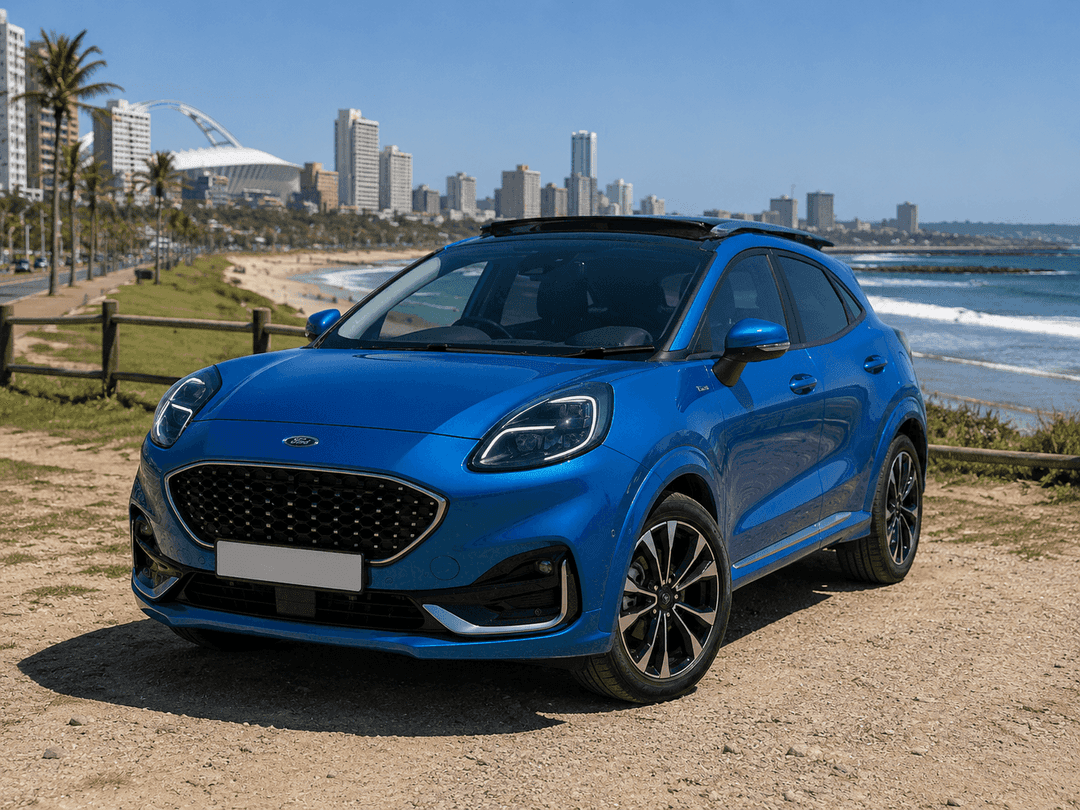
If you want to stand out in a car park full of T-Crosses and C3 Aircrosses, the Puma still does the job. Bulging rear haunches, headlights that squint instead of glare, and a profile that looks more hot hatch than baby SUV. The facelift brings a sharper face - slimmer LED headlights, a painted grille - but the overall shape is unchanged. How the Puma stacks up against rivals Line up a Puma alongside a Honda Elevate or Citroën C3 Aircross, and the Ford stands out - its stance feels more planted, and it actually looks like it’s itching to take on a twisty stretch of the highway at speed, not just school runs. Parked next to a T-Cross, it’s the VW that fades into anonymity. You get five doors, 17- or 18-inch wheels, and a roofline that hints at Fiesta DNA. It’s no surprise Ford felt bold enough to slap on a R569 000 launch sticker.
Trim cues
- Titanium gets softer springs - actually usable on pothole-strewn streets, unlike the ST-Line’s firmer setup.
- Facelifted models offer LED matrix headlights and adaptive high beam on upper trims.
- Painted cladding, skipping the usual black plastic most SUVs lean on.
Cabin & Practicality
Here’s where the facelift really moves the needle - and where local buyers got the short end. South Africa’s Puma stuck with the old dash, while the global update adds a 12-inch SYNC 4 touchscreen and a 12.8-inch digital cluster. Both are sharp, responsive, and finally bring wireless CarPlay and Android Auto as standard, about time.
The control problem
Ford decided to bin physical climate controls. Everything lives in the touchscreen now. On a billiard-smooth autobahn, maybe that’s fine. On the highway, bouncing over expansion joints, trying to jab at a digital slider is just... irritating. This is the one ergonomic misstep you’ll notice every single day.
Space, boot, family duty
The front seats? Spot on - low, supportive, with decent thigh support. The back seat? Not so much. A tall adult behind a tall driver is out of luck for knee room. Kids in booster seats? No problem. Four adults on a long trip? Pack patience.
The MegaBox is clever: 80 litres of washable, drainable storage under the boot floor. Wet hiking boots, muddy trail shoes, or a sneaky pair of wine crates all fit. Above the floor, Puma boot space is 456 litres; throw in the MegaBox and you gain useful flexibility. Some SA cars had a space-saver spare in there, so check before you buy used.
- Boot capacity: 456 litres (seats up)
- MegaBox under-floor: 80 litres, washable with drain plug
- ISOFIX: two outer rear positions
- Wireless smartphone mirroring: standard on facelift
On the Road
This is where the Puma actually earns its keep. The 1.0-litre three-cylinder EcoBoost makes 92kW and 170Nm with mild-hybrid help, sending power to the front wheels via a seven-speed dual-clutch Powershift. On paper at least, that sounds ordinary. It’s anything but.
The engine
Three-cylinders have their own soundtrack - gruff at idle, smoother above 2,000 rpm. The mild-hybrid system allows cylinder deactivation under light load; Ford says the changeover takes just 14 milliseconds. You won’t feel it. I clocked an indicated 7.1L/100 km on a long drive.
The Powershift gearbox
Let’s be honest, dual-clutch boxes in SA have a reputation - and not always a good one. This one’s sorted once it’s up to temperature. It can fumble from a standstill in slow traffic, but at speed, shifts are invisible and kickdown is sharp. If you’re buying used, a cold start test is non-negotiable.
Chassis
Underneath, it’s a thoroughly reworked Fiesta platform - firmer bushings, better top mounts. Steering feels natural, body control is tight but not crashy, and it turns in with more intent than anything else in this class. On a winding bit, the Titanium’s softer suspension soaked up mid-corner bumps that would have rattled your fillings in an ST-Line. Local roads will punish stiff setups; here, comfort wins.
Data & Comparison
Let’s talk numbers - because this is where the Ford Puma 1.0L EcoBoost Titanium 7AT price in South Africa story gets tricky. The Titanium launched at R569 000, the ST-Line Vignale at R613 900, and neither included a service plan. The new, bigger Territory arrived at R593 500 and basically undercut the Puma overnight. SA total sales? 1 798 units. The facelifted model never made it through local homologation, and by November 2025, inventory was finished.
Puma’s power versus rivals
Puma’s 92kW edges out the segment median of 90kW. Behind the wheel, it actually comes across with more urgency than the 89kW Honda Elevate CVT; a lot of that is down to the dual-clutch’s crisp shifts and the mild-hybrid’s little surge off the line, especially when you need to slot into a gap on the freeway.
| Model | Power | Gearbox | Avg Price (ZAR) | Fuel |
|---|---|---|---|---|
| Ford Puma 1.0 EcoBoost MHEV | 92kW | 7AT DCT | ~R402 451 | Petrol |
| Honda Elevate 1.5 CVT | 89kW | CVT | R434 000 | Petrol |
| Honda Elevate 1.5 MT | 89kW | Manual | R373 800 | Petrol |
| Citroën C3 Aircross 1.2 MHEV | 81kW | 6-spd DCT | R386 500 | Petrol |
Ownership numbers and reliability
- 5-year TCO estimate: R230 000 - average for the class
- Warranty (SA-supplied units): 4yr/120 000 km, no standard service plan
- Known issue: July 2025 fuel-line recall hit 1 796 SA cars - double-check before buying used
- Cylinder-deactivation transition time: 14 ms - quicker than most engines on sale
By November 2025, the crossover segment trend was dropping - score: 35.9. That’s a long way off the SUV (76.0) and Hybrid (72.3) numbers. Buyers are chasing bigger, electrified crossovers. The Puma slipped off the radar.
Editorial Focus
Did Ford’s compact crossover actually arrive? Sure - November 2023, big launch, clever MegaBox, and a chassis that embarrassed every rival for driving fun. By 2025, it was gone. PR gloss can’t change that.
Talking about the global facelifted 1.0 EcoBoost 92 kW Mild Hybrid Powershift is really a case of what-could-have-been. Here’s my real gripe: SA got the older 92 kW pre-facelift model at R569 000, while Europe moved to the 114kW mild-hybrid with bigger screens and better efficiency - for similar money. That’s the version we should have had from launch, and it’s what the Puma should have been from the start.
The Ford Puma finance numbers in South Africa didn’t help. No service plan, a price that put it next to the bigger Territory, and monthly repayments that looked ugly next to the spec sheet. Add reliability jitters about the wet-belt EcoBoost (it’ll last if you stick to 15 000 km intervals - miss one and you’re gambling), and Ford SA never gave the car a proper chance. Brilliant engineering, flawed commercial strategy. That contradiction defines the Puma’s local story.
People Also Ask
Is the Ford Puma still on sale in South Africa?
No. Ford SA canned the Puma in November 2025 after just 1 798 units sold. The 2024 facelifted model in this Ford Puma 1.0L EcoBoost Titanium 7AT never came here officially. If you want one, you’ll have to hunt the used market or hope for a leftover demo at an independent dealer - but stock is thin.
What is the Ford Puma price in South Africa? Was it launched at?
At launch in November 2023, the Titanium was R569 000, the ST-Line Vignale R613 900. No service plan included. By 2025, the average used Ford Puma price in South Africa was around R402 000, depending on mileage and spec. The facelifted 94kW version never got a local sticker price - it was dropped before launch.
What are the 2011 Ford Fiesta common problems and 2012 Ford Fiesta common problems relevant to the Puma?
The Puma shares bones with the Fiesta, so if you’ve heard horror stories about old Powershift shudders, worn clutches, and TCM faults from 2011 or 2012 Fiestas, you’re not wrong. The facelifted seven-speed is much improved, but always insist on a thorough diagnostic scan before buying any used example.
Ford Puma vs Honda Elevate - where does the value sit?
This comparison is all about your checklist. Need rear space, a warranty, or a service plan? The Honda Elevate has you covered and makes sense for families. Want proper handling, a lively three-pot, a 456-litre boot plus the clever 80-litre MegaBox, and some real Euro charm? The Puma is still the one you’ll want to drive. Priorities, plain and simple.
Is the Ford Puma reliable long-term?
Ford Puma reliability lives or dies by the EcoBoost’s wet timing belt. Stick religiously to the recommended intervals - officially every 10 years or 240 000 km, but many specialists say 6 years or 150 000 km - and the engine is solid. Miss it, and you risk belt debris clogging the oil pickup. The facelift’s DCT is way better than earlier efforts.
What's the Ford Puma boot space, and is it family-friendly?
Puma boot space is 456 litres above the floor, plus the 80-litre MegaBox for wet or muddy gear. That’s strong for a B-segment crossover. The weak spot is rear legroom - fine for kids, tight for tall teens or adults on a road trip.
Verdict
The facelifted Ford Puma 1.0 EcoBoost 92kW Mild Hybrid Powershift is the car South Africans should have had - and didn’t. As a technical package, it’s excellent: best chassis in the class, eager and frugal engine, genuinely clever packaging, and a now-modern cabin (touchscreen-only climate aside).
Buy used if: you drive for enjoyment, can confirm the July 2025 fuel recall was done, and you’ll keep to strict service intervals. Skip it if: you need genuine four-adult rear space, want a service plan, or can stretch to a Territory for similar money.
Rating: 7/10 - a brilliant car let down by a muddled local strategy. The Puma arrived, impressed, and then vanished. That’s on Ford SA’s planning, not the engineering. And that's the point.
Summary
The facelifted Ford Puma 1.0 EcoBoost (125 Hp) Mild Hybrid Powershift is the car South Africans should have had—and didn’t. As a technical package it’s excellent: best chassis in the class, eager and frugal engine, genuinely clever packaging, and a now-modern cabin (touchscreen-only climate aside). Buy used if: you drive for enjoyment, can confirm the July 2025 fuel recall was done, and you’ll keep to strict service intervals.