JAC T9 2.0L CTi Super Lux 4X2 Double Cab (2026) Review
A properly competitive double cab, let down only by a short resale history and some ergonomic misses that a mid-life update should sort out.
Summary
Here’s a straight-shooting JAC T9 review for South Africa: real-world driving, what you’re paying for, cabin quirks, and whether this Chinese bakkie is worth a punt if you’re shopping under R600k. We’ll get into JAC T9 engine problems, service plans, accessories, and how it stacks up against the Hilux and Ranger. This is the JAC T9 review South Africans actually need.
Introduction
Let’s be honest. You want a double cab with all the trimmings, but you’re not keen to hand Hilux Raider money over at your local dealer. The JAC T9 4x2 Super Lux might just tick your boxes. The catch? You’ll need to be okay with a badge that still has everything to prove in terms of long-term value. That’s the quick version. The longer story is about what you’re risking in badge cachet, resale, and whether you care about being a first mover on a bakkie still finding its feet here.
As of 2025, the T9 finds itself in a segment totally disrupted by new Chinese brands over the past three years. Double-cab demand is still high - our trend data hit 66 points in October, the highest of the year. South Africans love bakkies. The real question: are they ready for this one?
Key takeaway: The 2025 JAC T9 4x2 Super Lux lands with premium kit and a ZF-sourced auto box, at a price no legacy rival can touch spec-for-spec. That matters.
Design & Exterior
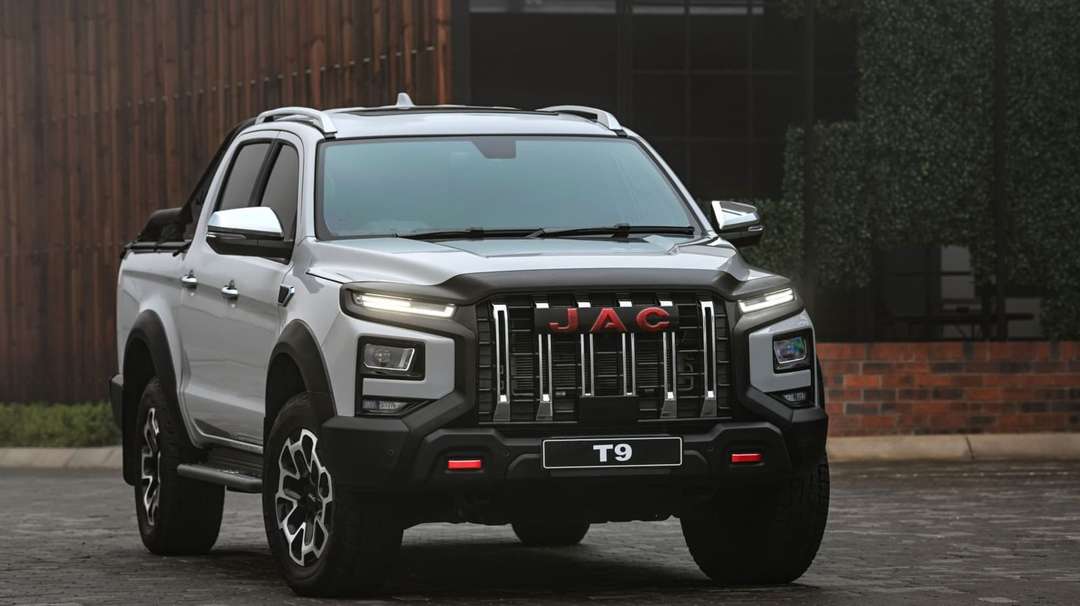
It’s big. At 5330 mm long, 1965 mm wide, and 1920 mm tall, the T9 matches Hilux for sheer presence and will absolutely dwarf a Mahindra Pik Up outside Builders Warehouse. The shape is honest: high shoulders, a bluff nose, and a bonnet so tall you can’t see the front bumper from the cockpit. Pure workhorse, not a weekend show pony.
What stands out
- The full-width LED light bar feels more Everest than entry-level, especially for under R600k.
- 18-inch alloys actually look like they belong, not like someone’s been on the phone to Tiger Wheel & Tyre.
- Standard side steps. You’ll thank JAC the first time you clamber in wearing chinos at a client site.
- Load bin is wide enough to matter, but a touch shallower than a Hilux. If you’re pricing up a JAC T9 canopy in South Africa, check the internal height before you commit.
It’s not a head-turner, but it won’t embarrass you at school pick-up either. That’s a win for this segment.
Cabin & Practicality
This is where the T9 throws down. Settle in, and you’ll find soft plastics up top, stitched leatherette across the middle, proper buttons for the aircon, and a digital cluster that thankfully doesn’t scream 2012. Built to a price, yes, but not built down to a price.
The wins
- Heated front seats, sunroof, 220V load-bin inverter, wireless charging pad, and a 10.4-inch vertical touchscreen – all standard.
- Physical climate control buttons. If you’ve ever tried to jab a touchscreen for fan speed on the M1 in traffic, you’ll know why this matters.
- Five seats with actual rear legroom. Grown-ups fit. No knees-in-the-dash trickery here.
The compromises
There’s still no reach adjustment on the steering – just rake – so taller drivers will sit closer to the wheel than they’d like. The infotainment display? Gets washed out by Highveld sun, and the menu logic is a bit 2018. Loading bin width at 1485 mm between the arches means a standard pallet fits if you pack smart, but don’t expect Ranger-level depth. Storage is standard double cab: deep centre bin, massive door pockets, space for a 1.5L Valpré bottle if that’s your thing.
My test unit felt tight as a drum. No rattles on corrugated gravel near Hartbeespoort, no tub squeaks. I did spot some uneven spray liner near the tailgate hinges – worth checking at handover. A mate flagged the same after a test in Polokwane.
On the Road
The 2.0-litre turbo-diesel puts out 125 kW and 410 Nm, running through a ZF eight-speed auto to the rear wheels. That ZF box is the big-ticket item here – same family as BMW and Land Rover, and it shows. Gear shifts are sensible, no pointless hunting, and it feels right on highway climbs.
How it actually drives
Urban cruising is relaxed. At 5 am, cold-start diesel clatter is surprisingly restrained, and above 60 km/h, engine noise fades. On the N1 to Bela-Bela at 120 km/h, the T9 sits steadily at 1700 rpm in eighth. Feels secure, but that tall body does catch a crosswind or two.
Push on, and you’ll find the limits. With just 168 hp moving well over two tonnes, overtakes need planning. The gearbox kicks down smartly, but you won’t be winning any traffic-light sprints. No shame in that for a bakkie.
Where rear-drive bites is on poor surfaces. Twice on wet gravel near Magaliesburg, the back stepped out under moderate throttle before traction control reeled it in. Hilux has spent decades fine-tuning this. The T9 isn’t quite there. Treat it like a bakkie, not a GTI, and you’re sorted.
Real-world economy
JAC claims 7.8 L/100 km combined. My week of mixed driving – highway, town, one heavy load – saw 7.4 L/100 km on the trip computer, and the pump agreed (within 0.2 litres). Others are seeing low-7s. On a staged run at Gerotek, it managed 6.2 L/100 km at a steady 115 km/h. With a 76-litre tank, you’re looking at 970 km between fills if you drive as I did, or over 1200 km if you’re set on saving.
Data & Comparison
The numbers that matter
- Engine: 2.0L turbo-diesel, 125 kW / 410 Nm
- Gearbox: ZF 8-speed automatic, RWD
- Claimed combined consumption: 7.8 L/100 km
- Length / width / height: 5330 / 1965 / 1920 mm
- Seats/doors: 5 / 4
- 5-year TCO estimate: R409 400
JAC T9 vs the segment benchmarks
| Spec | JAC T9 2.0 CTi Lux 4x2 A/T | Toyota Hilux 2.4 GD-6 Raider 4x2 A/T | Ford Ranger 2.0 SiT XL 4x2 A/T |
|---|---|---|---|
| Power (kW) | 125 | 110 | 125 |
| Torque (Nm) | 410 | 400 | 405 |
| Gearbox | 8-speed auto | 6-speed auto | 6-speed auto |
| Claimed L/100 km | 7.8 | 7.9 | 7.5 |
| Length (mm) | 5330 | 5325 | 5370 |
On paper at least, the T9’s numbers impress. The trickier part is resale. Two-year trade data shows about 13.5% depreciation over 25 000 km, which is better than doom-mongers predicted, but the sample size remains slim. Hilux is safer for resale, but the T9’s holding up better than some Chinese rivals. That’s where things stand for 2026.
JAC T9 ground clearance and 4x2 reality
Ground clearance sits at about 210 mm, depending on spec and tyres. That’s decent for a 4x2, fine for gravel school runs, farm tracks, or dodging ruts at Klein Karoo guest houses. Not a 4x4 replacement. If your weekends mean Sani Pass or Baviaanskloof, you’ll want the Hunter 4x4 or look elsewhere.
Ownership: service plan and accessories
Service intervals have improved. After your first 10 000 km check, it’s every 20 000 km or 12 months. That’s a real plus and aligns with what you’d expect from the established brands. Warranty is 5 years or 200 000 km. JAC now has over 70 dealers, stretching into Namibia, Botswana, Zambia, and Mozambique, so rural service is more credible than you’d think from a newcomer.
Accessory options are solid. Most dealers will quote you on nudge bars, tow bars, roller covers, and canopies. JAC T9 canopy prices in South Africa are in the Hilux ballpark, so not a bargain, but you’re not stuck with generic imports. The local aftermarket is taking the T9 seriously. For the full list, ask your dealer for the JAC T9 accessories South Africa price list.
JAC T9 engine problems and issues to know about
There are a few quirks. Nothing terminal, but worth knowing. The infotainment sometimes needs a reboot to get the radio working again; sunlight can kill the touchscreen’s visibility, and the tub liner finish can be rough at the tailgate. Mechanically, jac t9 engine problems aren’t cropping up in big numbers. The 2.0 diesel and ZF box combo is proving tough – international markets have run them for longer, and the early South African issues have been about ergonomics and electronics, not engines or gearboxes.
People Also Ask
Is the JAC T9 reliable for South African conditions?
Early days, but the signs are promising. The 2.0 diesel and ZF 8-speed have decent mileage overseas, and the local 5-year/200 000 km warranty plus that longer 20 000 km service interval mean JAC is backing its product. The bigger gamble is on long-term electronics, not the oily bits.
How does the JAC T9 compare to the Toyota Hilux on price?
The T9 4x2 Super Lux sits a good R80 000 to R120 000 below a similarly specced Hilux Raider, depending on deals. You get more kit as standard, like a sunroof and heated seats – things Toyota will charge for. Hilux still takes the win for residuals and dealer reach.
What are the JAC T9's boot space and load capacity?
Boot space in the T9’s load bin is right up there for the class – a standard pallet fits between the arches; payload is around a tonne. In the cab, five adults and the usual bakkie storage nooks. It’s a proper workhorse footprint, not a lifestyle compromise.
Does the JAC T9 hold its value?
Better than people expected. Two-year depreciation is tracking at 13.5% with average mileage. That’s ahead of some rivals and chips away at the “Chinese bakkies don’t hold value” cliché. That said, the data is still fresh, and how well it resells will depend on the used market’s appetite – which is growing as more T9s hit the road.
What's the real-world fuel consumption?
My week returned 7.4 L/100 km against JAC’s claim of 7.8. Highway cruising at 110 km/h dropped it into the high sixes, and a Gerotek economy run squeezed 6.2 at a steady 115. With a 76-litre tank, you’re looking at 950 to 1100 km per fill. That’s a proper bakkie range for South Africa.
Should I wait for a newer JAC T9 variant?
The T9 Hunter 4x4 is already available if you want all-paw grip. The 4x2 Super Lux is the current value pick – no major update is looming, so unless you’re chasing a special, there’s no reason to wait.
Verdict
The JAC T9 4x2 Super Lux is the best effort yet at making “budget bakkie” not feel like a compromise. There are rough edges – the rear-drive chassis needs another round of fine-tuning, infotainment needs a decent OTA update, and we need three more years to see how resale shakes out. But the big stuff – ZF gearbox, cabin finish, standard features, JAC T9 service plan South Africa, dealer reach – is right up there. And that’s the point.
If you’re a value shopper who reads the spec sheet, and you don’t need 4x4, this is a real option. If you live and die by three-year trade-ins, stick to the blue-chip badges. If you want the Hunter 4x4, wait for a deal. For the rest, the T9 finally makes the case for trying something new.
Rating: 7.5/10
A properly competitive double cab, let down only by a short resale history and some ergonomic misses that a mid-life update should sort out.
Summary
Here’s a straight-shooting look at the 2025 JAC T9 2.0 CTi Lux Double Cab 4x2 A/T. We’re talking real-world driving, what you get for your money, cabin quirks, and whether this Chinese bakkie is worth a punt for anyone shopping under R600k in the double-cab space.