Jetour Dashing 1.5T Prestige 7DCT (2026) Review

A striking and generously equipped compact SUV offering serious value per rand, held below a higher score by uneven driveline polish and an ownership record still being established on our shores.
Introduction
The Jetour Dashing Deluxe makes a fairly convincing argument for itself if you want plenty of equipment, bold styling and decent performance without pushing beyond the R500 000 mark.
Jetour entered South Africa with the advantage of being associated with the wider Chery group, but it still has to establish its own reputation among buyers who may never have heard of the badge before.
The Dashing tackles that challenge in a fairly obvious way: give buyers plenty to look at, plenty to play with and enough standard equipment to make similarly priced established rivals appear rather ordinary.
During my time with the Deluxe, I wanted to see whether that showroom appeal survives once the kilometres start accumulating and the vehicle has to deal with Johannesburg traffic, long highway runs and the realities of everyday ownership.
For the most part, it does, although there are a few rough edges beneath the polish.
Key takeaway: The Jetour Dashing Deluxe combines bold styling, strong standard equipment and competitive pricing, although low-speed drivetrain refinement and long-term resale remain areas where the brand still has something to prove.
Design & Exterior
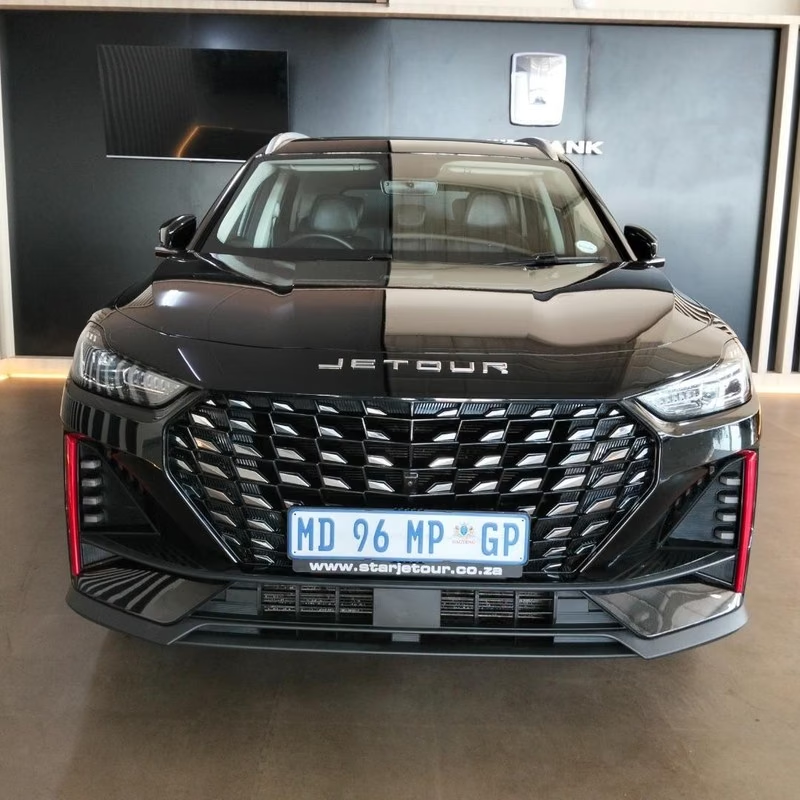
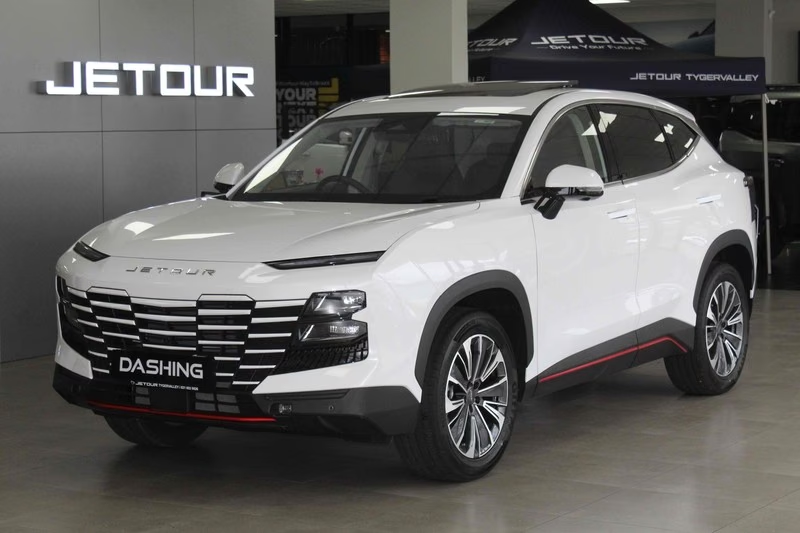
The Dashing is not a vehicle you are likely to walk past without noticing.
Park one at Mall of Africa and there is a good chance somebody will turn around for another look.
That is clearly intentional.
Styling that argues with itself
The front end has hints of European exotica in the narrow lighting and large lower intakes, while the rear carries a slightly more familiar premium-SUV influence.
Those elements should probably clash more than they do.
Instead, the Dashing manages to bring everything together into something distinctive.
Where something like a Corolla Cross is deliberately conservative, the Jetour wants to be noticed.
For a relatively new brand trying to establish itself in South Africa, that approach makes sense.
Bold styling is one of the quickest ways to give buyers the feeling that they are getting more car for their money.
Stance and footprint
The 19-inch alloy wheels fill the arches properly and give the Dashing a substantial stance.
Ground clearance of around 160 mm is less impressive, though.
That figure places it much closer to an urban crossover than a vehicle designed for serious off-road work, while drive is sent exclusively to the front wheels.
Maintained gravel roads should not present a problem.
Anything more adventurous needs to be approached with the understanding that this is very much a road-biased SUV.
Visually, however, the Dashing achieves exactly what Jetour intended.
Cabin & Practicality
Open the door and the Jetour Dashing interior becomes one of the strongest parts of the package.
Material feel and layout
The cabin immediately feels more expensive than the price suggests.
Soft-touch materials appear in areas where your hands, elbows and knees regularly make contact, rather than simply being placed across the dashboard for showroom effect.
The screens are large, bright and sharp, while the general layout gives the impression of something from a more expensive segment.
Deluxe specification is particularly generous:
- A panoramic roof that brings plenty of light into the cabin
- Heated and ventilated front seats
- A 540-degree camera system that makes tight parking far easier
- Adaptive cruise control, lane-keep assistance and blind-spot monitoring
- A useful notification when the vehicle ahead moves off in traffic
That final feature sounds trivial until you spend enough time in Johannesburg traffic.
When a set of dead traffic lights turns an intersection into a stop-start free-for-all, the system becomes surprisingly useful.
Space and the boot
The Dashing backs up the styling with useful practicality.
Boot capacity is quoted at 486 litres with the rear seats upright and 977 litres once they are folded.
During my test, two medium suitcases and a folded 74 cm pram fitted without needing to remove the parcel shelf.
Rear accommodation is equally reasonable.
Two adults have enough space to sit comfortably, although putting three across the rear bench makes things considerably tighter.
The biggest cabin frustration is the infotainment system.
It looks impressive, but too many everyday functions are buried inside menus that take time to learn.
A few additional physical shortcuts would improve the experience considerably.
On the Road
This is where the Dashing becomes more interesting, because the drivetrain does not feel quite as polished as the rest of the vehicle.
Powertrain and shove
The 1.5-litre TGDI turbocharged petrol engine produces 115 kW, driving the front wheels through a seven-speed dual-clutch transmission.
There is plenty of mid-range performance.
Overtaking a slower bakkie on the R21 required little effort once there was a clear gap, while my estimated 0-100 km/h run took around 8.7 seconds.
That is properly quick for a family crossover at this price point.
The engine has enough performance to make the Dashing feel more energetic than many naturally aspirated alternatives.
The gearbox is where the problems appear.
At very low speeds, the dual-clutch transmission can hesitate before engaging more abruptly than expected.
That becomes particularly noticeable in crawling traffic where the car can feel slightly clumsy as it shuffles between moving and stopping.
Give it an open road and the problem largely disappears.
Ride, refinement and real running cost
On a longer N3 run, the Dashing settled down nicely.
The cabin remains quiet enough at highway speed, while the suspension deals reasonably well with coarse-chip tar and changes in road surface.
Broken asphalt reveals a chassis that is composed rather than genuinely plush.
Move onto corrugated gravel and those 19-inch wheels allow more of the surface to filter through the cabin.
Fuel consumption is probably the bigger ownership consideration.
Two figures tell the story:
- Claimed consumption sits at approximately 7.8 L/100 km.
- Independent testing has returned closer to 10.0-10.4 L/100 km under mixed conditions.
During my own 612 km mixture of highway, suburban and gravel driving, the trip computer settled at 10.2 L/100 km.
That is a considerable difference from the claimed figure.
For a vehicle sold heavily on value, buyers should budget around what the car is likely to consume in real driving rather than building ownership calculations around the brochure number.
The Dashing is not ruinously thirsty, but it is not as economical as the official claim suggests.
Data & Comparison
Price remains central to the Dashing's appeal.
The Jetour Dashing price keeps it below many established alternatives while offering substantially more standard equipment.
How it stacks against the field
| Model | Power | Drive | Approx. price (ZAR) | Price vs Dashing |
|---|---|---|---|---|
| Jetour Dashing 1.5 TGDI Deluxe | 115 kW | FWD | ~R465 000 | - |
| Mazda CX-5 2.0 Skyactiv-G | 121 kW | FWD | R468 729 | +R3 495 |
| Haval Jolion 1.5T DCT | 110 kW | FWD | R460 820 | -R4 413 |
| Hyundai Kona 1.6 Turbo AWD DCT | 146 kW | AWD | R469 900 | +R4 667 |
The Mazda counters with an established reputation, a more mature driving experience and greater familiarity among South African buyers, although it gives away performance and standard equipment.
The Haval Jolion is probably the Dashing's most obvious Chinese rival and comes in slightly cheaper according to the supplied data.
The Hyundai Kona adds more power and all-wheel drive, although that generation is no longer a direct new-car showroom alternative.
The Dashing's lower seating position is also worth mentioning.
Buyers moving from something like a Hilux or Ranger may expect a more traditionally elevated SUV driving position than the Jetour actually provides.
Ownership maths and the warranty weapon
The estimated five-year total cost of ownership sits at around R230 000 based on the supplied modelling.
Jetour's warranty package remains one of the strongest parts of its ownership proposition:
- 5-year/150 000 km vehicle warranty
- 10-year/1 000 000 km engine warranty for the first owner
- 5-year/60 000 km service plan
That 10-year engine warranty is particularly significant for a relatively new brand.
It directly addresses one of the questions buyers are likely to ask before considering something unfamiliar.
Jetour has also continued expanding its dealer presence and local parts operation, which should improve confidence as more vehicles enter the market.
What remains difficult to predict is resale.
There simply has not been enough time for South Africa's used market to establish a dependable three- or five-year residual pattern for the brand.
That uncertainty needs to remain part of the buying decision.
Editorial Focus
What does the Dashing Deluxe really offer per rand?
Quite a lot.
At roughly the same money as some relatively modestly specified established rivals, the Deluxe gives you a panoramic roof, ventilated seats, a 540-degree camera and a comprehensive suite of driver-assistance technology.
These are features that were associated with much more expensive SUVs not very long ago.
The 115 kW turbocharged engine also gives the Dashing useful performance, while the cabin presentation does a convincing job of making the vehicle feel more expensive than it is.
Judged purely on equipment and presentation per rand, the argument is very strong.
The compromises appear once you spend more time with it.
The low-speed dual-clutch calibration needs more polish, real-world fuel consumption can sit considerably above the official claim and the long-term resale story has yet to be written.
Safety equipment is extensive, but where no directly applicable independent local crash rating exists, the equipment list should not be confused with a verified crash-test result.
For me, Deluxe specification makes the most sense.
It gives buyers most of the equipment that defines the Dashing without pushing unnecessarily into the more expensive derivatives.
That is really what the Dashing does well.
It gives you plenty of car for the money and makes sure you notice it.
The final layer of polish is not quite there yet, but the value proposition is difficult to dismiss.
Verdict
The Jetour Dashing Deluxe is one of the more interesting value propositions in the compact-SUV market.
It combines distinctive styling, a convincing cabin and a long standard-equipment list with enough performance to make daily driving easy.
The warranty package also gives Jetour a useful tool for reassuring buyers who may still be hesitant about committing to a relatively new nameplate.
There are compromises.
The dual-clutch transmission can be awkward at low speed, fuel consumption is higher than the claimed figure suggests and long-term resale remains unknown.
For the right buyer, though, those concerns may be outweighed by just how much equipment is included for the money.
- Buy it: If styling, equipment and road presence matter most and you want as much SUV as possible below R500 000.
- Shortlist it: If you are also considering the Haval Jolion or Mazda CX-5. Drive them back-to-back and decide whether equipment, refinement or established ownership confidence matters most.
- Wait: If an electrified Dashing derivative reaches South Africa and your daily driving routine makes a hybrid or PHEV more attractive.
- Walk away: If predictable resale, deeply established long-term reliability or perfectly polished low-speed drivetrain behaviour are non-negotiable.
Summary
Our full South African review of the 2024 Jetour Dashing 1.5 TGDI Deluxe covers its striking design, lavish cabin, everyday road manners, warranty and standing against the Haval Jolion, Mazda CX-5 and Hyundai Kona.
Ratings
Pros
- ✓If you’re a style-first buyer seeking maximum equipment and presence under R500k, with that 10-year engine warranty providing welcome reassurance.