Peugeot Landtrek Professional Single Cab 4X2 (2026) Review
Loses marks for over-light steering, optional service plan, and an engine that’s now a touch old-school compared to Peugeot’s newer 2.2. Earns its keep on price, payload, bed practicality, proper six-
Introduction
Look - if your fleet runs lean, your farm crunches numbers hard, or you’re the one hauling geysers across the municipalities, Peugeot’s Landtrek Single Cab Professional is the bakkie you can actually justify. It sneaks in under the Hilux on price, and that’s not something we’ve seen in a while. Plush? Hardly. Resale king? Not yet. But practical and priced for real South Africans - finally, Peugeot’s given us the workhorse single cab we needed. The bakkie wars aren’t just about who’s got the flashiest double cab anymore.
Key takeaway: Ridiculously affordable and single-minded, this 1.9-litre diesel is all payload and value - provided you’re okay with “good enough” polish inside and out.
Design & Exterior
Sticks to the brief
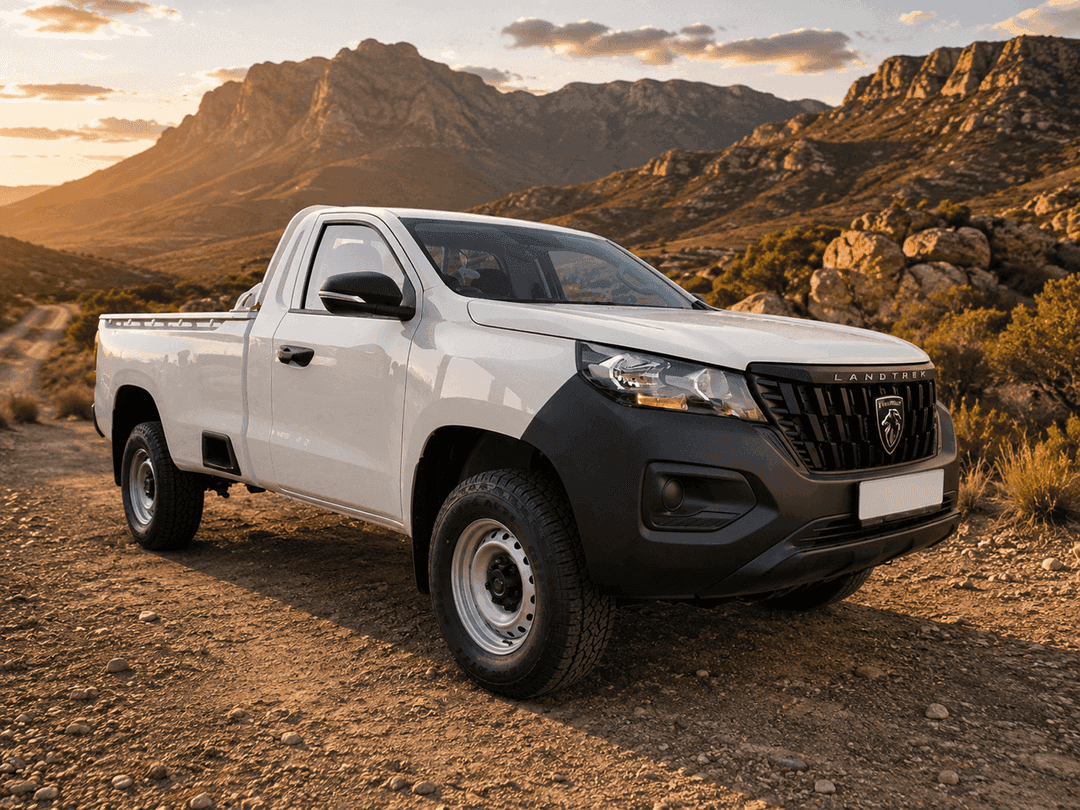
Nothing fancy here. Landtrek Professional wears its intentions on its sleeve: boxy nose, upright glass, squared-off load bin. Badge says Peugeot, but the stance is pure graft. Next to a Mahindra Pik Up Single Cab, it’s less “bakkie bar fight” and more “get the job done with some neatness.”
Segment placement
The target is clear: GWM Steed, base Mahindra Pik Ups, entry-level Hilux, and those last-of-the-line NP300s. It’s not chasing the Ranger XL crowd, and that’s exactly the right call. You get two doors, rear-wheel-drive, and a tray that’s longer than the double cab - so you can load those 2.4-metre boards flat, no drama, even if you’re hustling down the highway with a full load of irrigation pipe.
- Two-door, two-seater - no wasted space
- Rear-wheel drive - does its best work on tar and the odd patch of gravel
- Slab-sided bin, sized for real payloads
- Steelies and black bumpers - quick to knock back into shape after an oopsie
Cabin & Practicality
All about the essentials
You want glamour? Not here. Hard plastics everywhere, seat fabric that shrugs off grime, and a steering wheel that’s no-nonsense to the core. Controls are tactile - proper knobs and buttons, no fussy touch panels like you’ll find in some of the Chinese stuff. I once dropped a whole cappuccino on the dash, wiped it with a serviette, and it was none the worse. This is a cabin you don’t baby.
Two seats, nothing more
Space for you, space for your co-driver - even in winter jackets, you’re not elbowing each other. Stash slot behind the seats for a battered toolbox or your padkos. The six-speed manual’s perfectly placed, and the clutch? Lighter than the now-defunct Nissan NP300, easily. After a bumper-to-bumper crawl, my left leg was still fresh - not something I’ve said about every single cab I’ve tested.
The bed means business
This is where the Landtrek pulls ahead. The load bin swallows three Euro pallets - that’s a number that matters to anyone moving stock for a living. If you’re the guy schlepping plywood, seed, or council roadworks kit, this is the layout that respects your graft.
- Long load bed - three Euro pallets side-by-side
- Built-in tie-down hooks
- Tailgate holds two adults without groaning
- Dealer-fit load liner available
- Spare wheel tucked underneath - practical for roadside repairs
Forget litres. For the Peugeot Landtrek's boot space, the tray is king, and this single cab makes the double cab look like a compromise. Peugeot Landtrek ground clearance is enough for tough farm tracks or the cratered tar - you won’t be scraping your sidesteps every week.
On the Road
The 1.9 diesel: does the job
You know this engine by now - it’s willing, but don’t expect fireworks. Down on brawn next to the Ranger 2.0 SiT or GWM P-Series, and you’ll notice it on a loaded slog up Gillooly’s. But the six-speed manual works in its favour: short shifts, smart ratios, torque that’s there from 1,800 to 2,800 rpm. No drama, just steady work.
Ride, steering, noise
Empty, the rear hops around like every leaf-sprung rival. Add 400 kg of cement, and it settles. Steering is feathery - almost too much over 110 km/h on the highway, where you’re constantly making small corrections. Diesel clatter is mostly outside, so your neighbours will hate your 4:30 am site starts - but you won’t hear it much inside.
Real-world fuel numbers
Peugeot’s 8.9 L/100 km claim is in the ballpark. My run included Jozi traffic, two loaded trips to Magaliesburg, and some open highway - I landed at 9.4 L/100 km. For a bakkie this size and weight, that’s honest. As for the real-world Peugeot Landtrek's fuel consumption, it will swing from 8.3 to 11 L/100 km depending on how hard and how loaded you drive it.
Data & Comparison
Specs in brief
| Spec | Detail |
|---|---|
| Engine | 1.9d (110kW & 350Nm) |
| Gearbox | 6-speed manual |
| Drive | Rear-wheel drive |
| Doors | 2 |
| Body | Pick-up, Single Cab |
| Powertrain | Internal combustion |
| 5-year TCO estimate | R230,000 |
How the rivals line up
| Model | Engine | Gearbox | Drive | Body style |
|---|---|---|---|---|
| Peugeot Landtrek Professional | 1.9d | 6MT | RWD | Single Cab |
| Toyota Hilux S | 2.4 GD-6 | 6MT | RWD | Single Cab |
| Mahindra Pik Up S4 | 2.2 mHawk | 6MT | RWD | Single Cab |
| GWM Steed 5 | 2.0 VGT | 5MT | RWD | Single Cab |
What the numbers say
Bakkie sales between June and November 2025 held strong - segment interest sat between 41.8 and 43.1. Zoom in on single cabs, and you see a lift: 47.4 to 50.6. So, despite all the “bakkie market is dying” noise, workhorse buyers are still showing up.
Ownership costs & add-ons
Five-year TCO (R230,000) covers your basics - fuel, tyres, scheduled services, wear and tear. No finance or insurance included, so budget accordingly. The Professional’s service plan is an optional extra, not standard. Hilux buyers get a plan bundled in, which helps resale. As for the Peugeot Landtrek's accessories in South Africa, they include canopies, load liners, nudge bars, and roller shutters - all available, mostly via dealer fitment. Always quote accessories upfront; some (like powered roller shutters) can get pricey fast.
- The Peugeot Landtrek price in South Africa: Professional Single Cab undercuts the old double cab entry by about R243,000
- Service plan optional - factor it into your running costs
- Stellantis is investing in the Eastern Cape assembly - spares should get cheaper
- 5-year TCO: R230,000 if you pack smart
If you’ve owned a Peugeot before, relax, those Peugeot 207 common problems (dodgy electrics, injector dramas) and Peugeot 2008 engine problems (oil-bath timing belts) aren’t a factor here. The Landtrek’s 1.9 is a solid, well-known Chinese diesel - not the finicky Euro stuff.
Verdict
Who should not
Lifestyle bakkie fans, anyone who wants guaranteed resale, or if you’re obsessed with plush trim and sharp steering. If you’re eyeing a Ranger Wildtrak, you’re looking in the wrong place.
Summary
Farmers, plumbers, small business owners, municipal fleets — anyone needing a real one-tonner that’s cheaper to buy than a Hilux S, sips fuel honestly, and actually fits a pallet or three. It’s what the Landtrek range should have been from day one: a true commercial option.
Ratings
Pros
- ✓Farmers, plumbers, small business owners, municipal fleets — anyone needing a real one-tonner that’s cheaper to buy than a Hilux S, sips fuel honestly, and actually fits a pallet or three.
- ✓It’s what the Landtrek range should have been from day one: a true commercial option.