Suzuki Jimny 5-Door (2026): The R480k Car That Holds Its Value

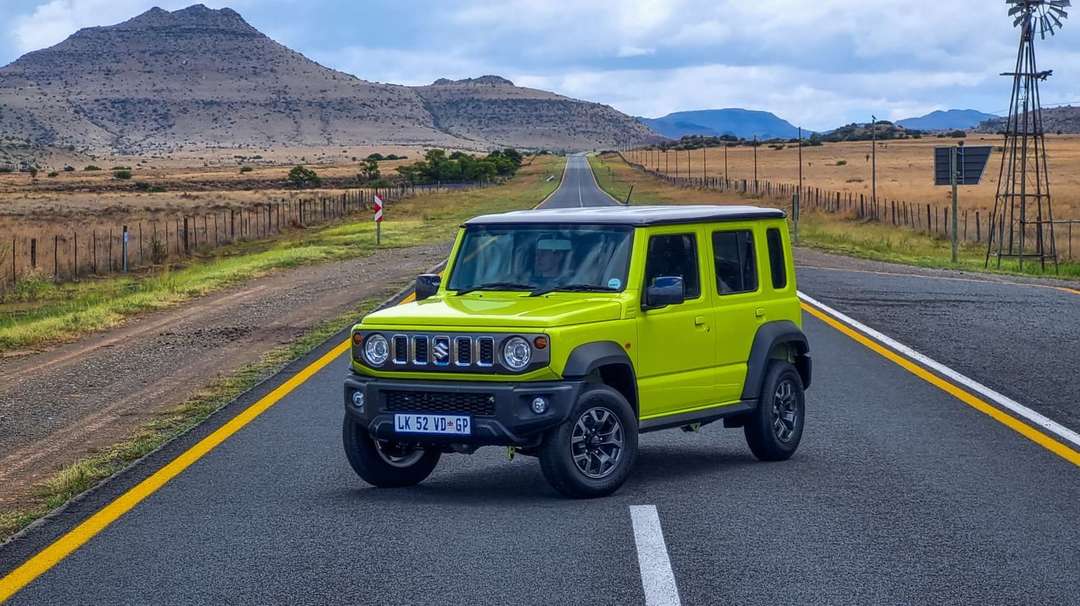
Flawed but deeply likeable, with genuine gravel ability and extraordinary resale value. Poor highway manners and unrated safety prevent a higher score.
Introduction
Look, the Suzuki Jimny 5-door makes sense if you already own a capable highway car and want a compact, characterful weekend 4x4. As your only vehicle, though, I’d think twice. Roughly 229 recent Jimny listings range from R269,900 to R499,900 in 2026, with some used examples matching or even exceeding new-car prices.
So forget asking whether the Jimny is good. It clearly is at what it does. The more important question is whether you’re buying a Suzuki Jimny — or simply paying extra for scarcity.
Key takeaway: Brilliant off-road, nervous on the highway and remarkably resistant to depreciation. Buy it as a second car, preferably new through a dealer rather than used at a premium.
Design & Exterior
Suzuki stretched the Jimny 5-door rather than reinventing it, adding wheelbase length and two genuinely useful rear doors while retaining its narrow body, flat panels and wonderfully defiant boxiness. From a distance, it still looks like a utility vehicle that was left in the wash too long — and that’s exactly why it works.
Footprint that works in the city
Park one beside a Fortuner in a Woolworths bay and the Jimny looks almost toy-like. Good. Its compact footprint suits narrow farm gates, crowded parking areas and mountain two-tracks where the Hilux or Ranger would need a three-point turn and a spotter.
The 5-door vs 3-door question
Choosing between the Jimny 5-door vs 3-door is fairly simple for most buyers. The longer version gives away little in terms of off-road ability, retains 210mm of ground clearance and adds two rear doors you’ll actually use every day. Purists may still prefer the 3-door for its compact proportions, but anyone regularly carrying children, adults or camping gear should take the Jimny 5-door.
Cabin & Practicality
Climb aboard and the Suzuki Jimny feels charming, functional and mildly irritating — often at the same time. Chunky dials, physical buttons and that substantial passenger grab handle suit its utilitarian character perfectly. I’m also glad Suzuki resisted burying basic functions inside a touchscreen. Too many manufacturers have mistaken novelty for progress, and the Jimny is better for keeping things simple.
Materials and controls
Hard plastics dominate, although they feel durable rather than apologetically cheap. Nothing attempts to imitate a premium SUV, and that matters, because expectations remain sensible. Android Auto and CarPlay work without drama, while the proper controls are easy to use on corrugated gravel.
Space and the seat problem
Rear access is vastly better than in the 3-door, and adults can finally sit behind adults. Still, two compromises deserve attention:
- Four doors don’t mean five seats. It seats four, with only two rear seatbelts despite four doors.
- Seat padding is thin, and larger drivers tackling a single-day Joburg-to-Kruger run will notice the weak lumbar support before the fuel warning appears.
Storage remains stingy, with door pockets barely large enough for a phone. Two 45-litre duffels fit in the luggage area with the rear seats occupied, but a bulky pram quickly exposes the limits. If you pack smart, it copes. If not, it bites back.
On the Road
Here’s where the charm runs into the R1 off-ramp. The Jimny’s 1.5-litre naturally aspirated four-cylinder produces 75kW and 130Nm, which is adequate around town and not much more beyond it. An estimated 0-100km/h time of 15.5 seconds tells you everything you need to know.
Passing slower traffic on a single-lane national road requires patience, planning and a generous stretch of clear tarmac. The Jimny is happiest when you accept that it’s built to go places, not get there quickly.
Highway manners
A tall, square body catches crosswinds with enthusiasm. Across the Huguenot Tunnel plateau or along the exposed N1 near Beaufort West, constant steering corrections become part of the journey. The steering feels vague around centre, while the brakes need a deliberate shove.
Cruising at 100 to 110km/h feels natural enough. Pushing towards the national limit, however, is less relaxing. The Jimny is far happier taking its time than pretending to be a long-distance express.
Off-road and gravel
Leave the tar and the Suzuki Jimny suddenly makes complete sense. Its AllGrip Pro four-wheel-drive system with low-range gearing, skinny tyres, 210mm of ground clearance and low kerb weight give it serious ability on Sani Pass gravel, farm two-tracks and dry riverbeds. I once watched a Jimny squeeze between rocks that had stopped a lifted double-cab in its tracks. Out here, being small isn’t a compromise — it’s an advantage.
Fuel consumption reality
Suzuki quotes a combined figure, while our spec data lists 7.7L/100km as the realistic number against a 40-litre tank. An observed return of 8.4L/100km across urban traffic, N3 cruising at altitude and gravel is believable, though hardly spectacular for such modest performance.
- Expect roughly 8 to 9L/100km in mixed real-world SA driving.
- That 40-litre tank means a working range around 450 to 500km before you are hunting for a Sasol.
Data & Comparison
Now for the strange bit. The Suzuki Jimny 5-door price for 2026 sits at a 2026 model-year average of around R467,965, while listings reach R499,900. Used examples then refuse to behave like ordinary used cars.
Used Suzuki Jimny prices by year
Current asking prices show just how slowly Jimny values decline. That’s the heart of the Suzuki Jimny resale value story in South Africa, and a major reason sellers remain confident.
| Model year | Listings | Median asking (ZAR) |
|---|---|---|
| 2020 | 19 | R309,900 |
| 2021 | 21 | R299,900 |
| 2022 | 43 | R332,500 |
| 2023 | 16 | R349,948 |
| 2024 | 13 | R389,950 |
| 2025 | 36 | R438,400 |
| 2026 | 121 | R487,900 |
Our data places the three-year residual near R353,578, an extraordinary result for a mainstream vehicle. Projected five-year cost-to-own is around R230,000, largely because depreciation is close to nil rather than servicing being magically free.
How it stacks up on paper
| Spec | Jimny 5-door | Used Toyota Fortuner (~R470k) | Used diesel double-cab (~R470k) |
|---|---|---|---|
| Ground clearance | 210mm | ~216mm | ~230mm+ |
| Highway ability | Weak | Strong | Strong |
| Tight-track agility | Excellent | Poor | Poor |
| Depreciation risk | Very low | Moderate | Moderate |
Ownership and safety
Suzuki’s South African dealer and parts network has expanded quickly, with groups such as Motus improving access beyond the major centres. Consumables are generally affordable, while insurance has historically been reasonable because theft demand was relatively low. The Jimny’s growing cult status could change that, though.
Safety needs a clear-eyed look. The Jimny 5-door has not been crash-tested by an NCAP body, while the 3-door’s 2018 Euro NCAP and ANCAP three-star results are now dated and don’t apply to the Indian-built 5-door. There’s also an important specification difference: the entry-level GL has two airbags, while the GLX gets six. Check the exact derivative rather than assuming every Jimny offers the same level of protection.
Editorial Focus
Does the Suzuki Jimny deserve its hype, or is it simply benefiting from scarcity? Honestly, both. With the 2026 median asking price around R487,900 and 2025 examples holding at roughly R438,400, nearly-new stock can sit surprisingly close to list price. Oddly, the Suzuki Jimny waiting list South Africa buyers complain about could actually save you money. Ordering through a dealer means waiting, but it also means avoiding a private seller charging a premium for a car that already has kilometres on the clock.
Cross-shop it without the sentimentality. Around R470,000 can also get you into a used Toyota Fortuner or a capable diesel double-cab with proper highway pace, greater towing ability and considerably more cabin space. Either will be calmer on the N1, N3 or R21, particularly with passengers and luggage aboard. The catch? They’re likely to depreciate harder.
My view is simple: the Jimny 5-door behaves more like a small recreational asset than a disposable commuter. You accept crosswind wander, slow overtakes, modest comfort and unrated safety in exchange for low running costs, serious gravel ability and unusually strong residual values. Its familiar shortcomings are real, but they’re much easier to forgive when it’s a second car rather than your only vehicle.
That distinction decides everything.
Verdict
A specialist tool wearing fashionable clothes, the Suzuki Jimny 5-door carries both identities convincingly. Give it the right job and it’s one of South Africa’s most sensible emotional purchases. Get that job wrong, though, and every windy N1 morning will test your patience.
- Just Buy It – the weekend overlander with a second car: Excellent gravel ability, minimal depreciation and genuine cult appeal make the Jimny an easy recommendation.
- Consider It – the rural or farm buyer: Its compact footprint and 210mm ground clearance suit daily two-track work, but those thin seats become tiresome on longer journeys.
- Shortlist It – the style-led urban buyer: Charming to own and excellent at retaining value, although you need to be honest about the practicality you’re giving up.
- Avoid It – the single-car city-and-highway commuter: Crosswind sensitivity, limited comfort and slow overtaking will eventually become frustrating. A used Toyota Fortuner is the better all-rounder.
Check current Jimny 5-door stock through Suzuki South Africa or a local Motus dealer, then value your current car before discussing the deposit. The Jimny works best when you treat it for what it really is: a second car that happens to be exceptionally reluctant to lose money.
Summary
For South African buyers, the 2026 Suzuki Jimny 5-door mixes excellent off-road ability and stubborn resale values with weak highway manners, limited practicality and surprisingly expensive used stock.
Ratings
Pros
- ✓Excellent gravel ability, near-zero depreciation and genuine cult appeal make it an easy recommendation.
Cons
- ✗Crosswind wander, limited comfort and slow overtaking will become frustrating.
- ✗A used Fortuner is the better all-rounder.