Ashok Leyland Dost 1.5 TD DSD (2026) Review
A well-judged workhorse that scores for warranty, fuel use, and price, but holds back with scant safety kit and a fledgling dealer footprint.
Summary
Here’s a straight-shooting look at the 2024 Ashok Leyland Dost 1.5 TD DSD: payload, cabin, fuel numbers, warranty, and why it makes sense for anyone running a small fleet or hustling on rural routes who wants the absolute lowest new diesel bakkie price in South Africa right now.
Introduction
Right, so the Ashok Leyland Dost 1.5 TD DSD is what you buy if getting stock to the spaza, handling farm chores, or running a small building crew is your reality – and you count value by the rand per kilo, not by badge flex. This isn’t a Hilux alternative, and it’s not pretending to be. At R170k to R180k, depending on the body, you’re getting SA’s cheapest factory-fresh diesel bakkie with a yellow-plate. It’s cabover, it’s a no-nonsense three-cylinder turbodiesel, and it comes with a 5-year/500,000 km warranty. No airbags, no ABS, and a thin dealer network – we’ll get to those.
Key takeaway: If you’re after the lowest new-diesel TCO and can live without modern safety, the Dost 1.5 TD DSD is in a league of its own.
Design & Exterior
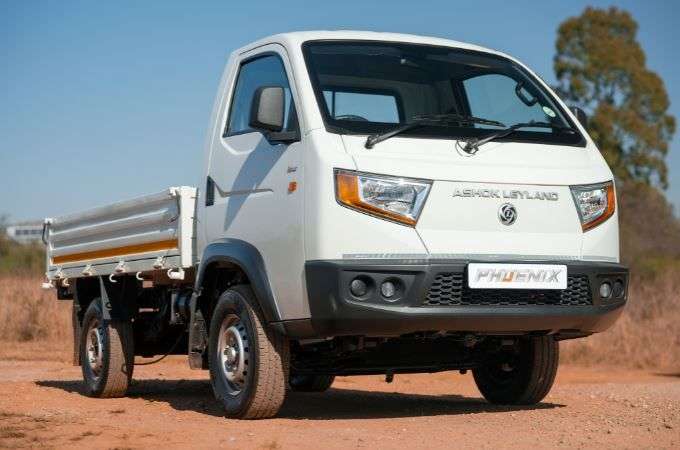
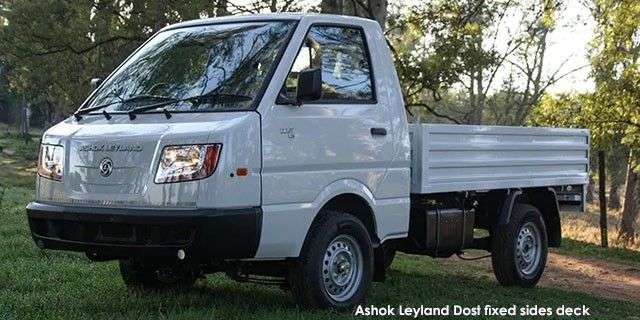
Cabover layout means you’re sitting right above the front wheels, leaving almost all of the 4,650 mm length for cargo. The DSD badge gets you a longer drop-side body than the FSD, handy for conduit, irrigation pipe, or cement bags stacked high. At 1,620 mm wide and 2,020 mm tall, it’s narrow and upright – threading through the Joburg Fresh Produce Market is a breeze, but crosswinds on the R59 will keep you awake.
What you actually see
Nothing here tries to charm. Flat panels, visible hinges, black bumpers, steelies with plastic caps – pure function. The cab protector is standard on DSDs, and that matters: cheaper bakkies get their window frames trashed by shifting loads within months.
Ground clearance and stance
The Ashok Leyland Dost ground clearance is 177 mm (launch figure), with 19 and 22 degrees for approach and departure. That’s proper for gravel roads between Free State farms or those bumpy links around Tzaneen. You’re not tackling Sani Pass, but you’re not grounding out at a muddy building site either.
Cabin & Practicality
First thing you’ll clock: only two seats. This is D+1 – driver and one passenger, because that’s how cabovers are packaged. Everything feels built to last: hard grey plastics, vinyl seats, a rubber floor that’ll take a hose. Power steering? Yes. 12V socket, phone holder, lockable glove box? Yes. Factory air-con? Not listed on the DSD spec, so budget for an aftermarket install if you’re based somewhere like Polokwane in summer.
The load bed is the cabin
This bakkie’s real “interior” is the bed. Payload runs 1,205-1,250 kg (body dependent), which actually puts a Hilux single-cab to shame on paper at least – and at a third the price. Drop-sides actually drop, which is not a given unless you’ve tried to load a fixed-side bakkie with a pallet jack.
- Longer drop-side body than FSD variant
- Cab protector as standard on DSD
- D+1 seating, ELR seatbelts
- Power steering, 12V, phone holder, lockable glove box
- No factory air-con for SA DSD
- No airbags or ABS in SA launch spec
The safety conversation
Let’s not sugarcoat: ABS and airbags are missing from the launch spec. You do get a front impact bar and emergency-locking seatbelts, but that’s about it. If your fleet policy mandates airbags and ABS (think mines, NGOs, SOEs), the Dost won’t make the cut. Owner-operators running between Mooketsi and Pretoria will judge it differently – just be honest about your risk appetite.
On the Road
The 1.5-litre turbodiesel is a 1,478 cc triple making 44 kW at 3,300 rpm and 158 Nm from 1,600 to 2,400 rpm, driving the rear wheels through a five-speed manual. These are numbers for working, not flexing at the car wash.
How it actually drives
Empty, it’s lively in town because it weighs very little and the gearing is short. You’ll hit 60 km/h in third before you know it. Loaded up with 800 kg of sand near Roodepoort, it’s a different story – you have to work the torque band, and you’ll find yourself dropping to fourth on N1 climbs. On the highway, fifth does all the work, but long hills will see you shifting down.
Ride, brakes, steering
Parabolic leaf springs front and rear give a firm ride when empty, but things settle once you load up. Brakes? Vented discs in front, drums at the back, and – surprisingly for this price – a load-sensing proportional valve (LSPV) that tweaks rear brake force based on your load. That’s a real win when you’re running empty one trip and fully loaded the next.
Fuel returns in the real world
Claimed combined is 6.2 L/100 km. I saw 6.7 L/100 km in town and on a 50 km highway stretch, unladen. With 800 kg on the back, that jumped to 8.0 L/100 km. The 40-litre tank gives you 500-550 km between fuel stops. For once, the Ashok Leyland Dost fuel consumption claim actually lines up with what you’ll see in SA, which is rare at this price.
Data & Comparison
Core specifications
| Specification | Figure |
|---|---|
| Engine | 1.5L Diesel, 3-cyl turbo |
| Power | 44 kW @ 3,300 rpm |
| Torque | 158 Nm @ 1,600-2,400 rpm |
| Gearbox | 5-speed manual |
| Drive | RWD |
| Fuel consumption (combined) | 6.2 L/100 km |
| Length / Width / Height | 4,650 / 1,620 / 2,020 mm |
| Seats / Doors | 2 / 2 |
| Estimated 5-year TCO | R372,600 |
Ashok Leyland Dost vs the local rivals
Stacking the Ashok Leyland Dost vs rivals isn’t really fair – nothing else brings this payload, engine type, and price together.
| Model | Engine | Payload class | Approx position |
|---|---|---|---|
| Ashok Leyland Dost 1.5 TD DSD | 1.5L diesel, 44 kW | ~1,205-1,250 kg | Cheapest diesel workhorse |
| Suzuki Super Carry | 1.2L petrol | ~740 kg | Smaller, urban only |
| JAC X100 dropside | 1.3L petrol | ~1,040 kg | Petrol rival, similar size |
| Hyundai H-100 dropside | 2.6L diesel | ~1,335 kg | Heavier, far more expensive |
Ashok Leyland Dost vs Bada Dost
People keep asking about the ashok leyland dost vs bada dost thing – mostly after watching Indian YouTube. The Bada Dost (aka Dost+) is a beefier version with more power and payload, but we get the 44 kW “standard” Dost in South Africa. If you see videos of the Bada Dost pulling away with ease, don’t expect that from ours – our tune is lighter-duty.
Ashok Leyland Dost vs Bolero Pickup
On ashok leyland dost vs bolero pickup, the Mahindra Bolero Pik-Up brings a bigger 2.5L diesel, proper single-cab shape, and a larger dealer network. It costs more, offers better highway manners and safety kit, and you’ll find parts in more towns. The Dost wins on price, fuel efficiency, and load bed length. Decide based on your actual routes – I’d take the Dost for city runs, Bolero for long rural hauls.
Running costs
The ashok leyland dost service cost is helped by a 15,000 km/1-year service schedule – that’s decent for a workhorse. Ashok leyland dost maintenance cost is straightforward: no AdBlue, no DPF, and a chunky 215 mm clutch made for hard work. Five-year TCO? R372,600. That’s the pitch in a nutshell.
Ashok Leyland Dost problems to watch
The real Ashok Leyland Dost problems list isn’t long, but you should know:
- Dealer network: only 14 at launch – check your nearest before buying.
- Safety spec is thin (no ABS or airbags on launch vehicles).
- Cabover seating position feels odd if you’re used to “normal” bakkies.
- No factory air-con for SA DSD – aftermarket is a must in hot regions.
- Long-term resale data is scarce since it’s new to SA.
Market context
SA’s bakkie interest (mid-2025 data) sits in the low 40s, double-cabs in the 60s. The lifestyle double-cab still owns the headlines. Single-cab, pure-work bakkies like the Dost keep ticking over quietly, and those buyers are absolutely ruthless about value.
People Also Ask
Is the Ashok Leyland Dost worth buying in South Africa?
If you’re running a small fleet, trading, or farming and need a diesel bakkie on a budget, absolutely. The 5-year/500,000 km warranty, 6.2 L/100 km claim, and lowest diesel-bakkie price make it hard to beat. Private buyers after lifestyle bling should look elsewhere – this is a tool, not a toy.
What is the Ashok Leyland Dost fuel consumption in real-world driving?
Claimed combined: 6.2 L/100 km. I measured 6.7 L/100 km unladen on mixed urban/highway testing, and with 800 kg loaded, it crept to 8.0 L/100 km. The 40-litre tank gets you 500-550 km a fill – enough for a workday’s routes.
How does the Ashok Leyland Dost compare to the Mahindra Bolero Pik-Up?
Bolero Pik-Up gets a bigger 2.5L diesel, familiar styling, better safety, and a bigger dealer network, but you’ll pay more. Dost is cheaper, lighter, and wins on fuel and load-bed length. Bolero is the rural comfort pick, Dost is the cost-cutting winner.
What is the Ashok Leyland Dost ground clearance?
Spec sheet says 177 mm, with approach and departure at 19 and 22 degrees. That’ll handle gravel, building sites, and farm roads – but don’t expect to go off-roading. At 4,650 mm long and 1,620 mm wide, it fits rural tracks where bigger bakkies just don’t.
How long is the Ashok Leyland Dost warranty?
You get a 5-year or 500,000 km warranty, whichever comes first. That’s a big deal in South Africa, where most rivals stop at 3 years/100,000 km. If your business racks up big mileage, that warranty alone could tip the scales because it pushes repair risk back to the brand through the bakkie’s working life.
Are there serious Ashok Leyland Dost problems owners should know about?
The main gripes are: small dealer network outside big cities, no ABS or airbags on launch spec, no factory air-con on SA DSDs, and not much long-term resale history yet. Mechanically, it’s based on a platform with over 200,000 Indian units built, so reliability isn’t a wild card.
Verdict
The upshot of this Ashok Leyland Dost review south africa: if moving goods cheaply is your business, the Dost 1.5 TD DSD is the sharpest new-vehicle buy out there. Industry-best warranty, honest diesel, a genuinely useful load bed, and the lowest running costs you’ll find in a new bakkie. Don’t bother if you want one car for work and family, need mandatory ABS/airbags, or live more than 200 km from a dealer.
Waiting? Ashok Leyland is prepping BEV and CNG light commercials for SA. If your routes are urban and you can wait 18-24 months, the electric version could change the maths again. For most, though, the numbers already add up...
Rating: 7.0/10
A well-judged workhorse that scores for warranty, fuel use, and price, but holds back with scant safety kit and a fledgling dealer footprint.
Summary
Here's a straight-shooting look at the 2024 Ashok Leyland Dost 1.5 TD DSD: payload, cabin, fuel numbers, warranty, and why it makes sense for anyone running a small fleet or hustling on rural routes who wants the absolute lowest new diesel bakkie price in South Africa right now.