Omoda C5 1.5T SHS DHT (2026) Review
Half a point off for those unknowns — we’ll only know hybrid reliability and resale in a couple of years. But OMODA has fixed what they can fix. And that’s the point.
Introduction
The OMODA C5 1.5T SHS DHT has barged into South Africa's R500k hybrid crowd, and it's not tiptoeing. Want hybrid running costs but baulk at Toyota's price tags? Willing to try a badge your neighbour can't pronounce? Here's your new wildcard. Arriving in 2026, the SHS lands just as South Africans are finally getting more than two affordable hybrid options.
Key takeaway: Sharper, punchier, and more grown-up than the pre-facelift - undercut by its Chery cousin, yes, but nothing else under R500k delivers this much power.
Design & Exterior
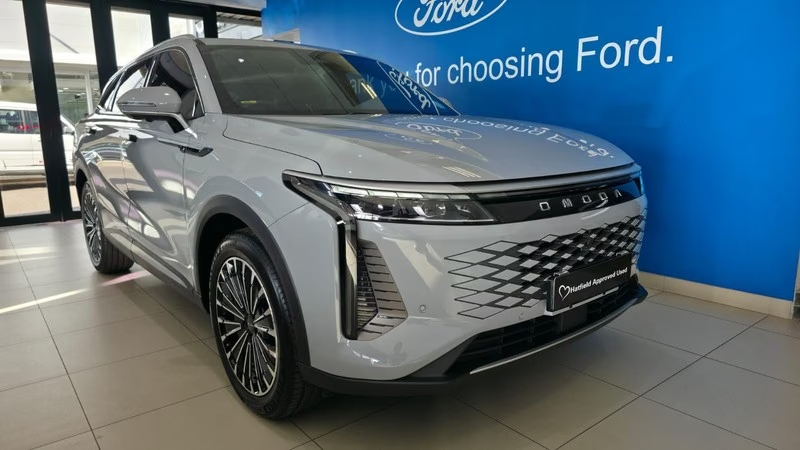
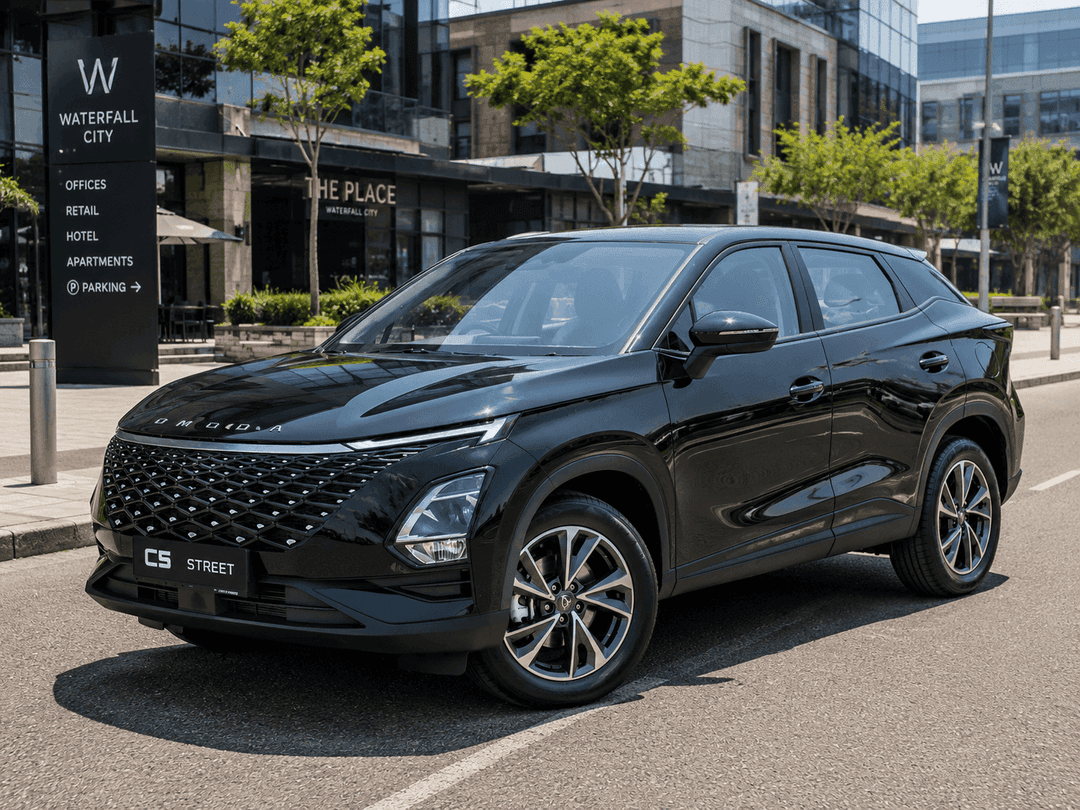
No wild reinvention here. The OMODA C5 still looks like nothing else in the parking lot - hexagonal grille, full-width LED bar, and enough presence to turn a few heads. The SHS gets the 2024 facelift body, so you’ll spot a cleaner bumper and subtler badgework.
What’s actually new on the hybrid?
- Front bumper air intakes tweaked for the new hybrid cooling needs
- SHS badges at both ends - you can spot them from a parking bay away
- Fresh alloys aimed to cut drag (marginally)
- Blue headlight tints as a not-so-subtle hybrid marker
Stance and presence on SA roads
Out on the open road, the C5 looks a half-size up from its rivals. Ground clearance is about right for those unmarked speed humps - tall enough for gravel, without pretending it’ll follow a Hilux to the bush. Park next to a Tucson at the lights and the C5 holds its own, badge snobbery aside.
Cabin & Practicality
Inside, you’re greeted by that dual-screen dash. It’s a leap from the 2023 version - softer dash, less shiny black plastic, and a steering wheel that actually feels pleasant. The wireless charging pad has moved away from the sun-baked dashboard corner - apparently, enough owners complained about roasting their phones. That’s the kind of detail that shows they’re finally listening. It’s what the C5 should have been from the start.
Physical controls - finally!
A real volume knob. About time. Most climate controls still live on screen - I’d trade some of those icons for honest-to-goodness buttons, but at least the basics are tactile. Voice controls? They’re there, but I wouldn’t trust them past Krugersdorp in a downpour.
Space and family duty
- ISOFIX points on both outer rear seats, easy enough to latch even with the seats upright
- Headroom in the rear dips for anyone above 1.85m - that sloping roofline does what it does
- Boot just wide enough for a folded Mountain Buggy pram if you pack smart
- 60/40 split rear bench, folding to a mostly flat floor
It’s honest. Not the roomiest, but for the price, the C5’s cabin is well-thought-out - unless your family is all over six feet, then you’ll want to look bigger. For reference, I managed to wedge a full week’s grocery haul plus a hiking backpack in the boot, but a double pram would have been a stretch.
On the Road
This is where the SHS justifies its spot in the line-up. The 1.5L turbo petrol and electric motor (via the DHT) combine for 165 kW - a big jump over the regular petrol C5’s 115 kW. Still front-wheel drive, still five doors, but with revised springs, dampers and, crucially, a multilink rear end that the old model desperately needed.
Around town
This hybrid handles low-speed pullaways better than most. Eco mode smooths out that awkward electric jolt you get in some hybrids. Switch to Normal, and there’s a half-beat lag as the petrol engine joins - you’ll notice it if you’re trying to dart into a gap in traffic. It’s a rhythm you pick up after a few days behind the wheel.
Highway from Joburg to Harties
I took the SHS on a long-ish drive, and at a steady 120 km/h, it settles down nicely. The hybrid system keeps revs low, with only a bit of wind whistle sneaking in around the A-pillars at speed. It’s not a CVT, despite what you might’ve heard. The car feels planted enough to overtake trucks without breaking a sweat.
Ride quality and SA tarmac
The switch to multilink rear suspension is the big win here, especially over the battered tarmac. There’s still some vibration on rough bits, but it’s a world ahead of the old torsion beam. Steering stays light and accurate, but don’t expect actual feedback - most Omoda C5 review buyers won’t care, honestly.
Data & Comparison
The numbers that matter
- Powertrain: 1.5L Petrol / electric (Full hybrid HEV)
- Combined output: 165 kW & 295 Nm
- Drive: FWD
- Doors: 5
- Generation: 5 (facelift 2024)
- Model year: 2026
- Estimated 5-year TCO: R230,000
That five-year TCO of R230,000 is a headline figure - if you’re weighing the hybrid cost against petrol-only rivals, start there. On paper at least, the SHS edges the segment for running costs. Boot capacity with a pram is about 375 litres, which is just enough for a weekend away if you pack smart.
Omoda C5 vs the SA hybrid pack
| Model | Powertrain | Combined output | Drive | Turbo? |
|---|---|---|---|---|
| OMODA C5 1.5T SHS DHT (2026) | 1.5T HEV | 165 kW | FWD | Yes |
| Toyota Corolla Cross Hybrid | 1.8 NA HEV | Lower | FWD | No |
| Chery Tiggo Cross HEV | 1.5 NA HEV | Lower | FWD | No |
| Haval Jolion Pro HEV | 1.5 HEV | Lower | FWD | Yes |
Trend context
Hybrid interest here has hovered around 72 points since mid-2025, with SUVs nudging 76. The C5 SHS sits right in this sweet spot - it’s exactly where buyers are watching.
Equipment and accessories
Omoda C5 accessories in South Africa are predictable: rubber floor mats, a tonneau cover, roof crossbars, and a tow bar. Enough to kit out for an escape without chasing grey-import parts. The Street + spec is the petrol’s value pick, but the SHS sits as the top of the range - so use the Omoda C5 1.5T Street + price in South Africa as your baseline before shelling out for hybrid flair.
The known unknowns
Let’s be honest: the SHS drivetrain is fresh, so long-term quirks aren’t mapped. Early C5s had infotainment freezes and hair-trigger ADAS braking, but software updates have fixed most of that. I’ve spotted forum threads about warning lights after updates, and the odd front bumper clip coming loose after a hard knock - classic C5 damage symptoms. Nothing major or structural so far, but it’s early days for the hybrid.
Safety rating
ANCAP · tested 2022
★★★★★ 5/5 adult occupant
Australian-market RHD rating — indicative for SA only where the SA derivative matches the tested safety spec (airbags/ESC/AEB). Official factsheet.
Verdict
This is the most complete OMODA yet for SA. That hybrid turbo combo stands out in a sea of naturally aspirated rivals, the cabin finally feels mature, and the new suspension means it rides like it should on Joburg’s worst. The 165 kW output is more than a number - it means you’ll overtake with confidence, and R230,000 for five years of running costs tips the value argument into OMODA’s favour.
Summary
This is OMODA’s most resolved product for South Africa — genuinely. The turbo-hybrid combo stands apart in a field of naturally aspirated rivals, the cabin is grown up at last, and the new suspension means it finally rides like it should on our battered roads. That 221 hp output pays dividends when you need to blast past a truck on the N1, and R230,000 for five years of running costs puts the maths in your favour.
Ratings
Pros
- ✓You want the most hybrid punch per rand, you’re not fussed about big-name badges, and you do enough varied driving to see actual fuel savings.
Cons
- ✗Resale is everything, or you need a dealer in every town — Toyota still wins both.
- ✗Also, if your back seats are always full of tall adults, look elsewhere.
- ✗The roofline isn’t forgiving above 1.85m.