Suzuki Dzire 1.2 GL+ CVT (2026) Review
Strong value, honest economy, and a decent feature list – but held back by a tight boot, fixed rear seats, and an engine that works hard for every kilometre.
Introduction
Look, if you want a no-frills sedan under R300k that won’t bleed you dry on fuel or servicing, and you care more about economy than acceleration, the Suzuki Dzire 1.2 GL+ CVT sits right near the top of the pile. It’s aimed at city commuters, young families, and e-hailing drivers who have spreadsheets open more often than Instagram. If you regularly haul four people from Joburg to the Cape or need a weekend fun machine, you’re better off elsewhere. The new Z12E three-cylinder with CVT only really makes sense once you’ve tried the manual in thin Highveld air and seen how much effort it demands. For 2026, the fourth-generation Dzire gets the GL+ trim, which is honestly the only one most private buyers should even bother with.
Key takeaway: The GL+ CVT suits Gauteng commuters who want low costs and easy driving, but the tiny boot and modest outputs set clear limits.
Design & Exterior
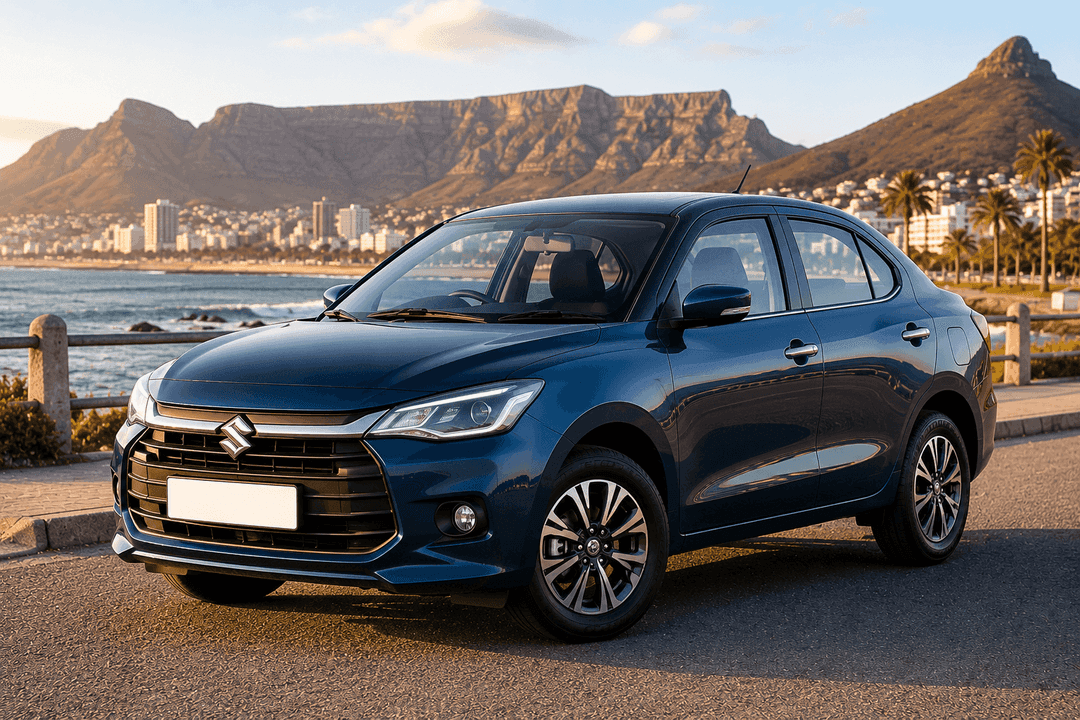
Gone is the old awkward Swift-with-a-boot vibe. The new Dzire is finally a proper sedan - longer nose, upright grille, and tail lamps that look like they belong on a car costing R100k more. At 3 995 mm in length, 1 735 mm wide and 1 525 mm tall, it ducks just under the four-metre mark for tax perks, which is why Suzuki can price it so keenly for local buyers.
GL+ trim differentiators
GL+ does enough to avoid the white-fleet look of the GA. You get:
- Black 15-inch alloys wrapped in 185-section rubber
- Boot spoiler – subtle, but there
- Body-coloured handles and mirrors
- LED projector headlights with DRLs
- A bit of chrome up front
It works. I parked next to a Hyundai Grand i10 Sedan at the Pick, and the Dzire looked better resolved, less like a hack. Proportions are still personal taste, but Suzuki’s clearly trying to step away from the Uber default image of the old model.
Cabin & Practicality
Inside, you’re greeted by a black-and-beige combo. Some will call it bright; others will see a cleaning bill. Saw a courier’s Dzire in Rosebank with beige seats already showing courier-life stains – parents of toddlers or anyone who eats Steers in the car, just get seat covers. Trust me.
Materials and controls
Plastics are hard, but that’s honest at this price. Top surfaces are decently textured, and the dash layout is fresh. Suzuki stuck with proper rotary climate dials. Three simple knobs, big markings, and no fiddling with screens while you’re merging onto the freeway. That matters – too many cheap cars now hide basics in touchscreens, which is just frustrating.
The 9-inch infotainment screen is crisp, with wireless CarPlay and Android Auto. Reverse camera and parking sensors are standard, which you’ll need because the rear window is tiny. Rearward vision? Not great.
Space and Suzuki Dzire boot space
Rear legroom is fair for adults under 1.85 m, though the middle perch is for emergencies only. Treat it as a four-seater, and everyone’s happy. Boot volume? 378 litres. Sounds decent, but see for yourself:
| Model | Boot (L) | Length (mm) |
|---|---|---|
| Suzuki Dzire 1.2 GL+ | 378 | 3 995 |
| Honda Amaze | 420 | under 4 000 |
| Hyundai Grand i10 Sedan | 402 | under 4 000 |
| BAIC Beijing X55 Pegas | 475 | under 4 000 |
The Dzire is outgunned on luggage space, and the rear seatbacks are fixed. That’s the headache. A flat-pack from Makro? Good luck. Two big suitcases and a stroller? You’ll be playing Tetris.
On the Road
Under the bonnet, the Z12E three-cylinder gives you 60 kW at 5 700 r/min and 112 Nm. Not exactly a hot hatch. On paper at least, it’s the slowest in its set. But the CVT changes the real-world story.
The CVT versus the manual
I started with the manual GL+ on the Highveld with four adults. Pulling away on a Northcliff incline took real effort to avoid stalling the engine. That’s why the CVT makes sense here. Yes, it adds 1.5 seconds to the 0-100 km/h run compared to the manual, but it keeps the engine where it’s happiest, and you don’t have to work so hard in Joburg traffic or at altitude.
Southbound on the M1 past Gold Reef City, the CVT keeps things calm at 120 km/h. Push the throttle, and you’ll get the typical CVT drone, but cruising, the noise isn’t intrusive. Around Sandton at rush hour, the gearbox is smooth, and while you’ll hear the three-cylinder’s grumble at every robot, it’s never rough enough to bother you.
Ride, steering and Suzuki Dzire ground clearance
The Heartect chassis gives you a surprisingly settled ride for a budget sedan. You’ll feel sharp potholes, but most expansion joints on the N3 are soaked up. Steering is light, just what you want for mall parking, and the 9.6 m turning circle is a gift in cramped Cape Town side streets or Sandton basements.
Ground clearance sits at 163 mm – enough for Centurion’s speed bumps and the battered tar you’ll find anywhere outside the city centre. Expect a scrape on vicious driveway entries. Occasional gravel to a Free State weekend spot? Fine. Daily farm roads? Rather get a Swift-based crossover.
Data & Comparison
Specs at a glance
- Engine: 1.2-litre three-cylinder petrol (Z12E)
- Power: 60 kW (81 hp)
- Torque: 112 Nm
- Transmission: CVT, front-wheel drive
- Claimed combined consumption: 4.5 L/100 km
- Length / width / height: 3 995 / 1 735 / 1 525 mm
- Seats: 5
- Doors: 4
Real-world fuel return
Independent tests have shown about 5.1 L/100 km in mixed driving for the manual. The CVT? Similar at the coast, but in Gauteng with four up and the aircon on, you’ll see closer to 6.0 L/100 km. With a 37-litre tank, expect over 600 km between fills if you drive with a light foot.
Suzuki Dzire vs the segment
Honda Amaze has a bigger boot and a silkier CVT, but Dzire wins on cheaper running and a far broader after-sales network. The Hyundai Grand i10 Sedan’s cabin can’t match the Dzire’s infotainment, and the BAIC Beijing X55 Pegas trumps it on boot space but not on dealer support or resale value. That’s the point – in SA, the badge and service network still count as much as spec sheets.
Suzuki Dzire price in South Africa and ownership
GL+ manual starts at R246 900 (August 2025), and the CVT bumps that into the high R260k range depending on what you add. That’s sharp for a well-specced auto sedan. Service plan covers the basics, and five-year running costs work out to about R340 250. That tells you why the fleet guys are lining up outside Suzuki showrooms.
SA segment trend
Sedan demand in SA is steady – monthly numbers sat between 65 and 71 from June to November 2025. SUVs are hotter, sure, but sedans still outpace hatches and double cabs. Anyone claiming sedans are finished here just hasn’t checked the numbers.
Suzuki Dzire problems to watch
No major issues yet, but buyers should check for:
- Beige seats pick up stains fast, even on new cars
- CVT fluid intervals, which are stricter than normal autos
- Noticeable idle vibration from the three-pot – totally normal
- Non-folding rear seats limiting boot flexibility
On balance, Suzuki’s reputation for reliable, simple running gear still holds. The Z12E is new, but its CVTs have been around long enough to iron out the major teething problems. If you pack smart, the Dzire’s day-to-day usability won’t let you down.
Verdict
This fourth-gen Suzuki Dzire 1.2 GL+ CVT is finally the honest, affordable sedan Suzuki needed in SA. It’s well equipped, safe for its price, and in CVT form it takes the sting out of Highveld commutes. The limitations? Smallest boot in the class, fixed rear seatbacks, and an engine that’s more about stretching every drop of petrol than stretching your arms in excitement. Beige trim will haunt any parent or Uber driver. Still, for city-bound families or operators chasing low running costs, it’s hard to beat. If you’re hoping for more gadgets, keep an eye out – if Suzuki brings over the wireless charger, 360-cam or sunroof from India, that could be the ultimate spec. For now, this is the sensible buy.
Summary
This is a full review of the 2025 Suzuki Dzire 1.2 GL+ CVT, taking it through its paces on Highveld roads, in city traffic, and against the usual suspects in the sub-four-metre sedan segment. We’re talking real running costs, boot space with shopping or a pram, and what it’s actually like to drive u