Suzuki Super Carry 1.2 (2026) Review

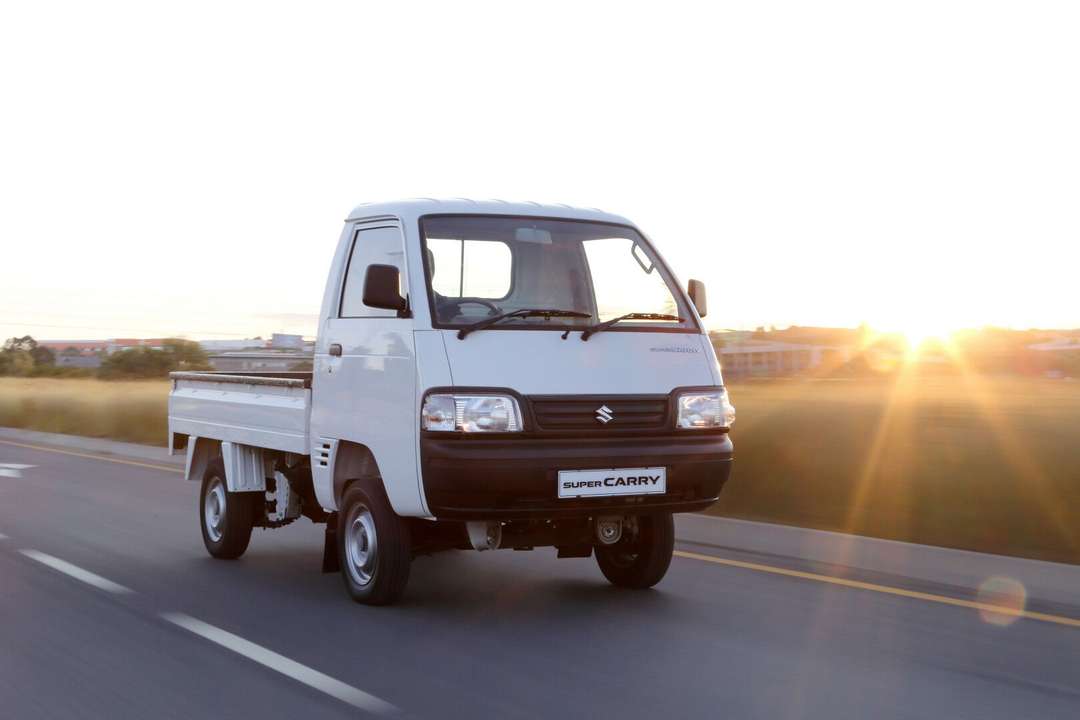
Blunt, honest, and cheap, the Super Carry delivers exactly what’s promised in the city. A higher rating is off the table until the safety spec finally gets dragged out of the past.
Introduction
If you’re hustling deliveries through dense suburbs or keeping a spaza shop stocked in Vosloorus, there’s one reason to pick the Super Carry: it’s the most affordable, honest new bakkie you can buy with a Suzuki badge and proper parts support. As of 2026, it’s one of the last sub-R200k new bakkies standing, and that matters because the half-tonne LCV market is now a ghost town for mainstream brands. This Suzuki Super Carry review for South Africa is for plumbers, florists, spaza resuppliers and canopy fitters, not the Sani Pass dreamers. Let’s not pretend otherwise – the Carry is a workhorse, through and through.
Key takeaway: The Super Carry gives you what you need and not a bit more: city-focused, wallet-friendly, and covered by Suzuki’s dealer network. Just know the safety spec is from another era, and long highway runs aren’t its strong suit.
Design & Exterior
A cab-over shape that earns its keep
Forget style points. The Super Carry’s cab-over single-cab shape is pure function. At 3,800 mm long and 1,562 mm wide, it’s about the size of a Swift hatch with a flatbed grafted on. Sitting above the front wheels means you get a big load tray for the footprint. On a choked Yeoville side street, or squeezing into a tiny Woodstock delivery bay, that tight turning circle is a lifesaver.
How does it look next to the new Chinese pack
Park it next to a DFSK K01S at a Boksburg dealership and the age gap is obvious: the Suzuki looks dated, basic, deliberately bare. That’s not a criticism. The current model’s roots go back to 2013, and the South African version doesn’t try to hide it - flat panels, halogen lights, steel wheels, painted bumpers, no chrome, no lifestyle spin. For a work bakkie, that’s spot on. And if you’re slapping on signage, the blank canvas doors are a bonus.
Dimensions that decide your route
- Length: 3,800 mm
- Width: 1,562 mm
- Height: 1,883 mm
- Ground clearance: 175 mm (Suzuki SA spec)
- Turning circle: 8.6 m (Suzuki SA spec)
Cabin & Practicality
Two seats, no apologies
Inside, it’s pure function: two seats, wind-up windows, a slide-adjust driver seat, and a slabby, utilitarian dash. No rev counter on most. No touchscreen. Aircon? Double-check before assuming. The driver’s seat is bolt upright with limited recline - fine for a 14 km delivery loop, but not if you’re slogging from Midrand to Pretoria twice a day.
Load bay, payload and the cab-over advantage
This bakkie is all about the tray. Suzuki SA quotes 2.18 m long, 1.49 m wide, and a 750 kg payload (against a 1,600 kg GVW). That width leads the micro-bakkie class, and the flat bed means you can angle in a standard pallet - something a Grand i10 Cargo simply can’t match. The tray bolts off easily, so drop-side and canopy conversions are quick work for a Pinetown upfitter. I watched a florist load twenty buckets of proteas in under two minutes; try doing that with a hatchback.
Safety: the part you have to read twice
Let’s not sugar-coat it: there are no airbags, no ABS. That’s 1990s spec, even if every direct rival is just as bare. If your driver has to slam anchors on a wet M1 on-ramp with 600 kg of tiles, it’s physics and luck, not electronics, that’ll save you. It’s a reality you can’t ignore, but at this price, every rival is just as primitive.
On the Road
The 1.2 in town
Under the seats sits a 1.2-litre petrol four (59 kW, 104 Nm) running to the rear wheels via a 5-speed manual. Those numbers sound feeble on paper at least, but the Carry’s featherweight build means it scoots around town easily. Around Mowbray, loaded with 200 kg of flowers, throttle response is decent, and the clutch is light enough for a 40-stop delivery day. No left calf trauma, even after a full shift.
Highway behaviour, unladen versus loaded
Worst-case scenario? N1 between Cape Town and Paarl, empty load bed, 110 km/h. The short 2.11 m wheelbase and tall body make it skittish; a passing Scania can shift it sideways. Drop 400 kg of cement in the back, and it settles down. Most bakkies are the opposite. That tells you exactly what this thing was designed for: city work, loaded, not high-speed cruising.
Fuel consumption: claim versus reality
Suzuki claims 5.9 L/100 km. My own mixed week (school runs to Sandton, two warehouse trips to Midrand, and a Bronkhorstspruit highway stretch) plus owner reports came out at 7.4 L/100 km. That’s a fair chunk more than the brochure, and it matters if you’re counting cents. For honest city driving, expect 7 to 8 L/100 km. The 40-litre tank gives a decent range, but don’t run it dry waiting for the warning light.
Data & Comparison
The headline specs
| Spec | Suzuki Super Carry 1.2i |
|---|---|
| Engine | 1.2L petrol, 4-cyl |
| Power | 59 kW |
| Torque | 104 Nm |
| Gearbox | 5-speed manual |
| Drive | Rear-wheel drive |
| Seats | 2 |
| Claimed combined fuel | 5.9 L/100 km |
| Length / Width / Height | 3,800 / 1,562 / 1,883 mm |
How it sits against the obvious rivals
| Model | Power | Payload (claimed) | Dealer footprint in SA |
|---|---|---|---|
| Suzuki Super Carry 1.2i | 59 kW / 104 Nm | 750 kg | Wide, mature |
| DFSK K01S | 65 kW / 115 Nm | 985 kg | Growing, newer |
| Hyundai H100 2.6D | 58 kW / 167 Nm | ~1,100 kg | Wide, mature |
Mahindra in the conversation
If you’re lining up the Suzuki Super Carry vs Mahindra Jeeto or even a Suzuki Super Carry vs Mahindra Pik Up, Mahindra’s Bolero and Jeeto deliver similar value: tough, simple, cheap to fix. Suzuki’s trump card is a dealer footprint that covers everywhere from East London to Polokwane, plus a powertrain made from proven passenger-car bits. It’s what the Carry should have been from the start, and that’s the point.
Ownership cost and the service plan question
- Estimated 5-year TCO (fuel, service, insurance, tyres, modelled): about R374,550
- 3-year residuals: low, as you’d expect for a sub-R200k bakkie
- The Suzuki Super Carry service plan for South Africa is usually an optional extra. Some dealers have run with a 10-year/1-million-kilometre warranty promo, but always check the fine print – headline numbers and real contracts often don’t match up.
That TCO is what I’d scribble on a whiteboard for any startup. Five years of city van work, under R400k, is honest money for a Mitchells Plain one-man business.
Segment trend context
Bakkie interest sat at 43 points in November 2025 on our internal tracker, while LCV-specific demand hovered at 1.5 points over six months. The Super Carry is fighting in a niche, but the Suzuki badge does some heavy lifting here.
Verdict
Super Carry answers a specific need: what’s the cheapest, basic, dealer-backed new bakkie I can send out on deliveries tomorrow? If that’s your job, it fits. The 750 kg payload, cab-over layout, 8.6 m turning circle and Suzuki parts backup are the tools city operators need. I watched a local courier load up for three stops in less than five minutes, barely breaking a sweat.
Walk away if your work means daily 120 km/h highway blasts, or if passengers expect airbags. Skip it too if you want comfort or tech – there’s nothing here for Friday-afternoon escapes. And a tip: Suzuki’s international Carry already offers AMT and 4WD elsewhere. If your dealer hints that a facelift is coming, and you can wait out the next six months, maybe hold off…
Summary
This is a 2025/2026 look at the Suzuki Super Carry 1.2i single-cab, targeted at small-business owners in South Africa. We’ll cover payload, running costs, real-world safety, and whether the cheapest Suzuki bakkie left standing can hold its own against the new Chinese contenders flooding the market.