GWM Tank 500 3.0TD 4WD Ultra Luxury (2026) Review

A lavishly equipped, comfortable and capable seven-seat off-roader, chiefly undone by hybrid thirst and residual uncertainty. Still, its sheer value is difficult to ignore.
Introduction
Look, the GWM Tank 500 makes sense if you want seven seats, serious off-road hardware and luxury-car equipment without moving into traditional luxury-SUV money. You’ll need to accept a thirsty hybrid and an uncertain resale story. That’s the deal. At its 2024 launch on our shores, GWM asked buyers to spend seven figures on a badge once associated with budget bakkies. This GWM Tank 500 review asks whether that bold value pitch holds up beyond the showroom.
Key takeaway: Vast equipment and genuine off-road ability, tempered by heavy fuel use and uncertain residuals.
Design & Exterior
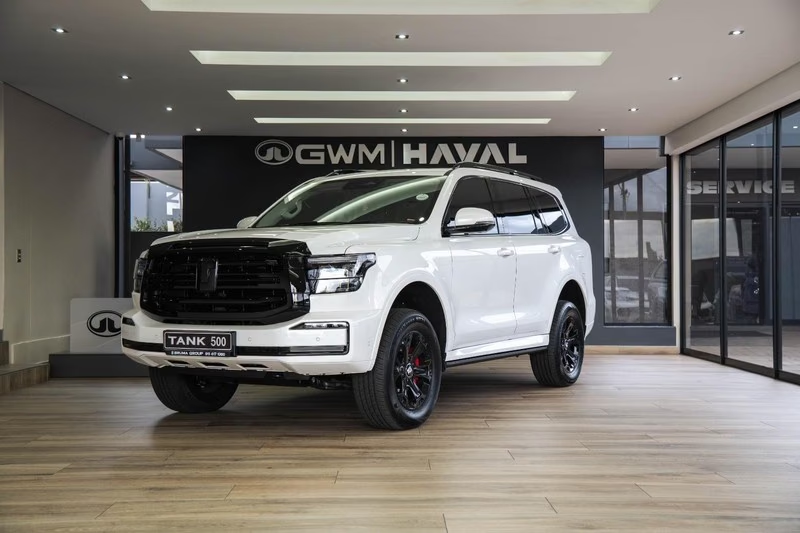
Styling first, because the Tank 500 divides a braai faster than the wood-versus-briquettes argument. Big, upright and drenched in chrome, it borrows openly from Land Cruiser and Land Rover without becoming a copy of either. Some will call it imposing. Others will call it excessive.
Presence and proportions
Measuring roughly 5,078 mm long, 1,934 mm wide and 1,905 mm tall, this is a substantial vehicle. Its 2,850 mm wheelbase adds visual heft. Park one beside a Fortuner at Woolworths and the GWM appears a class larger, which is precisely the point.
- Overall length: around 5,078 mm.
- Overall width: 1,934 mm.
- Overall height: 1,905 mm.
- Ground clearance: 224 mm.
Retro-boxy lines, slab-sided bodywork and the rear-mounted spare give it an old-school 4x4 flavour. I wasn’t convinced on collection day. By the end of my test tenure, I’d warmed to it.
Cabin & Practicality
Inside is where GWM’s argument becomes difficult to dismiss. The Tank 500 interior is why curious buyers enter a GWM dealer and leave wondering whether the established brands have become complacent. It feels expensive because, in most places, it is.
Materials and toys
Nappa leather, heated, ventilated and massaging front seats, a panoramic roof, a large central touchscreen, a digital instrument cluster, head-up display and ambient lighting are all standard. Matching that equipment elsewhere takes some doing, even among Everest and Fortuner range-toppers. Cabin value is the Tank’s strongest card. No question.
Seven seats and boot
Row three suits children best, although shorter adults will manage brief trips without lodging a formal complaint. Fold that third row away and you get 795 litres of luggage space. Folding both rear rows opens up 1,459 litres. Those figures apply with seats folded, so do not mistake the headline capacity for the space available with all seven seats occupied.
- Boot with third row folded: 795 litres.
- Both rear rows folded: 1,459 litres.
- Seating capacity: seven.
Most controls fall easily to hand, but several useful functions live inside touchscreen menus. Physical buttons would be far easier to use when broken tar has the cabin moving about.
On the Road
Power comes from a 2.0-litre turbo-petrol engine paired with an electric motor and a small hybrid battery, driving through a nine-speed automatic and four-wheel drive. Combined output is 255 kW. Straight-line pace is respectable, with GWM quoting 0–100 km/h in around 8.3 seconds at launch. Source: GWM’s HEV launch specifications
Ride and refinement
Here’s the surprise. Despite its ladder-frame construction and roughly 2,605 kg mass, the Tank 500 rides with impressive composure. Corrugated Karoo gravel, the kind that rattles lesser 4x4s into submission, was absorbed without shuddering through the cabin. Body roll remains sensible for something so tall. It is in these conditions that a vehicle’s true character is exposed, and the damping did not disappoint.
The powertrain caveats
Sustained climbs reveal cracks in the headline numbers. On the longer uphill stretches of the N3, the hybrid sometimes felt breathless and busy, particularly when asking it to pick up speed behind slower traffic. The outputs suggest it should feel more effortless.
Low-speed hesitation is also something to assess on a test drive. Pulling away from a junction should not leave you waiting for the drivetrain to catch up with your right foot. Ask the dealer whether the vehicle has the latest applicable powertrain software, and spend time in stop-start traffic before committing.
Steering weight can be adjusted through the menu, and the middle setting felt the most convincing.
Off-road hardware
Soft-roader? Not a chance. Its hardware is serious.
- Front and rear differential locks.
- Low-range transfer case.
- Off-road cruise control and multiple terrain modes.
- Tank Turn system for tight, low-speed manoeuvres on suitable loose surfaces.
- Quoted wading depth of 800 mm and ground clearance of 224 mm.
Approach, breakover and departure angles of 30, 22.5 and 24 degrees underline that intent. Across a deeply rutted farm track, it climbed with calm traction where a road-focused family SUV would have struggled for clearance and grip.
Data & Comparison
Now for the sums. The equipment makes a strong case for the asking price, but the running costs deserve just as much attention. Fuel consumption is the uncomfortable part.
The thirst problem
GWM claims roughly 8.5 L/100 km. Repeated urban use has produced 15 to 17 L/100 km, firmly in petrol-V8 territory. During one steadier N1 run, the indicated average settled at 11.8 L/100 km over 186 km. Later, crawling through traffic on the R21 soon had it climbing again.
- Claimed economy: around 8.5 L/100 km.
- Observed urban consumption: 15 to 17 L/100 km.
- Fuel tank capacity: 80 litres.
- Braked towing capacity for the hybrid: 2,500 kg.
That discrepancy hurts most in stop-start Joburg traffic, especially once pump prices and tolls join the calculation. A steady highway cruise improves matters, but this hybrid never delivered the thrift its badge might lead you to expect.
How it stacks up
| Specification | GWM Tank 500 HEV | Toyota Fortuner 2.8 GD-6 | Ford Everest V6 |
|---|---|---|---|
| Power output | 255 kW | 150 kW | 184 kW |
| Seating | 7 | 7 | 7 |
| Differential locks | Front and rear | Rear only | Rear only |
| Standard luxury equipment | Extensive | Moderate | Generous |
| Ground clearance | 224 mm | 216 mm | 226 mm |
Measured by hardware and standard equipment, the GWM makes a convincing case. Toyota and Ford counter with established ownership histories and familiar support networks, particularly beyond the major centres. Exact equipment still depends on the derivative you choose.
Segment context
The Tank 500 brings together three things that attract attention: SUV space, luxury equipment and a hybrid drivetrain. Buyer curiosity is understandable. The real test is whether that showroom interest translates into satisfied long-term owners.
Editorial Focus
So, does a seven-seat luxury off-roader from GWM truly add up? Yes, with qualifications. Your answer depends on how heavily you value equipment against long-term ownership certainty.
Specification is where the Tank 500 embarrasses parts of the establishment. Nappa leather, massaging seats, twin diff locks and a nine-speed auto arrive in a package that makes some rivals feel decidedly workmanlike. Warranty cover, a service plan and lengthy high-voltage battery protection make the proposal easier to swallow. GWM understands that generous aftersales cover matters when asking South Africans to trust it with seven figures.
Catches remain, and they centre on ownership confidence. Residual values are less established, so the purchase price deserves careful consideration alongside what the car might fetch at trade-in. Hybrid thirst also eats into the ownership argument. If your travels take you far into the Northern Cape, check the actual dealer, repair and recovery support along your routes before buying.
The newly introduced 3.0-litre turbodiesel adds another option. GWM launched it locally in September 2026 with 170 kW, 620 Nm and a towing capacity of up to 3,500 kg. That makes it worth considering for buyers whose priorities are towing and long-distance travel. Its real-world economy and touring range still need judging on their own merits.
Families drawn to the hybrid’s refinement and equipment should still give it a look. Regular towers should compare the diesel before deciding.
Safety rating
ANCAP awarded the Tank 500 a five-star overall safety rating under its 2024 assessment. That is an overall result, rather than a five-star score specifically for adult occupant protection.
The published rating covers the applicable Australian and New Zealand hybrid and plug-in hybrid variants. Check the South African derivative’s safety specification before treating that result as directly equivalent, particularly when considering the diesel.
Verdict
Few vehicles show more clearly how far GWM has moved beyond its old reputation. The Tank 500 isn’t flawless, and those fuel figures will send some buyers straight back to Toyota. Yet as a statement of GWM’s progress, and as a substantial luxury 4x4 for the rand, it carries real weight.
Buy it: Urban and suburban families wanting generous luxury equipment, seven seats and genuine off-road ability, provided the fuel bill fits the budget.
Shortlist it: Occasional overlanders prepared to trade established residuals for serious hardware and reassuring warranty cover. Include the diesel if towing and long-distance travel matter.
Wait: Buyers wanting a clearer picture of resale values or independent long-term results from the newly introduced diesel.
Walk away: Deep-rural operators whose routes lack suitable support, plus buyers unable to absorb heavy fuel bills or a potentially steep depreciation hit.
Summary
A proper South African review of the 2024 GWM Tank 500 2.0T 9HAT 4X4 Ultra Luxury, covering its hybrid powertrain, seven-seat cabin, off-road ability, ownership costs and prospects against the Toyota Fortuner, Ford Everest and Land Cruiser Prado.
Ratings
Pros
- ✓Urban and suburban families wanting maximum luxury equipment, seven seats and genuine off-road ability per rand, mostly for tar-road driving where touring comfort matters most.