Hyundai H-1 2.5 CRDI MPV A/T (2016) Review

A workhorse that earns its score for capacity and running-cost logic, but loses marks on cabin flexibility, a bouncy ride on bad tar, and an interior that’s starting to feel its age. For the right buyer, that's the point...
Introduction
Right, so if you actually need to move nine adults and your wallet doesn't stretch to a three-year-old Kombi, the H-1 2.5 CRDi auto still sits at the sensible end of the spectrum. That's not sugarcoating it. I drove this van in 2025, and let's be honest: it's about as fashionable as a Hi-Tec sandal, but that’s not the point. This is a minibus built for big families, B&Bs, shuttle duty, and church groups - the no-messing, budget-conscious choice. Just know what you’re getting into. There are compromises, and they're not small.
Key takeaway: If you want to move nine adults in comfort for the least money in South Africa, the H-1 2.5 CRDi auto is it. Just don't buy blind - inspect thoroughly and understand its commercial-van roots.
Design & Exterior
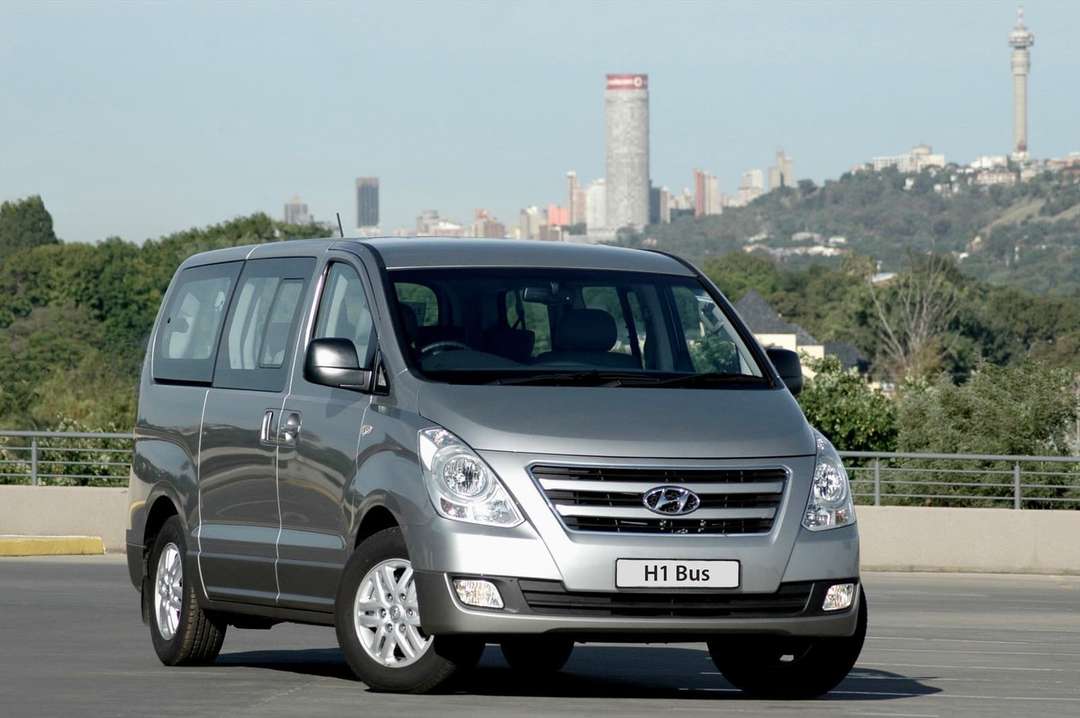
No one buys an H-1 for its looks. At 5125 mm long, 1920 mm wide, and 1925 mm tall, it’s unapologetically boxy. The 2016 facelift tried to soften it with a trapezoidal grille, projector headlamps, and 17-inch alloys, but let's call a spade a spade: it’s a bus. Parked next to a Quantum at an Engen one-stop, both take up serious space, but the H-1 edges ahead on the "car" vibe, if you squint.
Underneath the bodywork
Climb under the back, and the commercial DNA is obvious. The engine sits lengthwise, with a solid rear axle, and the fuel tank is completely exposed - no underbody protection. There's a full-size spare slung underneath. These are clues: it's built to haul weight, shrug off abuse, and be fixed cheaply, especially when panel-van taxis rule the local roads.
Practical touches that matter
- Sliding doors on both sides - a lifesaver when parking at Sandton City or in tight mall bays.
- Big tailgate, not barn doors, so you get actual shelter during a Highveld thunderstorm.
- Five doors in total, including up front.
- 17-inch alloys after the facelift, with tyres you can actually afford at Tiger Wheel & Tyre.
Cabin & Practicality
Here’s the fork in the road: the H-1 either solves all your problems or creates new ones. Three rows, nine seats, actual space for adults in the very back. That's what sets it apart from those seven-seat SUVs you see everywhere for similar money.
Material quality and physical controls
Don't expect luxury. The dash is hard plastic, most switches are basic, and the infotainment in Elite trim is barely passable by 2026 standards. But every climate control is a proper button or dial - no fiddling with screens while merging onto the N1 at Buccleuch. The leather steering wheel feels decent, cruise control is standard, and the cooled glovebox actually saved my chocolate in December traffic to Ballito. Small wins.
Seating and the third-row reality
Here’s the rub: the third row doesn't fold flat, and you can’t just yank it out without tools - and probably some swearing. You get proper adult space back there, but zero flexibility. A Caravelle gives you options; the H-1 gives you pure room. For shuttling guests from King Shaka, that’s perfect. For a family juggling bicycles and seven passengers, you’ll get frustrated.
Hyundai H-1 boot space
With all seats up, you get about 842 litres behind row three - that’s more than most seven-seat SUVs with five seats in use. Drop row three (figuratively, since it doesn’t really drop), and you could fit a fridge. For airport runs with nine and their carry-ons, it works. Nine with big bags? You'll need a roof box or trailer.
On the Road
Hyundai’s 2.5-litre diesel makes 120 kW and 392 Nm, drives the rear wheels through a five-speed auto, and, on paper at least, it looks a bit meek for a two-ton bus. It isn’t.
The drivetrain
The five-speed auto is smooth in Drive, slightly hesitant if you flick it to manual - not that you’ll need to. Diesel torque hits early, and the box holds gears smartly on big climbs. Heading down Van Reenen’s Pass, engine braking- not the brakes- does the heavy lifting. Expect about 12 seconds to 100 km/h - honest for this kind of machine.
Fuel return and range
Hyundai claims 9.7 L/100 km. In the real world, I’ve seen anything from 8.8 to 11.0 L/100 km, depending on how loaded you are and how much you’re stuck creeping along the R21. With four adults and luggage, you can hit the low nines. The 75-litre tank means a touring range close to 750 km - not bad, especially compared to most petrol SUVs.
Real-world fuel stat: 8.8 to 11.0 L/100 km observed in various tests, compared to the 9.7 L/100 km claim.
Ride, steering and weather behaviour
That solid rear axle? It’s the H-1’s biggest compromise. Loaded up, it rides well. Empty, especially on broken tar between Bloem and Colesberg, the tail will skip and shimmy over bumps. Steering is hydraulic and light, feedback is minimal, but the 5.6 m turning circle actually makes parking at Builders Warehouse less of a nightmare. The 2016 update brought ESP and side airbags - essential for a tall, rear-driven bus in Cape Town rain. Without those, a pre-facelift H-1 is a tough sell, no matter the price.
Data & Comparison
Hyundai stopped selling new H-1s when the 2009-2021 run ended. Now, it’s all about used pricing and running costs.
Spec snapshot
| Spec | Value |
|---|---|
| Engine | 2.5L Diesel |
| Power | 120 kW (161 hp) |
| Torque | 392 Nm |
| Gearbox | 5-speed automatic |
| Drive | Rear-wheel drive |
| Seats | 9 |
| Length / Width / Height | 5125 / 1920 / 1925 mm |
| Combined fuel claim | 9.7 L/100 km |
| Production run | 2009-2021 (H-1 II) |
Rivals at used money
| Model | Seats | Drive | Cabin flexibility | Typical used premium vs H-1 |
|---|---|---|---|---|
| Hyundai H-1 2.5 CRDi Elite | 9 | RWD | Fixed row 3 | Baseline |
| VW Kombi/Caravelle TDI | 7 | FWD | Removable, rail-mounted | Significant - often 50%+ more |
| Toyota Quantum 2.8 GD-6 | 10-14 | RWD | Fixed bench seats | Comparable to a slight premium |
| Kia Sedona/Grand Carnival | 7-8 | FWD | Slide-and-stow | Moderate premium for newer units |
Ownership maths
Figure on about R453 100 for five years of total running costs: that covers fuel, services, tyres, and wear items, but not your bank’s cut. That’s on a unit at or past its factory plan, and it’s why the H-1 is hard to argue against if you need every seat.
Service plan and what to inspect
Service plan coverage depends on when the H-1 was sold new. Early models got a 5-year/150 000 km plan and a 7-year/200 000 km drivetrain warranty. By 2025, most will be out of plan, so you’ll be at the mercy of an independent diesel specialist. Luckily, Hyundai’s dealer network is broad - I once needed a part in Polokwane and got sorted within a day, which you can’t say for every Euro van.
Hyundai H-1 reliability and common faults
The D4CB engine is tough, but not invincible. Usual suspects after 200 000 km: EGR cooler leaks, worn injectors, some turbo actuator gremlins, and sliding doors that get sticky if ignored. None of these is a deal-breaker if you see the full service history. If you’re buying “as is” off a WhatsApp group, walk away.
Segment trend context
By mid-2026, South Africans want double cabs and crossovers, not minibuses. Minivan and crewbus demand is thin, which hurts resale but helps buyers. That’s why H-1s stay affordable next to the Hilux and Ranger crowd.
Verdict
No, the H-1 isn’t aspirational or polished like a German rival, and you’ll never see one on a dream-car poster. That’s irrelevant. If your reality is moving eight or nine people week in, week out - or you’re in the B&B or shuttle game - this is still the most credible, cost-effective way to do it in South Africa.
Wait, if your heart is set on the Staria, Hyundai’s new-age replacement. It’s more modern but still pricey second-hand, so only wait if your budget allows.
Summary
A hands-on review of the Hyundai H-1 2.5 CRDi Bus Elite auto, tailored for South African used buyers. We'll break down practicality, what SA ownership really feels like, the post-service-plan picture, common headaches, and where the H-1 fits up against the Kombi, Quantum, and Sedona if you're shoppi
Ratings
Pros
- ✓You need genuine nine-seat capacity, adults in the third row, and you’re strict about pre-purchase checks and keeping up with servicing.
Cons
- ✗You only need seven seats now and then, and prefer crossover comfort the rest of the time.
- ✗A used Sedona or SUV will suit you better.