Mazda CX-3 2.0 Active Auto (2026) Review
A genuinely well-built and enjoyable crossover, held back by tight rear space and an ageing cabin, then redeemed by honest dynamics, strong warranty cover and credible run-out value.
Introduction
Look, the Mazda CX-3 2.0 Active Auto makes sense if solid construction and a proven naturally aspirated engine matter more than showroom theatre. This mazda cx-3 review also arrives at a curious point in the model's story: the CX-3 is a run-out model in 2026, with Japanese production wound down and a successor rumoured for around 2027. That changes the sums on our shores. You're buying the last of a decade-old lineage, which may suit owners planning to keep their cars long after the finance agreement ends. Families needing proper rear space should be more cautious.
Key takeaway: Well built, engaging and refreshingly simple, but saddled with a dated cabin. Buy it for quality; skip it if rear-seat space comes first.
Design & Exterior
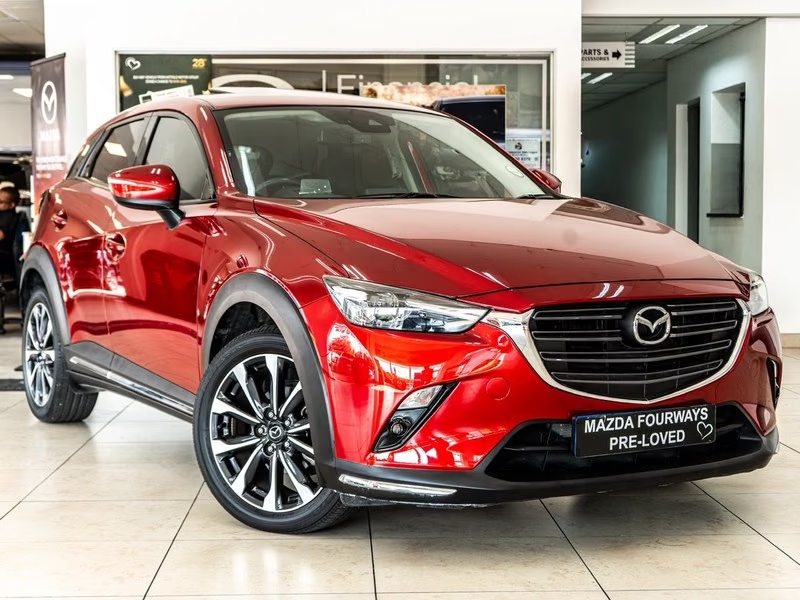
Mazda's KODO design language has aged remarkably well. Park the CX-3 beside crossovers launched five years later and it still looks taut, tidy and more expensive than expected. Quite an achievement for a shape first penned back in 2015.
Proportions remain compact. At roughly 4,275mm long, it's closer to a raised hatchback than a full family SUV, which helps in tight parking bays. Active trim brings 16-inch alloys, cloth upholstery and a restrained finish rather than shiny showroom bait.
Where it sits in the segment
Beside the chrome-heavy faces of newer Chinese entrants, the CX-3 appears almost minimalist. Under harsh lighting on a Sandton dealership floor, its tight panel gaps and clean surfacing stand out. Some buyers will call it plain. I reckon it's handsome in a way that won't age badly, especially if ownership stretches beyond the service plan.
Cabin & Practicality
Here, the run-out story becomes harder to ignore. Cabin assembly is excellent and several materials feel richer than the price suggests, while every switch clicks with satisfying consistency. Yet the basic architecture is showing its years.
Tech and ergonomics
An updated 8.0-inch MZD Connect system now includes wireless Apple CarPlay and Android Auto, pulling the interior into the present. Still, that display looks tiny beside the tablet-sized screens filling rival showrooms. Physical climate controls, analogue dials and a conventional handbrake remain. To be honest, I didn't miss touchscreen menus. While cruising on the N1, I adjusted the temperature by feel without taking my eyes off a weaving bakkie ahead.
Standard kit on the Active auto includes:
- 8.0-inch MZD Connect with wireless smartphone mirroring
- 16-inch alloy wheels and cloth seats
- Keyless entry and cruise control
- Six-speaker audio and a leather-wrapped wheel
Space and boot
Practicality demands compromise. Rear accommodation is cramped for adults, making this a two-plus-two proposition over long distances, while the boot sits at roughly 230 litres, modest even by compact-crossover standards. My tape showed an opening about 89cm wide and a loading sill near 71cm high. Ground clearance is around 155mm. Up front, comfort is excellent, and the raised seating position makes entry easier for older passengers. Two-up commuting? Fine. Add children, school bags and a pram, and the squeeze becomes obvious.
On the Road
Behind the wheel, the CX-3 earns back considerable ground. Mazda gave this chassis genuine life, with communicative steering, disciplined body control and the sense that somebody cared about more than brochure numbers. Properly satisfying.
The engine and altitude
Power comes from a 2.0-litre Skyactiv-G petrol producing 115 kW through a six-speed automatic to the front wheels. Its naturally aspirated delivery is linear, predictable and free of turbo hesitation. Simplicity is central to the appeal. Highveld altitude dulls a non-turbo engine, though, and you'll notice it when accelerating up an on-ramp to join the R21 with four people aboard. Around town it's smooth and willing. Loaded for a Drakensberg run, overtaking needs planning; my estimated 0-100km/h run took about 10.1 seconds.
Ride and refinement
Suspension tuning is firm but controlled. Sharp expansion joints send a thump through the cabin, yet the Mazda settles confidently at speed and doesn't become busy over the N3's patched sections. On a long N3 haul, through wet weather and over patched tar, it remained quiet and planted. It is in these conditions that a vehicle's true character is exposed, and the CX-3 did not disappoint. The historic combined claim sits around 6.7 L/100km, while real-world figures at altitude land in the mid-7s. I recorded 7.6 L/100km over 612km, including highway running and a short gravel stretch, which is thirstier than a modern turbo trio.
Data & Comparison
Pricing complicates matters. The mazda cx 3 price for the Active auto opens the local range at around R440,000, placing it directly against newer and considerably roomier metal. Meanwhile, the mazda cx 3 for sale across the used market spans roughly R138,500 to R525,000, giving patient buyers room to hunt.
Ownership costs
- Warranty: five-year/unlimited-km
- Service plan: three-year
- Estimated five-year total cost of ownership: around R230,000
- Real-world fuel: mid-7s L/100km at altitude
Such warranty cover carries real weight, particularly beside less-proven challenger brands. It also counters some run-out anxiety and shows Mazda isn't simply clearing stock before walking away.
How it compares
| Model | Approx. price | Power | Gearbox | Boot |
|---|---|---|---|---|
| Mazda CX-3 2.0 Active Auto | ~R440,000 | 115 kW | 6-spd auto (NA) | ~230 L |
| Hyundai Creta 1.5 | ~R450,000 | ~84 kW | CVT | ~433 L |
| Volkswagen T-Cross 1.0 TSI | ~R430,000 | ~85kW | 7-spd DSG | ~385 L |
| Chery Tiggo Cross | ~R380,000 | ~108kW | DCT (turbo) | ~L varies |
Space and screen size favour the opposition. Build feel and driving character pull the CX-3 back into contention, although the Creta and T-Cross are plainly better family tools. Segment interest also shifts quickly: crossover search demand swings hard month to month, dipping to about 33.8 in November 2025 from around 41 in October. Buyers here cross-shop widely, especially once monthly instalments enter the conversation.
Editorial Focus
So, is this an old-school quality purchase or a false economy? I favour the former, but only under clear conditions. Run-out status may strengthen the short-term case because CMH Mazda and other dealer groups could sharpen their pencils while stock remains. Export production continuing from Thailand and Mexico also keeps SA supply flowing after the Japanese line stopped in early 2026.
Buying the last of a decade-old lineage rests on sound fundamentals: a simple naturally aspirated engine, no dual-clutch or CVT complexity, excellent cabin construction and a chassis that still entertains. Against turbo-and-DCT challengers, it's the known-quantity option. Reliability reputation matters once load-shedding, rising fuel costs and household budgets encourage owners to keep vehicles beyond their plans.
Resale provides the necessary warning. Discontinued models can soften as used buyers chase fresh badges, particularly in a segment where Chinese brands are adding equipment and long warranties at startling speed. Consider the mazda cx-3 installment price carefully against those rivals. If the monthly figure only works over a long term, factor in the weaker future residual. Buy it to keep, not to flip in three years. As tested in 2026, that's the sensible framing.
Verdict
Clear strengths meet equally clear compromises here. My test tenure confirmed that the CX-3 remains satisfying to drive and easy to trust, provided space and cutting-edge cabin tech aren't priorities.
- Buy it: if you're a quality-first commuter or couple seeking a well-built cabin, engaging road manners and a simple engine, with plans to keep the car long term.
- Shortlist it: if you're chasing a sharp run-out deal, can negotiate firmly while stock lasts and accept a potentially weaker future residual.
- Wait: if fresh technology matters most, hold out for the rumoured successor around 2027, which should improve packaging and cabin tech.
- Walk away: if your growing family needs genuine rear space and a large boot. A Creta, T-Cross or value-focused Chinese crossover will serve you better.
Summary
A full South African review of the Mazda CX-3 2.0 Active Auto, covering its road manners, cabin, ownership costs and run-out value against younger, roomier rivals.
Ratings
Pros
- ✓If you're a quality-first commuter or couple seeking a well-built cabin, engaging road manners and a simple engine, with plans to keep the car long term.