2026 Toyota Vitz Review: SA's Cheapest Badge Swap

Cheap to fuel, simple to own and supported almost everywhere, the Vitz makes sense as basic transport. Modest safety performance and a shorter warranty than its Suzuki twin stop it scoring higher.
Introduction
Right, so the 2026 Toyota Vitz is one of South Africa’s cheapest new cars, backed by the country’s biggest dealer network. But know what you’re buying. It’s essentially a Suzuki Celerio built in Manesar, India, wearing Toyota badges. Any honest Toyota Vitz review 2026 needs to acknowledge that upfront. This isn’t a Japanese-built Toyota, but Maruti Suzuki’s small hatch sold through a brand South Africans know and trust for reliability and resale. For 2026, the range comprises the 1.0 base model, 1.0 XR manual and 1.0 XR AMT. So, is the Toyota badge enough to make the Vitz the smarter buy?
Key takeaway: Underneath, the Vitz is a Suzuki Celerio. Toyota's broader dealer coverage and stronger resale reputation are the meaningful differences.
Design & Exterior
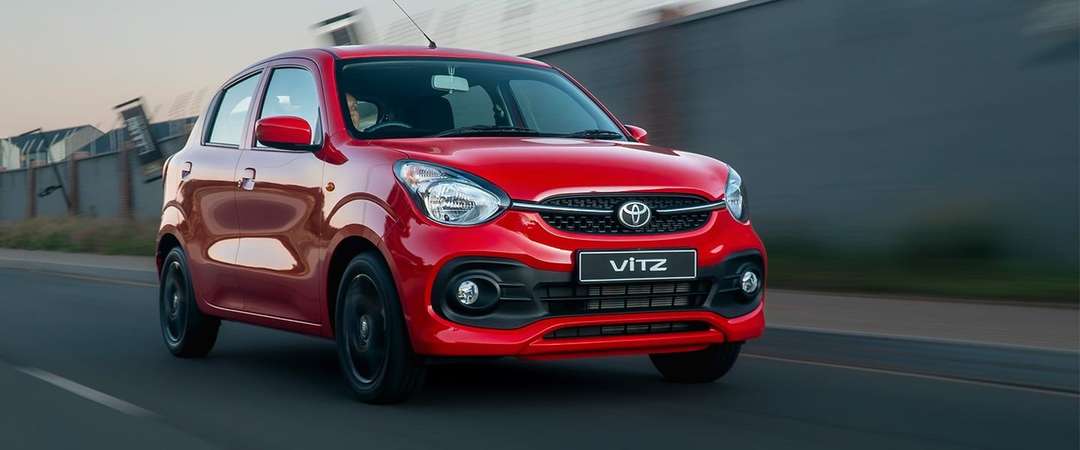
Nobody buys a Vitz to stop traffic. Toyota knows it, too. The upright shape is tidy, friendly and hard to dislike, with the revised grille and Toyota lettering providing most of the visual separation from the Suzuki Celerio. It’s not going to turn heads, but that was never really the point. The 2026 Toyota Vitz is designed to be simple, familiar and affordable — exactly what its target buyer is likely looking for.
The tall-boy silhouette
Packaging matters more here. Its tall roof, short overhangs and compact footprint make the Vitz easy to place on narrow streets and in tight parking bays. The 170mm of ground clearance is another bonus, helping it deal with speed bumps, broken tar and corrugated gravel without the chin-scraping anxiety you get in some lower-slung hatchbacks. It’s not glamorous, but this is where the Vitz makes a strong case for itself as a practical city car.
Wheels and stance
Small 14 and 15-inch wheels help the ride and spare your tyre budget. Replacement rubber shouldn't wreck the month's finances, which is a real ownership benefit at this price. XR trim adds a reverse camera and a slightly smarter face. Glamour ends there.
Cabin & Practicality
Climb inside, and the cost-cutting is obvious. Hard plastics cover most surfaces, the switchgear feels lightweight, and nobody will confuse this cabin with anything premium. Still, the driving position works, visibility is generous, and most everyday functions retain physical controls.
Materials and controls
Proper stalks and actual climate-control buttons deserve praise. You won't need to jab at a sluggish touchscreen just to adjust the fan, which helps during a busy commute. Seat cushioning feels fairly flat, although there's enough support for school runs and routine journeys along the M1.
Space and boot
Five doors and five seats give the Vitz more daily usefulness than its footprint suggests. Rear backrests split 60/40, while our loading check fitted two airline-size carry-ons and three soft bags in the boot. A family weekend works if you pack smart.
- Seats: 5, with a practical 60/40 split rear bench
- Doors: 5, making rear-seat access properly useful
- Fuel tank: 32 litres, stretched effectively by the economical engine
- Ground clearance: 170mm, useful on gravel and damaged roads
On the Road
Power comes from the familiar 998cc K10C three-cylinder engine, which produces 49kW and 89Nm. Shared with the Celerio, it delivers the modest but economical performance those figures promise.
City manners
Around town, this little Toyota settles into its groove. Light steering, a tight turning circle and eager low-speed response take much of the strain out of Joburg’s stop-start traffic. The AMT single-clutch automated manual gives your left leg a break, but it can hesitate when pulling away and shuffle noticeably between ratios under load. That’s a familiar Celerio AMT trait rather than a Vitz-specific fault. Smooth throttle inputs help, but the manual remains the more natural choice if you don’t mind doing the shifting yourself.
Highway reality
Once you’re on the N1 at Highveld altitude, those modest outputs are harder to ignore. Overtaking needs planning, while passengers and luggage make long climbs feel steeper than they look. Our observed 0-100km/h run took roughly 15.8 seconds with one occupant, which tells you pretty much everything you need to know about its performance. It’ll hold 120km/h without drama, but push harder and you mostly get more engine noise rather than more pace.
Fuel economy
Fuel use is the Vitz's strongest on-road argument. Toyota claims 4.4 l/100km, and ordinary driving shows that number is credible.
- Claimed Toyota Vitz fuel consumption: 4.4 l/100km combined
- Real-world: mid-fours to low-fives in mixed driving, closing to around 5.0 l/100km in heavy traffic
- CO2: 101 g/km
During my week in a Celerio-badged equivalent, gentle suburban driving returned a genuine 4.7 l/100km. I watched the fuel gauge barely shift across two commuting days. Paired with that 32-litre tank, such restraint keeps forecourt visits agreeably rare.
Data & Comparison
Money drives this decision. Across 51 recent listings, the average Vitz asks around R192,914, with entry examples starting from R149,900. In practical terms, that makes it the cheapest new car in South Africa in 2026, even undercutting its Suzuki sibling. For buyers shopping strictly on a budget, that price is difficult to ignore — and arguably the Vitz’s biggest selling point.
Toyota Vitz price South Africa, by model year
| Model year | Typical asking price | Range |
|---|---|---|
| 2023 | R179,925 | R169,950 - R199,900 |
| 2024 | R189,900 | R149,900 - R209,900 |
| 2025 | R209,900 | R189,800 - R239,950 |
| 2026 | R178,800 | R155,478 - R229,950 |
Look at how flat that pricing curve stays. A used 2023 Vitz still carries a median asking price close to R180,000, neatly supporting the Toyota Vitz resale value case. Here, the Toyota badge is doing exactly what local buyers expect.
How it compares
| Model | Power | Claimed fuel use | Notable |
|---|---|---|---|
| Toyota Vitz 1.0 | 49kW | 4.4 l/100km | Widest dealer network |
| Suzuki Celerio 1.0 | 49kW | 4.4 l/100km | 5yr/200,000km warranty |
| Renault Kwid 1.0 | Similar class | Comparable | Cheap entry, weaker resale |
Ownership costs
- Estimated 5-year TCO: around R230,000
- Estimated 3-year residual: around R182,025
- Service plan: now doubled to 4 services / 60,000km
- Warranty: 3yr/100,000km (the Suzuki twin offers 5yr/200,000km)
Affordable tyres, restrained fuel use and generally low insurance premiums make the Vitz one of South Africa's least intimidating new cars to own. Regular N3 tolls will still sting, but the car's running costs shouldn't. Toyota chains such as Halfway Toyota also make routine servicing easier across several provinces.
Editorial Focus
Here’s the badge on trial. Asking Toyota Vitz vs Suzuki Celerio isn’t really about which one drives better, because mechanically, they’re the same car. Both use the 998cc K10C engine, produce 49kW and share the same body, gearbox choices and that familiar, hesitant AMT. Three things separate them: price, warranty and dealer coverage.
Vitz pricing now undercuts the Celerio, removing the old argument that you’re paying extra simply for the Toyota badge. Suzuki counters with a longer 5-year/200,000km warranty, compared with Toyota’s 3-year/100,000km cover.
So why choose the Toyota? Resale and reach. Toyota has roughly 200-plus dealers across South Africa, comfortably more than Suzuki, and that matters if you live far from a major centre or regularly travel long distances. Easier access to servicing and parts can outweigh a longer warranty that’s less convenient to use locally. Listing data also suggests the Vitz follows a relatively flat depreciation curve, with healthier used supply than the scarcer Celerio. Buying one should be straightforward. Selling it should be, too.
Safety is the uncomfortable part of any conversation about Toyota Vitz problems. The Vitz itself hasn’t been tested by Global NCAP, but its Indian-built Celerio twin, in matching six-airbag and ESC specification, scored three stars for adult and two for child occupant protection in December 2025. Testers also flagged an unstable bodyshell and footwell. Six airbags are certainly welcome, but they can’t fully compensate for weaknesses in the underlying structure. That’s something worth understanding before signing on the dotted line.
Safety rating
Global NCAP India · tested 2025
★★★☆☆ 3/5 adult occupant
★★☆☆☆ 2/5 child occupant
All three 2026 SA Vitz derivatives (1.0, 1.0 XR MT, 1.0 XR AMT) have 6 airbags and VSC standard, matching the tested spec, so the result is indicative for the whole current range. Official factsheet.
Verdict
Exciting? No. Nor is the Vitz the Toyota-engineered hatch some shoppers might assume. What you get is honest transport at South Africa's lowest new-car price, supported by strong resale and a vast dealer footprint. Choose according to your priorities:
- Just buy it - the rural or gravel-road commuter: Toyota's 200-plus dealer network and 170mm clearance make the Vitz sensible away from major centres, where dependable access to servicing can settle the decision.
- Shortlist it - the urban runabout buyer: the XR AMT combines low fuel bills, affordable insurance and two-pedal convenience. You'll have to tolerate its hesitant shifts.
- Consider it - the first-car buyer: purchase and running costs look appealing, but carefully weigh the 3-star adult / 2-star child crash result and unstable bodyshell.
- Wait or walk away - the family safety-first buyer: shoppers prioritising child-occupant protection should consider alternatives or wait for a structural update that improves the shell rating.
Summary
Our 2026 Toyota Vitz review covers what South African buyers need to know: its Suzuki Celerio roots, pricing, fuel use, six-airbag safety update, resale prospects and position among budget hatchbacks.
Ratings
Pros
- ✓Toyota's 200-plus dealer network and 170mm clearance make it a sensible choice away from major centres, where reliable service access can decide the deal.