Ford Transit Custom: Is This R949k Van Better Than a Bakkie?

A clever, comfortable workhorse that carries more than a bakkie for less money, but weaker residuals and no 4x4 limit its usefulness on South Africa’s rougher routes.
Introduction
Buy the Ford Transit Custom if your daily job involves moving more equipment than people and you spend most of your time on tar or firm gravel. Too many tradesmen default to a Ranger or Hilux without asking whether a proper panel van might actually offer more usable space for less money.
On paper, at least, it does. In the 2025 market, the Transit Custom LWB starts at around R770,000, while the SWB Sport climbs to roughly R949,000. That’s a sizeable gap. I’ve looked at the numbers, checked current used listings and broken down the verdict by buyer, because a van and a bakkie earn their money in very different ways.
Key takeaway: The Transit Custom offers more secure cargo capacity per rand than a bakkie, but weaker residuals and no 4x4 narrow its appeal to load-first operators staying mostly on-road.
Design & Exterior
Ford’s second-generation Transit Custom sits lower and wider than before, losing much of that old appliance-on-wheels appearance. Its roof remains under 2 metres, which suddenly matters when a height barrier threatens to end your parkade visit early.
The Sport dresses up a work tool
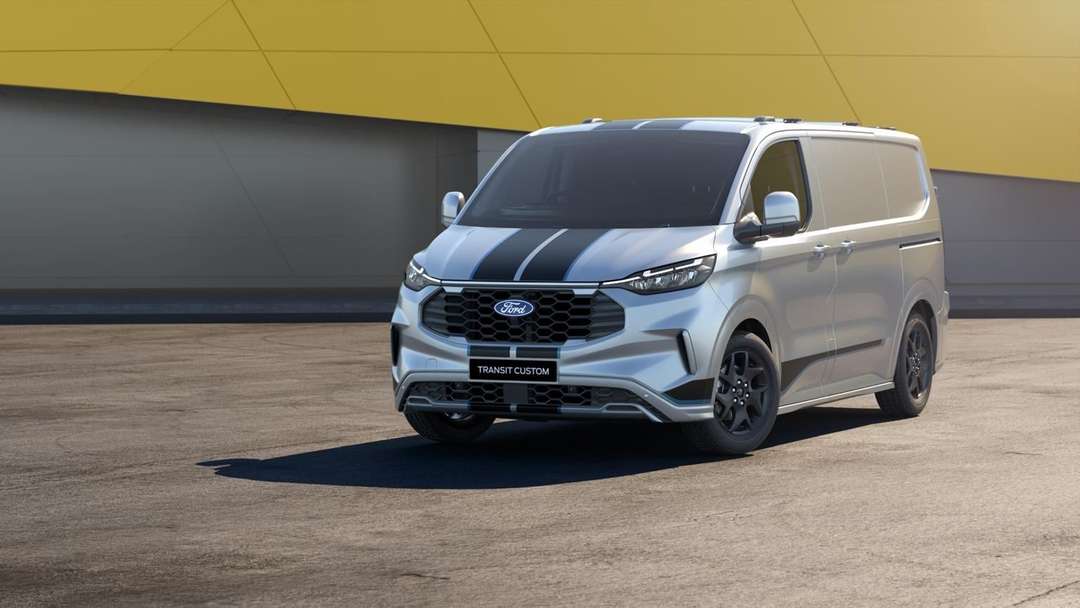
The Transit Custom Sport adds some visual theatre with a honeycomb grille, bonnet stripes, roof spoiler and 17-inch matte-black alloys. It’s clearly aimed at owner-operators who want their workhorse to look the part when pulling up outside a client’s property.
The base LWB looks far more businesslike, but gives you greater load length. Frankly, that’s the one I’d buy – unless looking good at the gate helps win you the next job.
Where it sits in the segment
Local van choice remains thin, with the Mercedes Vito, Hyundai Staria panel van and incoming VW Transporter partnership among the obvious alternatives. Realistically, its toughest opposition is still the Ranger and Hilux parked outside Builders and Mica stores nationwide.
Cabin & Practicality
Inside, moving the passenger airbag into the roof has freed up a genuinely useful storage shelf across the dashboard. A large landscape SYNC touchscreen and digital instrument cluster modernise the cabin, although I’d prefer more physical controls for frequently used functions. After nine hours behind the wheel, clear ergonomics matter far more than showroom sparkle.
Load bay: enclosed, lockable, weatherproof
Here’s the point no standard bakkie answers convincingly. The Transit Custom accepts up to three Euro pallets, keeping tools and stock away from rain, gravel dust and opportunistic hands at a Gauteng robot.
- Cargo volume: approximately 5.8m³ (SWB) to 6.8m³ (LWB)
- Payload: up to around 1 023kg in Sport SWB specification
- Seats: 2, plus a moulded floor liner and LED load lighting
- Ground clearance: 160mm
By comparison, a double-cab’s open bin leaves costly equipment relying heavily on a tonneau cover. For plumbers, electricians and installers, that enclosed body isn’t simply convenient. It forms part of the security budget.
The obvious compromise
Only two seats. A five-seat double-cab can carry the crew, the dog and everyone’s weekend bags, while this panel van prioritises stock. If your day requires both staff and equipment, the Ford loses before anyone opens a finance calculator.
On the Road
The big change underneath is the switch to coil-sprung independent rear suspension, and you notice the difference within a few kilometres. It gives the Ford Transit Custom a more settled, car-like feel than you might expect from a work van. No surprise, then, that the new setup helped it earn a Best Van award overseas.
Car-like, even part-laden
Around 30% more platform stiffness, roughly 100kg less kerb weight and up to 13% lower aerodynamic drag make the Ford feel calmer and less cumbersome. Even at half payload, the rear axle deals with broken surfaces more cleanly than the old leaf-sprung arrangement. Empty bakkies often skip over corrugations. This settles sooner.
The engine, honestly
South Africa gets a 1 996cc four-cylinder diesel producing 100kW and 360Nm through a six-speed manual transmission. Ford claims 8.2 l/100km, while my mixed Joburg run returned an indicated 9.4 l/100km over 187km. An estimated 0-100km/h run takes about 14.6 seconds unladen. Properly slow. Still, 360Nm supplies enough shove for joining the M1 or hauling a working load up the N3 at altitude.
Where it runs out of road
No 4x4. No low range. Just 160mm of clearance. It stays composed on the N3 and copes with maintained gravel, but Sani Pass or a wet Karoo two-track would reveal its limits quickly. I once heard the underside brush a raised gravel middelmannetjie. One scrape was enough. Serious rural work still belongs to the Hilux or the Ranger, and that’s the point.
Data & Comparison
Money brings the differences into focus, because the Ford Transit Custom price calculation for South Africa is where this van begins to make a persuasive case.
Used-market pricing by year
Across 35 recent listings, asking prices run from R289 900 to R789 000. Split by model year, the available stock currently looks like this:
| Model year | Typical asking price (median) | Price range |
|---|---|---|
| 2014 | R240 342 | R219 900 - R260 783 |
| 2019 | R309 900 | R299 900 - R319 900 |
| 2021 | R289 948 | R289 900 - R289 995 |
| 2022 | R299 900 | R289 900 - R359 900 |
| 2025 | R609 995 | R519 890 - R739 900 |
| 2026 | R686 800 | R669 000 - R789 000 |
Resale reality vs bakkie residuals
Now for the uncomfortable bit. A three-year-old Transit Custom sits around R316 567 in the current used market, while the Hilux and Ranger retain value with almost unfair consistency. Fleet managers and finance houses know this, which helps explain their enduring affection for double-cabs.
- 3-year residual for the van: approximately R316 567
- Estimated 5-year TCO baseline: around R230 000 in running costs
- Current used-market spread: R289 900 to R789 000 across 35 listings
Ford Transit Custom resale value remains the biggest weakness in its business case. You gain more cargo ability upfront, but depreciation may remove a larger chunk of your investment than it would with a comparable bakkie.
How it stacks up on paper
| Specification | Transit Custom (van) | Ranger 2.0 SiT DC | Hilux 2.4 GD-6 DC |
|---|---|---|---|
| Cargo arrangement | Enclosed 5.8-6.8m³ | Open bin | Open bin |
| Seating | 2 | 5 | 5 |
| 4x4 availability | No | Yes | Yes |
| Resale performance | Moderate | Strong | Strong |
| Claimed consumption | 8.2 l/100km | Similar class | Similar class |
Editorial Focus
Many South African tradesmen buy a double-cab almost by reflex, yet the sums deserve closer attention. Near R770 000, the base LWB Transit Custom provides enclosed, lockable volume no conventional double-cab matches, plus payload around a tonne. It comfortably beats a similarly priced Ranger or Hilux for secure load capacity per rand. Modern diesel fuel costs should be broadly comparable, leaving cargo security, seating needs and terrain to decide the outcome.
Where the bakkie claws back
Two numbers can reverse the decision. First is resale, with current used data placing a three-year-old van around R316 567 while bakkie prices remain stubbornly firm. Second is 160mm of ground clearance, combined with no 4x4, which excludes the van from farms, mines and muddy construction sites. Parts availability also needs investigation. Ford’s dealer network knows the Ranger intimately, but a specialised Transit component at an Upington branch could mean a wait that Hilux owners seldom face. Its warranty (4yr/120 000km, 5yr corrosion) offers reassurance, yet it can’t build a mature used market overnight. The panel van vs bakkie South Africa question isn’t about brand loyalty. Your load, route and passenger count should make the call.
Safety rating
ANCAP · tested 2012
★★★★★ 5/5 adult occupant
Australian-market RHD rating — indicative for SA only where the SA derivative matches the tested safety spec (airbags/ESC/AEB). Official factsheet.
Verdict
The Ford Transit Custom 2025 might be the smartest work vehicle many South African tradesmen won’t buy, largely because the bakkie habit runs deep. It carries more cargo, protects that load better and provides greater volume per rand, while driving with passenger-car composure. Two seats, no 4x4 and weaker residuals deny it a straightforward victory. If you’re weighing up a used Ford Transit Custom for sale, judge your daily load and routes rather than the badge. Ford Transit Custom vs Ranger? The van wins for secure on-road cargo work, then concedes as soon as the terrain becomes properly rough.
- Courier/fleet operator - Buy it. High-mileage, cargo-first work on tar suits this van. Its enclosed security and load volume per rand beat a conventional bakkie.
- Owner-tradesman (plumber, electrician, installer) - Shortlist it. If you remain on tar and don’t transport a crew, it’s the sharper tool. Frequent off-road site visits still favour the double-cab.
- Shuttle / tour business - Wait. The panel van has only two seats, so hold back for passenger variants and the incoming Transporter partnership before committing your money.
- Camper converter - Buy it. An under-2m roof, flat load floor and composed ride create a convincing conversion base. Treat it as a tar-and-gravel tourer, not a 4x4 overlander.
Summary
A straight-talking review of the Ford Transit Custom for South African buyers, comparing it with double-cab bakkies on cargo space, running costs, warranty cover and used-market resale. Tradesmen, fleet operators and shuttle businesses, this one's for you.
Ratings
Pros
- ✓High-mileage, cargo-first work on tar fits the van perfectly.
- ✓Its enclosed security and load volume per rand beat a conventional bakkie.