2026 Toyota Urban Cruiser Review: Who Should Buy It?


A well-built and comfortable family SUV, spoiled by an old 4-speed gearbox and a badge premium that the resale figures don’t fully support.
Introduction
Buy the Toyota Urban Cruiser if you’re a badge-loyal urban family that values easygoing town manners and a huge dealer network more than highway muscle. Skip it if your weekends involve four people, luggage and long Karoo passes. Our Toyota Urban Cruiser review in South Africa asks the question launch drives often avoid: does the Toyota badge really protect your money?
The 2026 update brings a larger 9-inch screen and a neat XS-to-XR specification walk, but the mechanical package remains unchanged. With new-car pricing now sitting uncomfortably close to clean used examples, the buying decision has changed. In 2026, it pays to look beyond the showroom and shop around before signing.
Key takeaway: Comfortable, practical and backed by excellent dealer support, but the 77kW engine and 4-speed auto struggle at altitude. The premium over the identical Suzuki is difficult to defend.
Design & Exterior
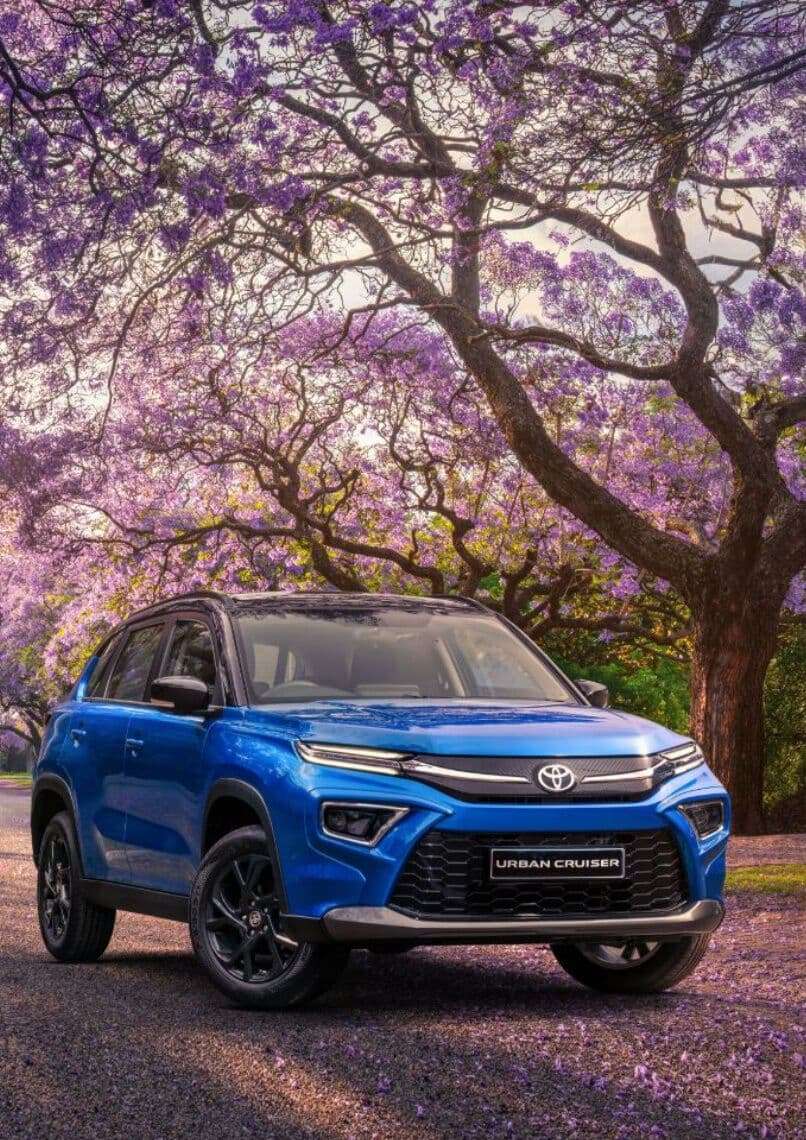
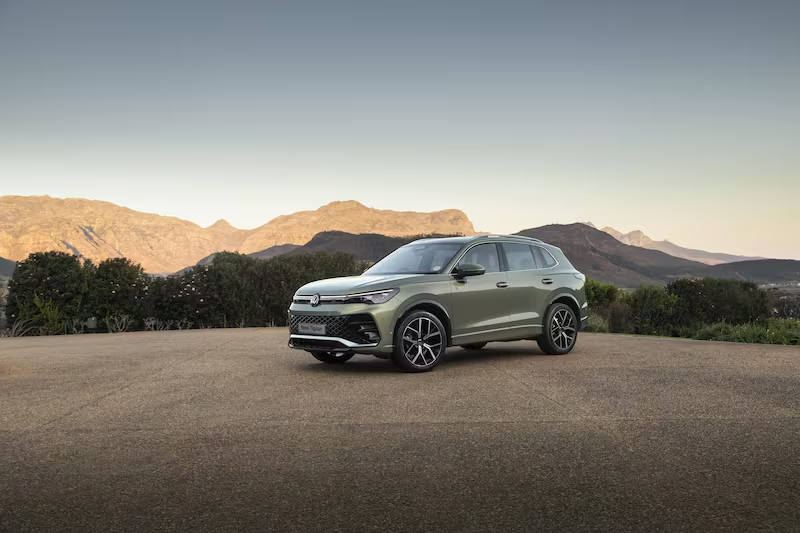
Look, the second-generation Urban Cruiser has grown up. It’s now a properly family-sized SUV, longer and taller than the rebadged Brezza it replaced, with balanced proportions and an upright, honest-looking nose.
Exciting? Not really. But Toyota’s conservative styling should age well, which matters if resale value is part of your buying decision. The 198mm ground clearance is another win, dealing with ugly shopping-centre speed humps and rougher roads without scraping.
Sensible wheels, a full-size steel spare underneath and an upright glasshouse make daily life easier. This is an SUV designed to be used, not admired from a coffee-shop window — and that practicality is arguably where the Urban Cruiser makes the strongest case for itself.
Cabin & Practicality
Space and boot
Cabin space is where the extra size earns its keep. Adults fit comfortably in the rear, while the boot swallowed two medium suitcases, a folded pram and three soft bags during our check, with roughly 90mm of loading height still available beneath the parcel shelf. A full-size spare is also worth carrying when gravel claims a tyre two hours from the nearest fitment centre.
- Seats: 5
- Doors: 5
- Fuel tank: 48 litres
- Ground clearance: 198mm
Materials and controls
For 2026, the 9-inch touchscreen finally looks appropriate for the price. Material quality is acceptable rather than plush, with hard plastics across the obvious touchpoints, but the assembly feels tidy. Better still, Toyota retained physical climate-control dials. On a choppy section of the R512, I adjusted the temperature without taking my eyes off the road. Small win.
XS trim covers the essentials, while XR adds the comfort and safety equipment most families will actually want. The XS carries only dual front airbags plus stability control; XR steps up to six airbags. That gap should decide the specification for you.
On the Road
Town competence
Around town, the Urban Cruiser is easy company. Light steering, a high seating position and a gentle throttle make school runs and stop-start traffic painless. Its 1.5-litre naturally aspirated four-cylinder produces 105hp and 138Nm, which is enough for suburban work without feeling particularly exciting. It’s smooth, predictable and easy to drive — exactly the sort of character that suits a family SUV better than outright performance.
Gravel-road ride
Gravel brings out one of the Urban Cruiser’s better qualities. Across corrugations and pothole-scarred district roads, the suspension absorbs punishment with genuine composure rather than bouncing from one impact to the next. I heard the spare-wheel carrier rattle once over a badly washed-out section near the Vaal, but the cabin itself remained impressively settled. Traction and stability control add another layer of reassurance on loose surfaces, making the Urban Cruiser feel more capable than its city-focused image suggests.
The honest weak spots
Right, so here’s the compromise. That modest engine feels adequate at the coast and distinctly thinner on the Highveld, where reduced oxygen costs naturally aspirated engines useful shove. Add four occupants and luggage, then join the N1 at altitude, and every overtake needs forethought.
- Claimed fuel consumption: 5.3 l/100km
- 0-100km/h: not officially quoted, but expect leisurely progress
- CO2: 147 g/km
The Toyota Urban Cruiser XR automatic uses a Suzuki-sourced four-speed torque-converter gearbox, and it’s easily the weakest part of the package. Our measured 0-100km/h estimate was 13.2 seconds at altitude, which feels every bit as leisurely from behind the wheel. With only four ratios, the transmission drones under acceleration and hunts between gears at 100-120km/h — exactly where a Highveld family car often settles into a cruise.
On a long N1 haul, particularly with tolls, passengers and loaded overtakes thrown into the mix, the gearbox becomes the main limitation. Among the recurring Toyota Urban Cruiser problems, this one is hardware-deep rather than a software niggle, so there’s no update coming to magically add another gear.
Data & Comparison
What the money looks like
Pricing for the updated 2026 range starts at roughly R342,700 for the 1.5 XS and reaches about R373,800 for the 1.5 XR Auto. That’s the key Toyota Urban Cruiser 2026 price in South Africa. Across 116 live listings, the average asking price is R290,353, while clean 2026 stock averages R351,152.
Price by model year
| Model year | Typical asking price (median) | Listings |
|---|---|---|
| 2021 | R234,900 | 15 |
| 2022 | R239,972 | 44 |
| 2023 | R289,900 | 15 |
| 2024 | R305,900 | 23 |
| 2025 | R336,500 | 29 |
| 2026 | R369,900 | 5 |
Read the table carefully. A clean 2025 example asks around R336,500, barely R6,000 less than a new base XS. Used doesn’t automatically mean value here, and that’s the point.
How it stacks up
| Spec | Urban Cruiser 1.5 | Suzuki Grand Vitara 1.5 | Toyota Corolla Cross Hybrid |
|---|---|---|---|
| Power | 77kW | 77kW (identical) | 1.8 hybrid |
| Claimed fuel use | 5.3 l/100km | ~5.3 l/100km | ~4.3 l/100km |
| Gearbox | 4-speed auto | 4-speed auto | CVT (e-CVT) |
| Ground clearance | 198mm | ~210mm | ~160mm |
Here’s the crux of the Toyota Urban Cruiser vs Suzuki Grand Vitara debate: they’re the same car, produced on the same line. Suzuki has historically included a longer warranty and service plan. Your premium therefore buys the Toyota badge and South Africa’s widest dealer network, not additional engineering or equipment.
Ownership
Ownership cover comprises a 3-year/100,000km warranty and a 4-year/60,000km service plan. Estimated 5-year total cost of ownership sits near R230,000, while current data suggests a three-year residual around R297,350. Respectable, yes, but hardly the runaway retention promised by the badge’s reputation.
Editorial Focus: The badge tax, audited
Here’s the question launch reviews tend to sidestep: does the Toyota badge protect your money better than its identical Suzuki twin? Based on live listing data, the answer is “less than you think.”
Across 116 Urban Cruiser listings, asking prices remain strong. But a high advertised price isn’t the same as superior value retention once the original purchase price enters the equation. Analysis of the first-generation twins produced year-dependent results: Toyota held up slightly better in one model year, then shed value faster than Suzuki in another. A badge isn’t an insurance policy.
After-sales cover complicates things further. The Grand Vitara has typically offered longer protection, meaning the cheaper vehicle also came with greater peace of mind. Suzuki’s dealer network remains smaller, although its expanding franchise base is steadily closing the gap. Toyota’s parts and service reach across dorpies from Upington to Mthatha is still hard to beat. That network, rather than assumed resale strength, is the sensible reason to pay extra.
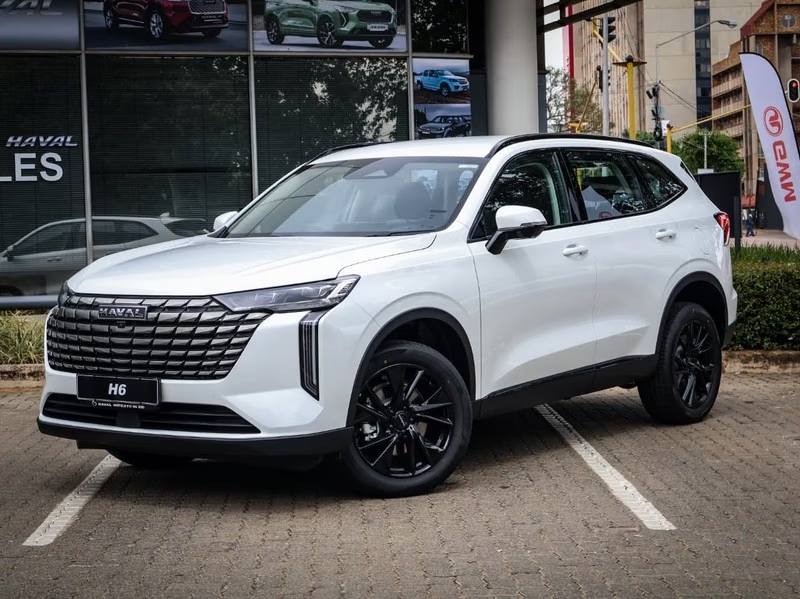
Now for the kicker. Between R350k and R400k, the used market also offers a Corolla Cross with the petrol-electric hybrid powertrain our Urban Cruiser doesn’t get. Neither is a plug-in EV, so there’s no battery-size or DC-charging debate here, but the Corolla Cross Hybrid can return economy the old four-speed auto simply can’t match. If Toyota Urban Cruiser fuel consumption and relaxed highway progress matter most, you might be paying the badge tax on the wrong Toyota.
Verdict
Toyota’s Urban Cruiser is comfortable, sensible and superbly supported, yet it quietly disappoints on open roads. Whether it belongs in your driveway depends almost entirely on where and how you drive.
- Buy it - badge-loyal urban families: If life consists mainly of school runs, shopping trips and occasional gravel weekends, the comfortable ride, full-size spare and huge Toyota dealer network make ownership pleasantly low-stress.
- Shortlist it - value-focused used buyers: A clean 2024 or 2025 example at under R310,000 meaningfully undercuts new pricing. Compare it directly with the Suzuki twin, then drive both before deciding.
- Only if... - you can live with the gearbox: The 4-speed auto and 77kW engine are acceptable at sea level and around town. Choose the automatic only if highway journeys and altitude driving are limited.
- Avoid - frequent highway and Karoo drivers: If you regularly travel long distances while loaded, or live on the Highveld and overtake often, walk away. For similar money, a used Corolla Cross Hybrid is far better suited to the job.
Compare live Urban Cruiser listings, read the Grand Vitara twin review and run a free valuation before trading in.
Summary
A full review of the 2026 Toyota Urban Cruiser for South African buyers, covering its revised specification walk, real-world performance at altitude, gravel-road ride and the “badge tax” against its Suzuki Grand Vitara twin, using live used-listing data.
Ratings
Pros
- ✓If life consists mainly of school runs, shopping trips and occasional gravel weekends, the comfortable ride, full-size spare and huge Toyota dealer network make ownership pleasantly low-stress.
Cons
- ✗If you regularly travel long distances while loaded, or live on the Highveld and overtake often, walk away.
- ✗For similar money, a used Corolla Cross Hybrid is far better suited to the job.