BYD Shark 6 1.5T DMO Premium 4WD (2026) Review
A clever, polished PHEV bakkie that did not disappoint around town, but touring limitations and uncertain resale keep it from scoring higher.
Introduction
Right, so the BYD Shark 6 review lands while diesel still rules local double-cab sales, yet this ambitious Chinese newcomer has arrived with a plug and plenty to prove. Buy the Shark 6 if you charge at home nightly, cover most kilometres around town and want loadshedding backup parked outside. Skip it if heavy towing or long gravel trips into the Karoo define your weekends. Its PHEV bakkie pitch sounds convincing, but whether the sums beat the Hilux or the Ranger depends entirely on your routine. As tested in 2025, it’s among the most intriguing vehicles to reach our shores in years.
Key takeaway: Quick, quiet and economical for disciplined home chargers, but far less persuasive once the battery is depleted.
Design & Exterior
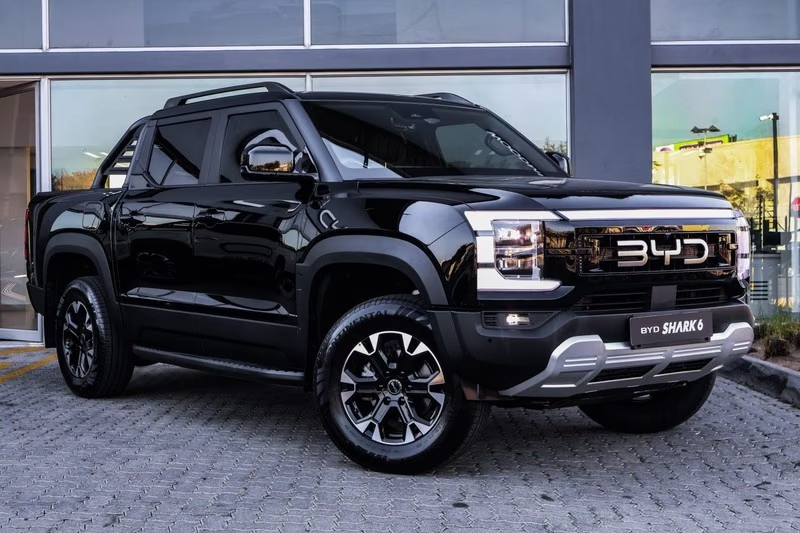
BYD has borrowed from the American full-size truck playbook, then scaled the result for a South African parking bay. Blocky, broad-shouldered and thoroughly modern, the Shark 6 has presence. Its oversized tailgate badge divides opinion. Some owners will love the confidence; others may find it rather shouty.
Presence on our roads
Measuring roughly 5,457mm long and 1,971mm wide, this is no compact runabout. It stands 1,925mm tall on 18-inch alloys wrapped in 265/65 R18 rubber. Park it beside a Ford Ranger and the BYD doesn’t appear remotely outclassed, while 230mm of ground clearance delivers proper bakkie posture rather than a lifted-crossover impression. To be honest, the shape grew on me during my test tenure. It photographs bigger than it feels from behind the wheel.
Where it sits
Think lifestyle double cab first, working bakkie second. Those proportions, polished details and road-focused stance make its priorities perfectly clear.
Cabin & Practicality
Climb aboard and the mood turns decidedly upmarket. Soft-touch finishes, a large rotating touchscreen and a genuinely spacious rear bench give the cabin more polish than many similarly priced diesel rivals. Thanks to a long wheelbase of 3,260mm, rear knee room is generous enough for adults spending several hours on the N3.
Tech and comfort
- A large central touchscreen that rotates between portrait and landscape orientations
- A comprehensive driver-assistance package, although its repeated alerts can become nagging during highway driving
- Vehicle-to-load functionality for running appliances or supplying emergency power to parts of a home
- Independent front and rear suspension, delivering a settled ride with an SUV-like character
The loadshedding angle
Vehicle-to-load is its killer South African feature. During a stage-four evening, I powered a fridge, several lights and a laptop from the tailgate socket without fuss. No conventional diesel double cab can match that trick. For households tired of juggling inverters whenever Eskom blinks, the bakkie effectively becomes a mobile generator.
On the Road
Pairing a turbo-petrol engine with electric motors, the DMO 1.5T plug-in hybrid system delivers properly quick combined shove. Independent testing has recorded 0-100km/h in the region of 5.7 seconds, which feels faintly absurd in something this large.
Refinement
EV mode brings near-silent progress. Pulling away from a quiet Pretoria suburb at dawn, I heard little beyond the tyres brushing over the tar. Compared with a clattering diesel, the refinement gap is substantial and obvious from the first kilometre. Instant electric torque also makes urban driving wonderfully easy.
Ride and handling
Sharp ridges expose a firm edge, but the general ride remains composed. Across patched Free State tar, the Shark stayed settled, although expansion joints landed with more of a thump than they would in a plush SUV. All-wheel drive brings reassuring traction on wet surfaces and loose gravel. It is in these conditions that a vehicle's true character is exposed, and the BYD tracks confidently without feeling nervous.
Off-road reality
Don’t mistake confidence for hardcore ability. There’s no low-range transfer case, independent rear suspension limits wheel articulation, and the standard tyres favour tar. Gravel and sand are well within its brief. Sani Pass heroics aren’t. Treat the Shark as a lifestyle 4x4 rather than a dedicated bushveld tool.
Data & Comparison
Here are the numbers that shape ownership. Claimed EV range sits around 80 to 100km on the test cycle, while real-world use is nearer 85km. Energy comes from a 29.6 kWh LFP Blade pack. Charging peaks at roughly 7kW AC and about 55kW DC, which is modest enough to rule out genuinely quick top-ups during a highway run.
Statistics that matter
- Combined system output rated around 321kW / 650Nm on the core variant
- Fuel tank of roughly 60L, smaller than the 80L tanks common on diesel rivals
- Real-world consumption near 6.8 L/100km with disciplined charging
- Battery-depleted highway consumption climbing to about 8 to 8.8 L/100km
- Towing around 2,500kg braked on the core variant
How it compares
| Spec | BYD Shark 6 | Diesel Double Cab (typical) | Petrol V6 Double Cab |
|---|---|---|---|
| Powertrain | 1.5T PHEV AWD | 2.0-2.8 turbodiesel | 3.0-3.6 petrol |
| 0-100km/h | approx 5.7s | approx 9-11s | approx 7-8s |
| Fuel tank | approx 60L | approx 80L | approx 80L |
| Loadshedding backup (V2L) | Yes | No | No |
| Home-charge economy | approx 6.8 L/100km | approx 7-8 L/100km | approx 11-13 L/100km |
Pricing and ownership
Local byd shark price positioning puts the Premium around R959,900, with listings observed across roughly R829,900 to R1,149,900 depending on variant and stock. Put plainly, the byd shark 6 price south africa question ends near the million-rand mark. That’s premium diesel flagship territory, not bargain-bakkie money, though the ownership package takes some sting from the figure.
- 5-year / 100,000km vehicle warranty
- 8-year / 200,000km battery warranty
- 5-year / 100,000km maintenance plan
- Included home wall-box and portable charger
Estimated five-year running cost lands near R230,000, supported by inexpensive electric kilometres and the supplied charging hardware. Resale remains the uncomfortable unknown. BYD is still building local trust, while the Hilux and Ranger carry decades of buyer confidence through dealer floors such as Motus. That uncertainty, rather than the driving experience, is the deal’s biggest risk. A generous warranty and maintenance plan help, but they can’t manufacture residual history overnight.
Editorial Focus
The PHEV bakkie disruptor: real fuel maths vs diesel double cabs
Here’s the honest arithmetic, stripped of brochure optimism. The advertised sub-2.0 L/100km figure survives only within a narrow battery state-of-charge window. Once charge drops below that point, consumption roughly quadruples into the 8 to 8.8 L/100km bracket. On a battery-depleted N1 run to Bloemfontein, the Shark drinks more like a thirsty petrol vehicle than a frugal diesel, while its 60L tank forces a fuel stop before an 80L diesel would need one.
So, yes, the disruptor claim comes with conditions. Charge nightly at home and keep your daily travel inside the 85km EV range, and most kilometres cost little in electricity. Against a petrol V6 double cab, the savings can be substantial. Feed it from home solar and those trips become exceptionally cheap. Diesel cannot answer that.
Without a home plug, or during regular long-distance touring, the calculation flips. Heavy towing places further strain on the hybrid system and reduces range. A traditional diesel still delivers over 1,000km of touring range per tank, then refuels in three minutes almost anywhere between Gauteng and the coast. The Shark is an excellent urban money-saver but a compromised long-hauler. Buy for the driving you do every week, not the ambitious gravel trip you make twice a year.
Safety rating
ANCAP · tested 2025
★★★★★ 5/5 adult occupant
Australian-market RHD rating — indicative for SA only where the SA derivative matches the tested safety spec (airbags/ESC/AEB). Official factsheet.
Verdict
Few Chinese bakkies have made a stronger case for themselves on our shores. The Shark 6 is quick, quiet and impressively finished, while disciplined charging makes it cheap to run. It’ll even keep household essentials alive when Eskom drops the lights. Its flaws are straightforward: modest charging speed, a small fuel tank, reduced towing range and no proven resale record.
- Buy it - if you’re an urban or suburban driver with home charging or solar, and want a refined daily bakkie with serious pace and loadshedding backup.
- Shortlist it - if you tow occasionally, favour cabin quality and comfort, and can accept less touring range than a diesel offers.
- Wait - if residual value matters deeply, give BYD another year or two to establish meaningful local resale data before spending near a million rand.
- Walk away - if you’re a heavy-tow farmer or long-distance gravel tourer who needs 1,000km-plus tank range and rapid roadside refuelling.
Summary
A full review of the 2025 BYD Shark 6 DMO 1.5T plug-in hybrid double cab, covering real-world fuel use, towing, loadshedding backup, local pricing and its prospects against South Africa’s trusted diesel bakkies.
Ratings
Pros
- ✓- if you’re an urban or suburban driver with home charging or solar, and want a refined daily bakkie with serious pace and loadshedding backup.