JAC T9 2.0CTI double cab Super Lux 4x4 (2026) Review

A capable, generously equipped double cab with persuasive pricing and proper 4x4 hardware, held back by low-speed roughness and an unfinished resale story.
Introduction
The JAC T9 4x4 makes a convincing argument for itself if you want double-cab space, proper low-range ability and a long list of standard equipment without immediately stepping into the pricing territory of the established players.
The uncomfortable question is whether a relatively new nameplate can genuinely compete with the Hilux and Ranger once you start matching specifications rather than simply comparing base prices.
For buyers dealing with higher vehicle prices, fuel costs and interest rates, that question has become far more relevant than it would have been a few years ago.
The T9 arrives with plenty of equipment, proper four-wheel-drive hardware and a price that still manages to undercut similarly specified rivals.
The compromise is that long-term resale remains less predictable, while some of the drivetrain calibration still needs polish.
Key takeaway: The T9 delivers flagship-level equipment and genuine off-road hardware for less money than many established rivals, although low-speed refinement and long-term resale remain areas to consider carefully.
Design & Exterior
JAC is not entirely new to South Africa.
Its commercial vehicles have been operating locally for years, but the T9 represents a much more deliberate push towards private buyers who want a bakkie for family use, camping, cycling trips and the occasional towing job rather than purely commercial work.
Presence on the road
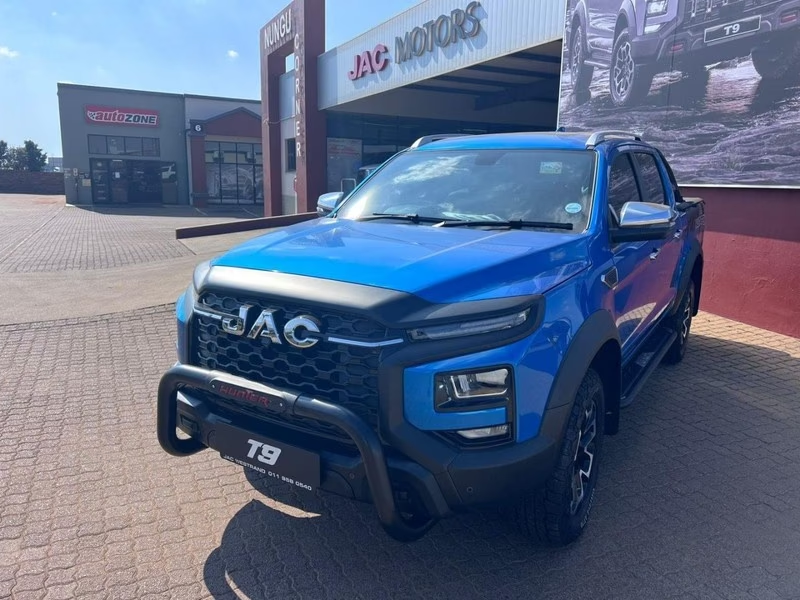
At around 5.33 metres long, the T9 occupies much the same amount of road as a Hilux or Ranger.
There is nothing compact about it.
The split LED lighting, two-tone 18-inch wheels and wide front grille give the T9 considerably more presence than the price may initially suggest.
Parked beside a mid-spec Hilux, the JAC can actually appear like the more expensive vehicle.
That is clearly deliberate.
The design manages to look substantial without becoming unnecessarily aggressive.
Where it sits in the segment
The South African double-cab market is one of the most competitive places to launch a new product.
Buyers already have strong opinions about Toyota, Ford and Isuzu, while newer brands are increasingly competing through specification and price.
The T9 arrives with the visual confidence expected from a much more established product.
Its shape is upright and purposeful, and JAC has avoided adding unnecessary styling tricks simply to make the bakkie stand out.
Cabin & Practicality
The cabin is where the T9 starts making its strongest argument.
Super Lux specification includes leather upholstery, an electric sunroof, heated seats, a 360-degree camera and a large infotainment system with smartphone integration.
Matching that level of equipment in some of the established rivals can require moving considerably further up their respective ranges.
Materials and ergonomics
The overall cabin presentation is better than the price suggests.
The dashboard and main touchpoints feel reasonably solid, while the general design makes the T9 feel more like a lifestyle double cab than an entry-level workhorse.
One issue remains the steering adjustment.
The column adjusts for height but not reach, and for taller drivers that can make finding the ideal driving position unnecessarily difficult.
After a longer Johannesburg-to-Bela-Bela drive, I noticed that compromise more than I expected.
You can adapt to it, but on a vehicle designed to cover long distances, you should not really have to.
Space and family duty
Rear legroom is competitive for the segment, while ISOFIX mounting points make the T9 practical enough for family use during the week.
The load bin is equally useful.
During my test, it swallowed two large storage crates, a folded gazebo and four soft bags with roughly 180 mm of usable load length still remaining.
Useful standard equipment includes:
- 360-degree camera with useful reversing assistance
- Electric sunroof and heated front seats
- Leather upholstery and a large central touchscreen
- Two-tone 18-inch alloy wheels and full LED lighting
- Multiple airbags across the range
On the Road
Power comes from a 2.0-litre CTI turbodiesel producing approximately 125 kW, paired with an eight-speed ZF automatic transmission and a part-time four-wheel-drive system.
Performance is adequate rather than exciting.
My estimated 0-100 km/h run took around 12.4 seconds, which feels entirely believable from behind the wheel.
The gearbox is one of the stronger parts of the drivetrain.
At highway speeds, it shifts smoothly and keeps the diesel engine relaxed, particularly during long N1 runs.
Refinement over SA surfaces
The T9 handles broken South African roads surprisingly well.
Across rougher sections near Modimolle and around the toll plazas, the suspension remained composed where older ladder-frame bakkies can become noticeably unsettled.
Wind noise is also well controlled at highway speeds.
The bigger weakness appears in low-speed driving.
The auto-hold system can make pull-aways feel jerky, particularly in stop-start traffic, and the relationship between throttle input and drivetrain response is not always as smooth as it should be.
Over approximately 612 km of mixed highway, urban and gravel driving, the trip computer settled at an indicated 8.6 L/100 km.
Off the tar
This is not a soft-roader dressed like a bakkie.
The T9 uses a proper part-time four-wheel-drive system with low range and a rear differential lock, which gives it the hardware needed for gravel roads, muddy tracks and steeper off-road sections.
On ordinary dirt-road touring, the system feels straightforward and easy to use.
Ground clearance and underbody angles are not quite as generous as some of the segment benchmarks, so buyers intending to spend weekends tackling more serious rock obstacles should inspect those numbers carefully.
For the type of off-road driving most owners will realistically do, however, the T9 is more than capable.
The power question
The T9 is not one of the most powerful vehicles in this segment, and it never feels like it is trying to be.
Its performance is more about steady progress, useful low-down torque and acceptable fuel consumption than outright acceleration.
For normal highway work, family duty and occasional towing, there is enough performance.
Buyers looking for the strongest engine in the segment will need to look elsewhere.
Data & Comparison
The numbers are where the T9's value argument becomes clearer.
It may not lead the class for performance, but the combination of purchase price, equipment and service intervals helps bring the ownership equation back in JAC's favour.
- Power: Approximately 125 kW from the 2.0-litre turbodiesel.
- Claimed economy: Around 7.8-7.9 L/100 km, competitive for a full-size diesel double cab.
- Service intervals: Up to 20 000 km or 12 months, with the first service at 10 000 km.
- Estimated five-year total cost of ownership: Approximately R230 000 based on the supplied modelling.
How it stacks up against rivals
| Model | Power | Drive | Avg price (ZAR) |
|---|---|---|---|
| JAC T9 2.0 CTI 4WD Auto | ~125 kW | 4x4 | See range below |
| Ford Ranger 2.0 EcoBlue 4x4 Auto | ~125 kW | 4x4 | R586 133 |
| VW Amarok 2.0 TDI 4MOTION Auto | ~154 kW | 4x4 | R601 662 |
| Ford Ranger Raptor 2.0 4x4 Auto | ~157 kW | 4x4 | R594 315 |
The most useful comparison is probably with the single-turbo Ranger.
Both produce similar peak power, but the T9 arrives with considerably more standard equipment in higher specifications.
That is where the value argument becomes more compelling.
A top-spec T9 sits around the R660 000 mark in the supplied pricing, but matching features such as leather, heated seats, a sunroof and 360-degree cameras in some traditional rivals can widen the gap quickly.
The residual caveat
Resale remains one of the harder parts of the T9 ownership equation.
Hilux and Ranger have decades of South African used-market history behind them, while JAC is still building that track record.
Chinese bakkies have improved significantly in both acceptance and resale, but the market is still developing.
That does not automatically make the T9 a bad financial decision.
A lower purchase price can offset weaker residuals, particularly if the vehicle is kept well beyond the initial finance term.
For someone replacing a bakkie every three years, resale matters far more.
For somebody planning to keep it for seven or eight years, the initial saving starts carrying more weight.
Editorial Focus
Is the T9 really worth choosing over a pricier Hilux or Ranger?
This is where the T9 deserves to be taken seriously.
Buyers looking at the 4x4 Super Lux are not comparing it with stripped-down commercial derivatives.
They are looking at comfort, technology, equipment and how much bakkie they receive for the money.
JAC includes features such as a 360-degree camera, sunroof, leather upholstery and heated seats, while matching that list in some established rivals requires moving into more expensive derivatives.
The drivetrain also gives the T9 proper credibility.
A ZF eight-speed automatic, low-range transfer case and rear differential lock mean the value proposition is based on more than screens and leather.
There are still reasons to be cautious.
Long-term high-mileage durability is not as well documented locally, resale remains uncertain and the low-speed drivetrain calibration needs more work.
Regular heavy towing is another area where the established brands still have the advantage of a much deeper local track record.
My view is relatively simple.
If you tow occasionally, use your bakkie for family trips and intend keeping it for several years, the T9 deserves serious consideration.
If your livelihood depends on towing heavy loads every week or you replace vehicles every three years, the more established alternatives still offer greater certainty.
Safety rating
ANCAP · tested 2024
★★★★★ 5/5 adult occupant
The Australian-market right-hand-drive rating should be treated as indicative for South Africa only where the local derivative matches the tested safety specification, including airbags, ESC and autonomous emergency braking.
Verdict
The JAC T9 proved to be a far more convincing package than its badge may initially suggest.
It is spacious, comfortable, well equipped and backed by genuine four-wheel-drive hardware rather than simply looking the part.
The 2.0-litre turbodiesel has enough performance for everyday use, while the ZF automatic works particularly well on longer highway journeys.
There are still weaknesses.
Low-speed calibration needs refinement, long-term resale remains uncertain and JAC does not yet have the same high-mileage history as the established bakkie manufacturers.
For buyers willing to keep the vehicle beyond the first few years of ownership, however, the numbers begin making considerably more sense.
- Buy it - the value-focused family tourer: If you want proper four-wheel-drive ability, plenty of equipment and a lower entry price without sacrificing everyday comfort.
- Shortlist it - the pragmatic cross-shopper: Compare it directly with similarly priced Hilux and Ranger derivatives rather than their entry-level models, then drive all three over broken tar and gravel.
- Wait - the resale-sensitive buyer: If you replace vehicles every three years, more local residual data would make the financial decision easier.
- Walk away - the heavy-duty weekly tower: If regular heavy towing and proven high-mileage durability are essential to your work, an established rival still carries the stronger long-term track record.
Summary
Here’s the pitch: the JAC T9 2.0 CTI double cab in 4x4 Super Lux trim offers serious kit without Hilux or Ranger money. We assess its road manners, value, running costs and whether South Africans should trust the badge.
Ratings
Pros
- ✓Choose the T9 4x4 Super Lux if equipment, genuine 4x4 ability and long-term Rand value matter more than badge status.